









Advanced Zirconia Ceramic: Ceramic Components for Chemical Processing
In the highly demanding chemical processing industry, material failure is not merely an inconvenience—it is a critical safety hazard and a massive financial liability. Extreme temperatures, high pressures. And highly corrosive media rapidly degrade standard metals and polymers. To combat these aggressive environments, engineers are increasingly turning to advanced technical ceramics. Specifically, the demand for high-performance zirconio-ceramic/”>zirconia ceramic ceramic components for chemical applications has surged due to the material’s unparalleled fracture toughness, chemical inertness. And wear resistance.
At Great Ceramic, we specialize in the precision lavorazione della ceramica of advanced materials. In this comprehensive technical guide, we will explore the material science behind Zirconium Oxide (ZrO2), detail its mechanical and chemical properties. And explain why it is the ultimate material choice for manufacturing rugged components used in chemical synthesis, fluid handling. And analytical instrumentation.
The Material Science: Why Zirconia for Chemical Applications?
Unlike traditional technical ceramics. This are incredibly hard but inherently brittle, Zirconia exhibits a unique microstructural phenomenon known as Transformation Toughening. Most industrial zirconia is alloyed with a stabilizer, typically Yttrium Oxide (Y2O3), creating Yttria-Stabilized Tetragonal Zirconia Polycrystal (Y-TZP).
When a micro-crack begins to form under extreme mechanical or thermal stress, the material at the crack tip undergoes a phase transformation from a tetragonal crystal structure to a monoclinic structure. This phase change involves a volume expansion of roughly 3% to 5%. This effectively compresses the crack, halting its propagation. This gives zirconia the highest fracture toughness of any monolithic technical ceramic, earning it the nickname “ceramic steel.” Coupled with its exceptional resistance to acids, bases. And organic solvents, Y-TZP is exceptionally qualified for chemical engineering applications.
Technical Properties of Yttria-Stabilized Zirconia (Y-TZP)
When designing components for corrosive environments, engineers must rely on precise material data. Below is a comprehensive table outlining the standard mechanical, thermal. And electrical properties of our high-grade Zirconia.
| Proprietà | Unità | Y-TZP Zirconia Value |
|---|---|---|
| Densità | g/cm³ | > 6.0 |
| Durezza (Vickers) | HV | 1200 – 1300 |
| Durezza alla frattura (K1c) | MPa·m^1/2 | 8.0 – 10.0 |
| Resistenza alla flessione | MPa | 900 – 1200 |
| Resistenza alla compressione | MPa | > 2000 |
| Temperatura massima di utilizzo | °C | 1000 (continuous) |
| Conducibilità termica | W/m-K | 2.0 – 3.0 |
| Coefficiente di espansione termica | 10^-6 / °C | 10.3 |
Critical Zirconia Ceramic Components for Chemical Processing
Due to its high density, zero porosity. And chemical stability, zirconia is machined into a wide variety of vital chemical handling components. Great Ceramic regularly manufactures the following parts:
1. Pump and Valve Components
Chemical dosing pumps and control valves handle harsh media like sulfuric acid, hydrochloric acid. And aggressive alkalis. Zirconia valve seats, balls. And seal rings prevent chemical leaching and offer superior wear resistance against abrasive slurries, vastly outperforming stainless steel and PTFE.
2. Plungers and Pistons
High-pressure liquid chromatography (HPLC) and chemical metering pumps rely on precise fluid displacement. Zirconia plungers can be polished to a mirror finish (Ra < 0.1 µm), reducing friction against seals and eliminating particulate contamination in high-purity chemical processes.
3. Mechanical Seals and Bearings
In chemical mixers and agitators, mechanical seals face both dry-running conditions and highly corrosive environments. Zirconia’s low coefficient of friction and high thermal shock resistance ensure long-lasting, leak-free operation.
4. Nozzles and Flow Meters
For chemical spray applications and flow measurement, dimensional stability is paramount. Zirconia nozzles resist the erosive effects of high-velocity chemical sprays, maintaining their exact orifice dimensions over millions of cycles.
Precision Machining Considerations for Zirconia
Because zirconia is exceedingly hard post-sintering, manufacturing precise zirconia ceramic ceramic components for chemical industry clients requires advanced machining capabilities and deep metallurgical understanding. At Great Ceramic, we employ a multi-stage manufacturing process:
- Lavorazione verde: To reduce costs, the bulk of the shaping (turning, milling, drilling) is done on the “green” (unsintered) or “bisque” ceramic blank using standard carbide or diamond tooling. We carefully calculate the ~20% shrinkage rate that occurs during sintering to ensure near-net shape.
- High-Temperature Sintering: The machined green parts are sintered in advanced computer-controlled kilns at temperatures exceeding 1400°C to achieve full densification and the critical phase transformation properties.
- Hard Grinding & Machining: Post-sintering, zirconia achieves its extreme hardness (9 on the Mohs scale). Final tight tolerances (up to ±0.001mm) are achieved exclusively through precision diamond grinding, honing. And lapping using multi-axis CNC machines.
- Surface Polishing: For chemical seals and plungers, we utilize diamond paste lapping techniques to achieve ultra-low surface roughness, preventing bacterial growth and chemical residue buildup.
Zirconia vs. Alumina in Chemical Environments
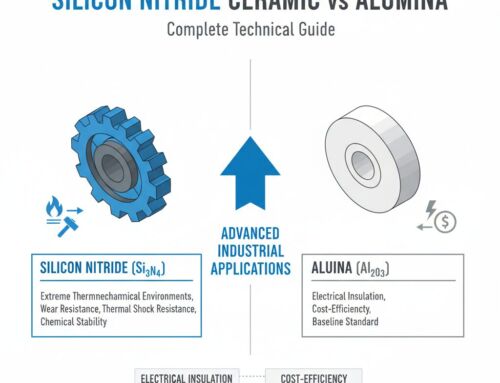
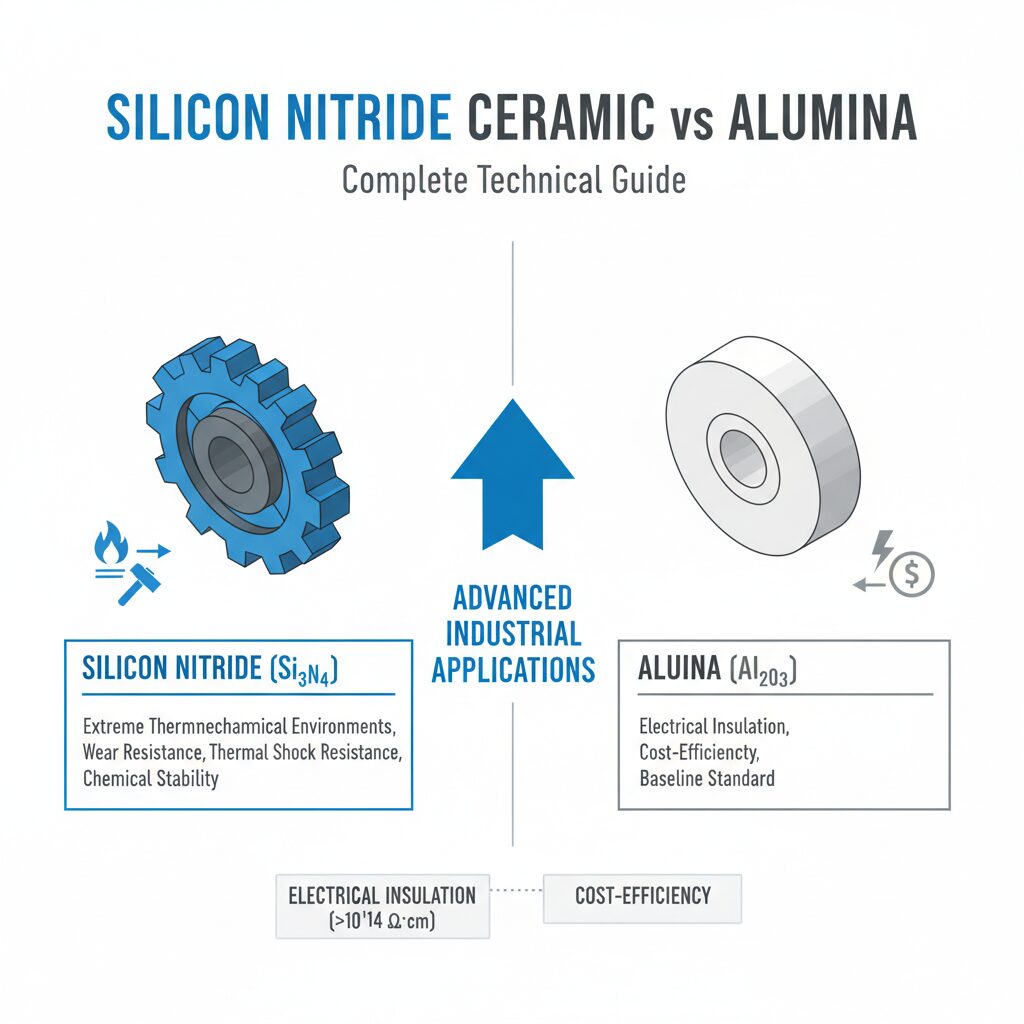
While Alumina (Al2O3) is a more cost-effective ceramic for general chemical resistance, Zirconia is specified when the component is subjected to significant mechanical stress, high impact, or requires an extremely smooth surface finish. Zirconia has nearly double the flexural strength and more than double the fracture toughness of 99% Alumina. However, engineers should note that Zirconia is generally heavier (higher density) and more expensive to machine.
Domande frequenti (FAQ)
Is Zirconia ceramic completely chemically inert?
Zirconia is highly inert and resists attacks from most strong acids, alkalis. And organic solvents at room and elevated temperatures. However, like most silicate and oxide ceramics, it can be vulnerable to Hydrofluoric acid (HF) and hot concentrated sulfuric acid over prolonged exposure.
Can Zirconia handle severe thermal shock?
While zirconia has a relatively low thermal conductivity compared to allumina, its high strength and fracture toughness allow it to withstand moderate thermal shock better than many other ceramics. However, for extremely rapid thermal cycling, Silicon Nitride (Si3N4) might be recommended instead.
What are the tightest tolerances Great Ceramic can achieve with Zirconia?
Through advanced CNC diamond grinding and lapping, Great Ceramic can achieve dimensional tolerances up to ±0.001 mm and surface finishes down to Ra 0.05 µm for chemical components like plungers and mechanical seals.
Partner with Great Ceramic for Your Chemical Component Needs
When system failure is not an option, you need a material that can withstand the harshest chemical environments on earth. At Great Ceramic, our expertise in lavorazione di precisione della ceramica ensures that your custom zirconia ceramic ceramic components for chemical applications are manufactured to exact specifications, delivered on time. And built to outlast conventional materials.
Contact our engineering team today to discuss your blueprints, material selection. And custom machining requirements for your next chemical processing project.
zirconia ceramic ceramic components for chemical is widely used in advanced ceramic applications.
zirconia ceramic ceramic components for chemical is widely used in advanced ceramic applications.
Per saperne di più Componenti ceramiche di zirconia per il settore chimico e i nostri servizi di lavorazione della ceramica di precisione.