









Silicon Carbide Ceramic vs Silicon Carbide: Complete Technical Guide
When engineers evaluate high-performance materials for extreme industrial environments, understanding the distinction of carburo di silicio ceramic vs silicon carbide is paramount. In engineering terminology, “silicon carbide” (SiC) broadly refers to the raw chemical compound, synthesized abrasive powders, or single-crystal semiconductor wafers utilized in advanced electronics. Conversely, “silicon carbide ceramic” refers to the highly engineered, polycrystalline structural components that have been formed and sintered at extreme temperatures (often exceeding 2,100°C) to create rigid, wear-resistant mechanical parts. This distinction dictates the material’s behavior under thermal shock, high-velocity abrasion. And corrosive chemical exposure. The primary industry challenge lies in machining these sintered structural ceramics due to their extreme hardness (exceeding 2,800 HV). Traditional metalworking methods fail immediately, necessitating advanced diamond grinding kinematics to achieve tight tolerances. Great Ceramic specializes in overcoming these exact challenges, providing world-class lavorazione di precisione della ceramica with dimensional accuracies down to ±0.005mm. Whether you require reaction-bonded structures or solid-state sintered components, our engineering team is equipped to translate your complex CAD designs into flawlessly executed ceramic realities. Contact Great Ceramic today to discuss your next high-tolerance SiC project.
Proprietà dei materiali
| Proprietà | Valore | Unità |
|---|---|---|
| Densità | 3.10 - 3.20 | g/cm³ |
| Durezza | 2800 | HV |
| Resistenza alla flessione | 400 - 450 | MPa |
| Resistenza alla frattura | 3.5 – 4.5 | MPa-m½ |
| Conducibilità termica | 120 – 200 | W/m-K |
| Resistività elettrica | 10² – 10⁶ | Ω-cm |
| Temperatura massima di lavoro | 1600 | °C |
The core thermomechanical properties of carburo di silicio ceramic stem from its unique atomic structure. Silicon and carbon atoms are bonded covalently in a tetrahedral lattice, exhibiting approximately 88% covalent and 12% ionic bonding characteristics. This strong atomic cohesion is responsible for the material’s exceptionally high theoretical density of 3.21 g/cm³ and a Vickers hardness rating that can reach up to 2800 HV, making it one of the hardest commercially available structural materials, second only to diamond and boron carbide. Unlike metallic alloys. This undergo rapid yield and creep deformation at temperatures above 800°C, high-purity sintered SiC ceramic retains its 450 MPa flexural strength uniformly up to 1,600°C in an oxidizing atmosphere. Furthermore, the material features an extremely low coefficient of thermal expansion (CTE) ranging from 4.0 to 4.5 x 10⁻⁶ /K (measured between 20°C and 1,000°C). When combined with a high thermal conductivity of up to 200 W/m·K, this low CTE gives silicon carbide ceramic an exceptionally high thermal shock resistance parameter (R-value), allowing it to survive rapid temperature differentials of ΔT = 400°C without initiating catastrophic micro-cracking.
Confronto con altre ceramiche
| Proprietà | Carburo di silicio | Allumina | Zirconia | Nitruro di silicio |
|---|---|---|---|---|
| Conducibilità termica | 120 – 200 | 20 – 35 | 2.0 - 3.0 | 30 – 90 |
| Durezza | 2800 | 1500 - 1650 | 1200 - 1300 | 1500 – 1600 |
| Resistenza alla frattura | 4.0 | 4.0 - 5.0 | 8.0 - 10.0 | 6.0 - 8.0 |
| Costo | Alto | Basso | Medio | Molto alto |
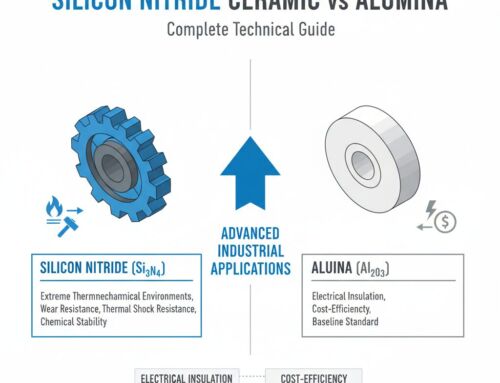
Selecting the optimal advanced ceramic requires a rigorous evaluation of operational stresses, thermal loads. And tribological requirements. When engineers evaluate the performance matrix of structural materials, the comparison of these four primary ceramics reveals highly specific usage scenarios.
Compared to Alumina: allumina/”>Allumina (Al₂O₃) is the most widely utilized technical ceramic due to its excellent cost-to-performance ratio, typically costing 40% to 60% less to manufacture and machine than SiC. However, alumina is fundamentally limited in extreme environments. Alumina’s thermal conductivity maxes out at approximately 35 W/m·K. And its coefficient of thermal expansion is roughly 8.1 x 10⁻⁶ /K. This is nearly double that of SiC. Consequently, alumina is highly susceptible to thermal shock and will fracture under rapid cooling scenarios that SiC easily withstands. Furthermore, SiC’s hardness (2800 HV) vastly outperforms alumina (1650 HV), resulting in a wear life that is typically 3 to 5 times longer in aggressive abrasive slurry applications.
Compared to Zirconia: Zirconia (ZrO₂), particularly Yttria-Stabilized Zirconia (YSZ), is renowned as the “ceramic steel” due to its phase-transformation toughening mechanism, yielding an exceptional fracture toughness of 8.0 to 10.0 MPa·m½. This makes zirconia highly resistant to impact forces where SiC would shatter. However, zirconia is an extreme thermal insulator with a thermal conductivity of just 2.5 W/m·K, making it entirely unsuitable for heat exchangers or semiconductor rapid thermal processing (RTP) components. Additionally, zirconia suffers from low-temperature degradation (LTD) in high-humidity environments around 250°C. And its hardness rapidly drops at elevated temperatures, whereas SiC maintains its mechanical integrity far beyond 1,500°C.
Compared to Silicon Nitride: Nitruro di silicio (Si₃N₄) represents the closest competitor to SiC in high-temperature, high-stress applications. Silicon nitride boasts a superior fracture toughness (6.0 – 8.0 MPa·m½) and an inherently lower coefficient of thermal expansion (3.2 x 10⁻⁶ /K), giving it the highest thermal shock resistance of all advanced ceramics. However, silicon carbide remains significantly harder (2800 HV vs 1600 HV) and features much higher thermal conductivity (up to 200 W/m·K vs 90 W/m·K). While silicon nitride is often preferred for high-speed ceramic ball bearings and metal forming tools, silicon carbide is the definitive choice for chemical mechanical planarization (CMP) rings, mechanical seals. And extreme high-temperature kiln furniture where thermal heat transfer and absolute abrasive resistance are non-negotiable.
Applicazioni
- Semiconductor Manufacturing Components: Utilized in Chemical Vapor Deposition (CVD) susceptors, wafer handling effectors. And CMP retaining rings. In an environment where dimensional stability is critical down to the nanometer, SiC is chosen because its CTE closely matches that of the silicon wafer (approximately 2.6 x 10⁻⁶ /K at room temperature). This prevents thermal mismatch during epitaxial growth processes operating at 1,100°C, while its extreme purity prevents metallic ion contamination.
- High-Pressure Mechanical Pump Seals: Deployed as rotating and stationary seal faces in chemical processing and petrochemical extraction pumps. SiC is selected for this exact scenario because it can withstand absolute chemical attack from aggressive acids (like HF or H₂SO₄) while maintaining a surface flatness of less than 2 helium light bands (0.6 microns). Its 2800 HV hardness prevents grooving from abrasive particulate slurries that would destroy stainless steel or tungsten carbide seals in weeks.
- Advanced Heat Exchangers: Implemented in waste-to-energy plants and corrosive chemical incinerators operating at temperatures up to 1,400°C. Metallic heat exchangers suffer from rapid oxidation and creep failure above 900°C. SiC is chosen because it combines a high thermal conductivity of 150 W/m·K (approaching that of metallic alloys) with absolute immunity to high-temperature oxidative corrosion, ensuring optimal heat transfer efficiency and a service life measured in decades rather than months.
- Ballistic Armor Protection: Used as the strike face in composite military armor plates for personnel and lightweight combat vehicles. When impacted by a high-velocity armor-piercing projectile traveling at 900 m/s, the extreme 2800 HV hardness of the SiC ceramic strike face shatters the projectile core, while the ceramic’s low density (3.15 g/cm³) significantly reduces the overall weight burden on the soldier or vehicle compared to standard Rolled Homogeneous Armor (RHA) steel.
- FGD Nozzles for Power Plants: Utilized in Flue Gas Desulfurization (FGD) systems within coal-fired power plants. These components spray abrasive limestone slurries at high pressures (up to 50 psi) to scrub sulfur dioxide from exhaust gases. Reaction Bonded Silicon Carbide (RBSiC) is chosen specifically because it offers unparalleled erosive wear resistance and can be cast into complex vortex-generating internal geometries that maintain their precise spray angle and flow rate (e.g., 500 gallons per minute) for over 50,000 continuous operational hours.
Processo di produzione
Transforming raw silicon carbide powder into a dense, high-tolerance structural component involves a complex sequence of thermodynamic and mechanical processes. The fundamental compound is initially synthesized via the Acheson process, reacting high-purity silica sand with petroleum coke in an electrical resistance furnace at temperatures reaching 2,500°C. The resulting crystalline mass is crushed, chemically washed. And milled into sub-micron powders (typically 0.5 to 2.0 microns in diameter). These powders are then uniformly mixed with transient organic binders and specific sintering aids, such as boron and carbon (for Solid-State Sintered SiC) or yttria and alumina (for Liquid-Phase Sintered SiC). The precise control of particle size distribution and binder rheology is critical to ensuring uniform shrinkage during the thermal densification phase, minimizing internal porosity and mitigating the formation of microscopic stress concentrators that could lead to premature mechanical failure in the field.
Metodi di formatura
- Pressatura isostatica a freddo (CIP): The formulated SiC powder is enclosed in a flexible elastomeric mold and subjected to uniform hydraulic fluid pressure ranging from 200 to 300 MPa (29,000 to 43,500 psi). This method achieves a highly uniform green density (typically 60% of theoretical density) across complex, thick-walled geometries, minimizing anisotropic shrinkage during sintering.
- Stampaggio a iniezione di ceramica (CIM): For high-volume, highly intricate components (such as small turbine blades or specialized nozzles), SiC powder is compounded with thermoplastic binders. The feedstock is injected into a cooled metal die cavity at pressures between 50 and 150 MPa. After molding, the parts undergo a rigorous catalytic or thermal debinding process to remove the 15-20% by volume polymer binder before high-temperature firing.
Sinterizzazione
The densification of SiC is notoriously difficult due to the highly directional and strong nature of its covalent bonds. This severely limits atomic diffusion rates. Pressureless sintering (generating Sintered Silicon Carbide or SSiC) occurs in vacuum or inert argon atmospheres at extreme temperatures between 2,100°C and 2,200°C. The addition of sub-micron boron (0.5 wt%) and carbon (1.0 wt%) reduces the silica layer on the particle surfaces and lowers grain boundary energies, facilitating densification up to 98-99% of the theoretical limit. During this phase, the green body undergoes significant volumetric shrinkage of 15% to 20%. Alternatively, Reaction Bonded Silicon Carbide (RBSiC) is produced by infiltrating a porous compact of SiC and carbon with molten elemental silicon at approximately 1,500°C. The molten silicon reacts with the carbon to form secondary in-situ SiC, filling the pores. A major advantage of the RBSiC process is that it exhibits near-zero shrinkage (< 1%), allowing for the production of extremely large or geometrically complex components without severe dimensional distortion.
Lavorazione finale
Due to the massive volumetric shrinkage of SSiC during densification, the fired “as-sintered” components rarely meet the stringent dimensional tolerances required for precision engineering applications (often exceeding ±0.5mm variance). To achieve the final required geometries, the fired ceramic must undergo hard machining. Because the material hardness exceeds 2800 HV, traditional high-speed steel (HSS) or carbide cutting tools are completely useless. they will dull in seconds. Final machining relies entirely on abrasive material removal utilizing diamond-impregnated grinding wheels, ultrasonic-assisted CNC milling. And precision lapping. This stage is extremely capital-intensive and time-consuming, requiring rigid machine tools, active thermal stabilization of the cutting zone. And flood coolant at pressures up to 1,000 psi to flush away microscopic ceramic swarf and prevent severe thermal damage to the workpiece surface.
Vantaggi e limiti
Vantaggi
- Extreme Tribological Performance: With a Vickers hardness of 2800 HV, SiC ceramic exhibits virtually zero wear in unlubricated, high-friction mechanical systems, vastly outperforming tungsten carbide (1500 HV) and hardened bearing steels (700 HV) in abrasive slurry applications.
- Gestione termica eccezionale: The material features a thermal conductivity ranging from 120 to 200 W/m·K. This allows for rapid and efficient heat dissipation in high-power semiconductor packaging and dense mechanical seals, preventing localized thermal runaway and subsequent material galling.
- Chemical Inertness: SiC ceramic is entirely immune to corrosive degradation from virtually all strong acids and alkalis, including boiling hydrofluoric acid (HF), nitric acid (HNO₃). And sodium hydroxide (NaOH) solutions up to 200°C, ensuring zero contamination in highly sensitive chemical processing.
- High-Temperature Strength Retention: Unlike superalloys (such as Inconel) which experience severe creep deformation and strength loss above 900°C, SiC maintains its 450 MPa flexural strength and dimensional rigidity continuously up to 1,600°C, enabling highly efficient, high-temperature combustion processes.
Limitazioni
- Intrinseca fragilità: The covalent bonding that provides SiC with extreme hardness also limits its fracture toughness to a relatively low 3.5 to 4.5 MPa·m½. The material is highly susceptible to impact shock, point-loading stresses. And catastrophic failure if exposed to high-velocity mechanical strikes.
- Extreme Machining Costs: Machining sintered SiC requires expensive, specialized diamond tooling and prolonged cycle times. The material removal rate (MRR) for SiC is typically 1/50th that of aluminum alloys, leading to manufacturing costs that can be prohibitive for non-critical applications.
Considerazioni sulla lavorazione
The primary hurdle in deploying this material is overcoming the extreme machining challenges inherent to its 2800 HV hardness and low fracture toughness. When evaluating silicon carbide ceramic vs silicon carbide machining dynamics, the material must be removed via brittle fracture or ductile-regime grinding. In brittle fracture, diamond abrasives initiate micro-cracks that propagate and intersect, expelling microscopic chips of material. However, aggressive feed rates will drive these micro-cracks deep into the substrate, causing Sub-Surface Damage (SSD) that drastically reduces the component’s flexural strength from 450 MPa down to less than 200 MPa. To avoid this, finish grinding must transition into the ductile regime. By maintaining the depth of cut (ap) below the critical threshold—often less than 1.5 micrometers—the material is removed via plastic deformation rather than fracturing, resulting in a flawless, mirror-like surface finish (Ra < 0.1 µm) completely free of micro-cracks.
Executing ductile-regime grinding on SiC demands state-of-the-art kinematics. Spindle speeds must often exceed 20,000 RPM while maintaining ultra-slow feed rates of 0.1 to 1.0 mm/min. The machine tool itself must possess immense static and dynamic stiffness to eliminate vibration, as chatter will instantly shatter the diamond wheel or the ceramic workpiece. Furthermore, tooling selection is critical. resinoid-bonded diamond wheels with extremely fine grit sizes (e.g., D15 or D46) are utilized for finishing passes, while electroplated or metal-bonded diamond tools are used for roughing. Active thermal compensation and high-pressure synthetic coolants are required to manage the intense frictional heat generated at the tool-workpiece interface. Great Ceramic’s engineering team has mastered these complex tribological mechanics. Utilizing multi-axis, rigid CNC grinding centers equipped with in-process laser metrology, we consistently achieve dimensional tolerances of ±0.005mm, true concentricity below 0.01mm. And pristine surface finishes that maximize the material’s inherent strength. Ready to overcome your ceramic manufacturing bottlenecks? Submit your CAD files to Great Ceramic for a comprehensive manufacturability analysis.
FAQ
What is silicon carbide ceramic vs silicon carbide?
The term “silicon carbide” (SiC) generally refers to the raw chemical compound consisting of silicon and carbon, often found as a synthetic abrasive powder (carborundum) or grown as single-crystal wafers for high-voltage semiconductor electronics. In contrast, “silicon carbide ceramic” refers to a dense, solid, structural component created by pressing and sintering polycrystalline SiC powders at extreme temperatures (over 2,100°C). While raw SiC is the fundamental building block, the structural ceramic represents the fully engineered, hardened mechanical part used for wear rings, ballistic armor. And high-temperature kiln furniture.
What are the main applications of silicon carbide ceramic?
Due to its extreme hardness (2800 HV), exceptional chemical inertness. And high thermal conductivity (up to 200 W/m·K), silicon carbide ceramic is utilized in the most demanding industrial environments. Primary applications include rotating and stationary mechanical seal faces for highly corrosive chemical pumps, Chemical Vapor Deposition (CVD) susceptors and gas distribution plates in semiconductor manufacturing, high-temperature heat exchangers for waste incineration, Flue Gas Desulfurization (FGD) nozzles in power plants. And composite ballistic armor strike faces for military personnel and vehicles.
How does silicon carbide ceramic compare to other ceramics?
Silicon carbide ceramic is significantly harder (2800 HV) and features much higher thermal conductivity (200 W/m·K) than standard alumina (1600 HV, 35 W/m·K) or zirconia (1200 HV, 2.5 W/m·K). This makes it superior for applications requiring maximum wear resistance and thermal heat transfer. However, SiC has a lower fracture toughness (4.0 MPa·m½) compared to zirconia (up to 10.0 MPa·m½) or silicon nitride (up to 8.0 MPa·m½), making it more brittle and susceptible to impact damage. While it is more expensive to produce than alumina, its operational lifespan in extreme environments often justifies the initial cost.
What are the advantages of silicon carbide ceramic?
The primary advantages of silicon carbide ceramic include its extreme dimensional stability under thermal loads, driven by a low coefficient of thermal expansion (4.0 x 10⁻⁶ /K) and high thermal conductivity. It maintains its structural integrity and flexural strength (450 MPa) at temperatures up to 1,600°C, where metallic alloys would melt or undergo severe creep deformation. Furthermore, it offers absolute chemical resistance to highly aggressive acids and alkalis (including HF and NaOH) and provides unparalleled abrasive wear resistance due to its position as one of the hardest engineered materials available.
How is silicon carbide ceramic machined?
Machining fully sintered silicon carbide ceramic is a highly complex process requiring specialized equipment due to its 2800 HV hardness. Traditional HSS and carbide tools cannot cut it. instead, material is removed using precision diamond-impregnated grinding wheels, ultrasonic-assisted CNC machining, or electrical discharge machining (EDM) if the specific SiC variant is electrically conductive. Achieving precision tolerances requires rigid machine tools, vibration-free kinematics, high spindle speeds. And micro-inch depth of cuts to avoid sub-surface micro-cracking. Great Ceramic leverages state-of-the-art 5-axis CNC grinding centers and advanced diamond tooling to provide unparalleled machining capabilities, strictly maintaining tight tolerances of ±0.005mm for complex structural geometries.
Need custom silicon carbide ceramic vs silicon carbide parts? Contatto Great Ceramic per servizi di lavorazione di precisione con tolleranze ristrette, oppure inviate un'e-mail a [email protected].
silicon carbide ceramic vs silicon carbide is widely used in advanced ceramic applications.
Per saperne di più Silicon Carbide Ceramic Vs Silicon Carbide e i nostri servizi di lavorazione della ceramica di precisione.