









Machinable Glass Ceramic for Vacuum Industry: Complete Technical Guide
For high-tech engineering applications, specifically in ultra-high vacuum (UHV) environments operating at pressures below 10-9 Torr, material selection dictates system viability. The challenge lies in sourcing an insulating material that offers zero porosity, exceptionally low outgassing rates. And high dielectric strength, while simultaneously avoiding the extended lead times associated with diamond-grinding conventional advanced ceramics. Machinable glass ceramic for vacuum industry applications directly addresses this structural and operational bottleneck. Composed of a fluorophlogopite mica matrix dispersed within a borosilicate glass base, this material achieves a helium leak rate of less than 10-11 cc/sec without requiring post-machining firing. It delivers dimensional stability at continuous operating temperatures up to 800°C and peak intervals of 1,000°C. For procurement managers and engineering design teams facing stringent project timelines, machinable glass ceramic provides the immediate structural integrity of technical ceramics with the machinability of metals. If you require immediate prototyping, lavorazione di precisione della ceramica of glass ceramics accelerates R&D cycles by eliminating the 4-to-6-week sintering and grinding delays standard in conventional ceramic manufacturing.
Proprietà dei materiali
The operational superiority of machinable glass ceramic in UHV systems stems directly from its unique microstructural composition. Approximately 55% of the volume consists of interlocking, 2D mica crystals (typically 20-30 microns in length). This arrest crack propagation and allow localized shearing under a cutting tool. The remaining 45% is a non-porous borosilicate glass matrix that ensures complete hermeticity. This continuous glass phase guarantees zero open porosity, resulting in an outgassing rate that is practically unmeasurable and highly compatible with systems maintaining 10-10 mbar environments. Below is the quantitative engineering data defining this material’s physical, thermal. And electrical capabilities.
| Proprietà | Valore | Unità |
|---|---|---|
| Densità | 2.52 | g/cm³ |
| Durezza | 250 | HV |
| Resistenza alla flessione | 94 | MPa |
| Resistenza alla frattura | 1.53 | MPa-m½ |
| Conducibilità termica | 1.46 | W/m-K |
| Resistività elettrica | >10¹⁶ | Ω-cm |
| Temperatura massima di lavoro | 800 (Continuous) / 1000 (Peak) | °C |
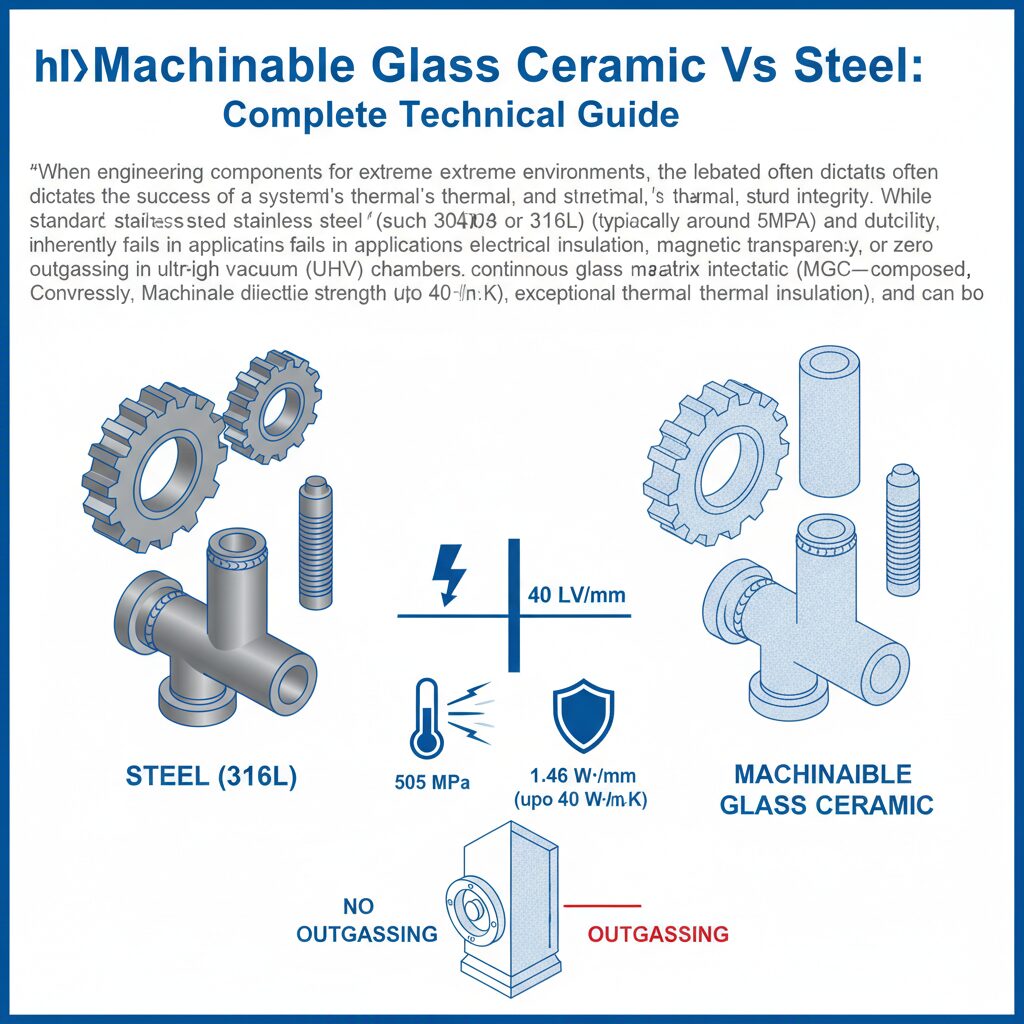
In vacuum technology, thermal expansion matching is critical to preventing hermetic seal failure during high-temperature bake-outs (typically 250°C to 400°C). Machinable glass ceramic exhibits a Coefficient of Thermal Expansion (CTE) of approximately 9.3 µm/m·°C (from 20°C to 300°C). This value closely aligns with titanium (8.6 µm/m·°C), 300-series stainless steels (16.0 µm/m·°C). And sealing alloys like Kovar, enabling the design of rigid, leak-tight metal-to-ceramic assemblies. Furthermore, the material’s exceptionally high electrical resistivity (>1016 Ω·cm at 25°C) and robust dielectric strength (40 kV/mm at 0.25mm thickness) make it the optimal insulator for high-voltage vacuum feedthroughs and charged particle accelerators.
Confronto con altre ceramiche
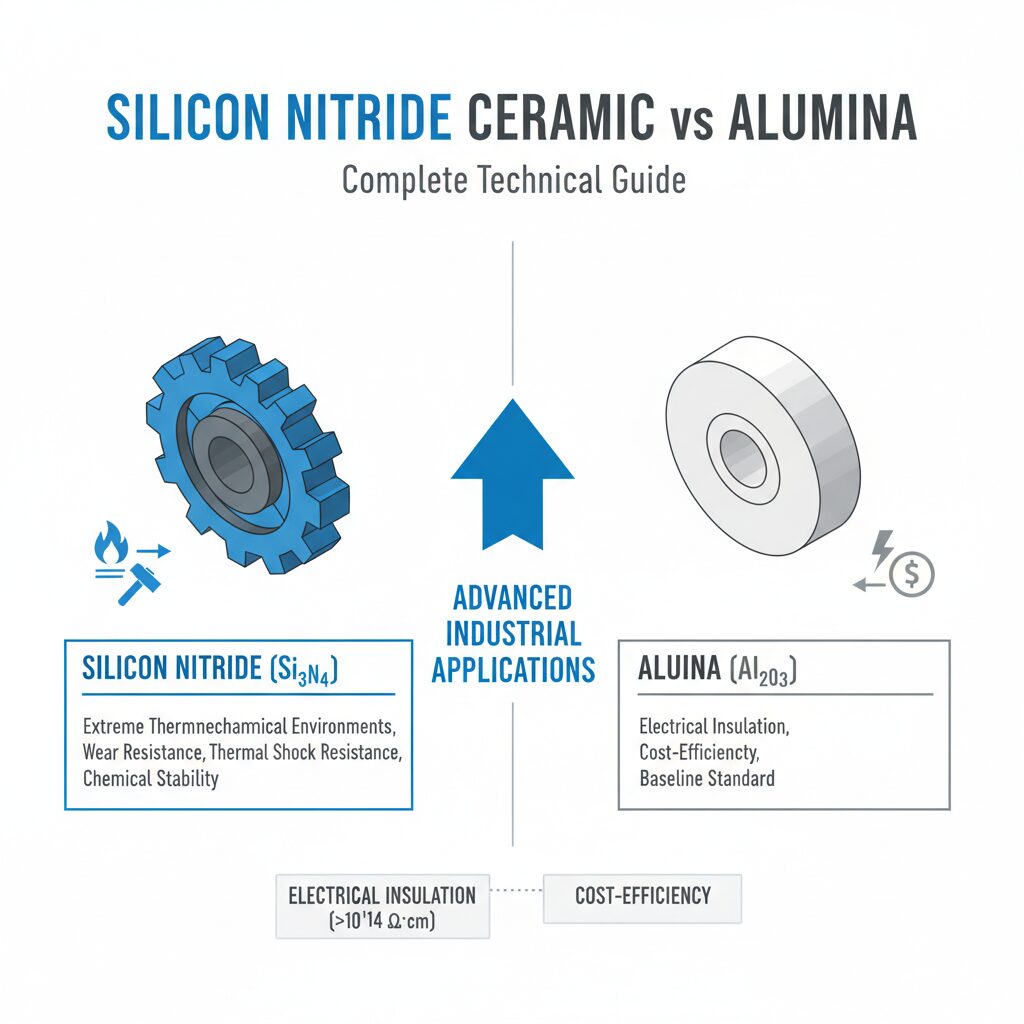
When engineering vacuum systems, designers frequently evaluate machinable glass ceramic against other advanced technical ceramics. While materials like allumina and zirconia offer superior mechanical strength, they require expensive diamond tooling and time-consuming post-sintering grinding to achieve tight tolerances. The following table contrasts machinable glass ceramic with other widely utilized materials.
| Proprietà | Vetroceramica lavorabile | Allumina (99,5%) | Zirconia (YTZP) | Nitruro di silicio |
|---|---|---|---|---|
| Conducibilità termica (W/m·K) | 1.46 | 30.0 | 2.2 | 25.0 - 30.0 |
| Durezza (HV) | 250 | 1500 | 1250 | 1500 |
| Durezza alla frattura (MPa-m½) | 1.53 | 4.0 | 8.0 - 10.0 | 6,0 – 7,0 |
| Costo | Moderato | Low (in volume) | Alto | Molto alto |
Comparing these materials requires a structural analysis based on application stress factors. When evaluating allumina, engineers typically rely on its exceptional dielectric properties and 30.0 W/m·K thermal conductivity. However, alumina has a hardness of 1500 HV, requiring diamond abrasive grinding that complicates the machining of internal threads or complex geometries, ultimately extending lead times. Machinable glass ceramic, at 250 HV, allows for direct tapping of M2 threads using standard high-speed steel (HSS) or carbide taps, drastically reducing machining costs for low-to-medium volume vacuum components.
Al contrario, zirconio provides exceptional fracture toughness (up to 10.0 MPa·m½), making it ideal for high-impact structural applications. However, zirconia is prone to thermal degradation at intermediate temperatures and carries a higher mass density (6.05 g/cm³ compared to glass ceramic’s 2.52 g/cm³). This can be detrimental in weight-sensitive aerospace vacuum assemblies.
Finally, nitruro di silicio offers extreme thermal shock resistance and maintains its structural integrity at temperatures exceeding 1,200°C. While silicon nitride is superior for high-stress, high-temperature dynamic environments, its extreme hardness (1500 HV) and very high manufacturing cost make it overkill for static, moderate-temperature (under 800°C) UHV insulating components where machinable glass ceramic performs flawlessly at a fraction of the cost and production time.
Applicazioni
- Ultra-High Vacuum (UHV) Electrical Feedthroughs: Operating in environments reaching 10-11 Torr requires absolute hermeticity. Machinable glass ceramic is chosen for its zero porosity and exceptional dielectric strength (40 kV/mm). It provides reliable electrical isolation for high-voltage pins transmitting signals into vacuum chambers without releasing trapped gases during the standard 250°C system bake-out procedures.
- Mass Spectrometer Component Insulators: In mass spectrometry, maintaining an uncontaminated flight tube is paramount. Machinable glass ceramic is non-magnetic, contains zero organics. And emits no detectable outgassing. It is widely used to manufacture precision quadrupole rod supports and ion source insulators, easily machined to strict ±0.005mm tolerances to ensure absolute alignment of the electromagnetic fields.
- Vacuum Deposition (PVD/CVD) Equipment Housings: Physical and Chemical Vapor Deposition systems require materials that withstand cyclic heating and plasma exposure. This material is selected because it withstands continuous thermal loads of 800°C and resists sputtering damage. Its low thermal conductivity (1.46 W/m·K) effectively isolates high-temperature deposition zones from sensitive external chamber instrumentation.
- Cryogenic Support Structures in Vacuum: Deep-space simulators and quantum computing vacuum enclosures operate at cryogenic temperatures down to 4 Kelvin. Machinable glass ceramic is chosen because it maintains its structural dimensions and mechanical stability without embrittlement at extreme cryogenic levels, preventing thermal contraction from misaligning sensitive optical or quantum sensors.
- Microwave Tube and Klystron Components: High-frequency vacuum electronics demand materials with specific dielectric properties. With a low loss tangent (0.007 at 8.6 GHz) and a stable dielectric constant (6.03 at 1 MHz), machinable glass ceramic prevents RF signal attenuation and power loss, making it ideal for internal supports, windows. And spacers within high-power microwave transmission tubes.
Processo di produzione
The creation of machinable glass ceramic represents a sophisticated intersection of glassmaking and controlled crystallographic engineering. Unlike conventional technical ceramics that require pressing and high-temperature sintering of dry powders—which induces 15% to 20% volumetric shrinkage—this material is processed similarly to specialized glass, resulting in fully dense, shrinkage-free billets. The zero-porosity nature of the final product is guaranteed by this molten processing methodology, making it inherently ready for vacuum applications.
Metodi di formatura
- High-Temperature Melting: The raw materials—including silica, magnesium oxide, alumina. And potassium fluorosilicate—are combined and melted in a platinum crucible at temperatures exceeding 1,400°C. This ensures complete homogenization and eliminates any internal gas pockets or inclusions that could compromise vacuum integrity.
- Colata continua: The molten borosilicate glass is poured or continuously cast into oversized molds (billets, rods, or sheets). At this stage, the material is technically a glass, possessing an amorphous structure that is entirely free of open or closed porosity.
Sinterizzazione
Unlike standard ceramic powder compaction, the “sintering” of this material is actually a carefully controlled heat treatment process known as “ceraming.” The cast glass billets are subjected to a two-stage thermal cycle. First, the material is heated to approximately 600°C to initiate the nucleation of chondrodite crystals. The temperature is then elevated to between 800°C and 900°C. During this phase, the chondrodite transitions into highly interlocked, two-dimensional fluorophlogopite mica crystals. This highly controlled crystallization consumes roughly 55% of the volume, leaving 45% as an amorphous borosilicate glass matrix. The volume remains perfectly stable during this process, resulting in zero shrinkage and eliminating the need for post-fire machining.
Lavorazione finale
Because the ceraming process leaves the material fully dense and stress-relieved, final machining can commence immediately using standard CNC milling and turning centers. The interlocking mica crystals act as microscopic crack deflectors. when a cutting tool strikes the material, it micro-fractures the mica rather than propagating a macroscopic crack through the glass matrix. This allows Great Ceramic to achieve complex geometries with standard tungsten carbide tooling. Need precision tolerances? Contact us for lavorazione della ceramica personalizzata tailored specifically for UHV environments.
Vantaggi e limiti
Vantaggi
- Zero Porosity and Zero Outgassing: The continuous glass phase ensures absolute hermeticity. Helium mass spectrometer leak tests demonstrate leak rates below 10-11 standard cubic centimeters per second (cc/sec), making it completely safe for ultra-high vacuum environments up to 10-10 mbar.
- Eccezionale lavorabilità: It can be milled, turned, tapped. And drilled using conventional metalworking tools. This eliminates the need for expensive diamond grinding, reducing prototyping and production lead times by up to 50% compared to traditional technical ceramics.
- Alta rigidità dielettrica: Capable of withstanding 40 kV/mm DC at a thickness of 0.25mm. And possessing a volume resistivity exceeding 1016 Ω·cm at room temperature, it provides superior electrical isolation for high-voltage vacuum applications.
- Excellent Thermal Stability: With a continuous operating temperature of 800°C (and brief peaks to 1,000°C) and a CTE of 9.3 µm/m·°C, the material accurately matches the thermal expansion profiles of many common metals, ensuring stress-free hermetic seals during aggressive UHV bake-outs.
Limitazioni
- Resistenza meccanica moderata: With a flexural strength of 94 MPa and a fracture toughness of 1.53 MPa·m½, it is significantly weaker than structural ceramics. It should not be used in high-stress, load-bearing applications or environments subjected to severe mechanical impact.
- Limited Maximum Temperature: The borosilicate glass matrix begins to soften above 1,000°C. For vacuum furnaces or deposition systems exceeding 1,200°C, engineers must specify high-temperature alternatives like carburo di silicio or high-purity alumina.
Considerazioni sulla lavorazione
While machinable glass ceramic for vacuum industry applications is highly workable, achieving tight tolerances without inducing surface micro-cracking requires strict adherence to specialized machining parameters. The material behaves entirely differently than metals. it machines via a localized, controlled fracture process rather than plastic deformation and chip formation. Because of this, heat generation and tool pressure must be meticulously managed to prevent edge breakout, especially on thin-walled components or internal threads.
For CNC turning, Great Ceramic utilizes highly polished, uncoated tungsten carbide inserts with positive rake angles to ensure sharp shearing action. Spindle speeds are carefully regulated between 1,000 and 1,500 RPM, coupled with low feed rates ranging from 0.01 mm/rev to 0.05 mm/rev. During milling operations, climb milling is strictly enforced rather than conventional milling. Climb milling directs the cutting forces into the bulk of the material, significantly reducing the risk of edge chipping upon tool exit. When drilling, especially for deep UHV feedthrough holes, peck drilling is mandatory (with pecks of 2.0mm to 3.0mm) to clear the abrasive ceramic dust and prevent drill bit binding. This could shatter the workpiece.
Coolant strategy is uniquely critical for vacuum parts. While water-soluble coolants drastically improve tool life and surface finish, UHV components must not retain trapped hydrocarbons. If liquid coolants are used, the parts require rigorous ultrasonic cleaning in aggressive solvents, followed by vacuum baking. Alternatively, Great Ceramic employs pressurized air cooling to entirely bypass liquid contamination, directly addressing the strict purity requirements of the vacuum industry. Through these optimized, data-driven methodologies, Great Ceramic consistently achieves ±0.005mm tight-tolerance precision, delivering complex M2-tapped insulators and ultra-flat (surface roughness Ra 0.1 µm) vacuum components without requiring post-process diamond lapping.
FAQ
What is machinable glass ceramic for vacuum industry use?
Machinable glass ceramic is an advanced composite material consisting of approximately 55% fluorophlogopite mica crystals embedded within a 45% borosilicate glass matrix. This specific microstructure creates a material that possesses the zero-porosity, high-dielectric. And low-outgassing properties of technical ceramics, while allowing it to be CNC machined, drilled. And tapped using conventional high-speed steel or carbide metalworking tools without the need for post-machining firing.
What are the main applications of this material?
Due to its absolute hermeticity (zero porosity) and high electrical resistance (>1016 Ω·cm), its primary applications are in ultra-high vacuum (UHV) environments. It is extensively used to manufacture high-voltage electrical feedthroughs, insulating spacers for mass spectrometers, thermal isolators in physical vapor deposition (PVD) chambers, structural supports for cryogenic vacuum systems. And precision components for microwave transmission tubes where low dielectric loss is required.
Come si colloca la vetroceramica lavorabile rispetto alle altre ceramiche?
Compared to standard ceramics, its defining characteristic is machinability. While alumina and zirconia offer superior flexural strength (350+ MPa vs. 94 MPa) and higher maximum operating temperatures (1,600°C vs. 800°C), they require expensive, time-consuming diamond grinding. In contrast to nitruro di boro. This is also easily machinable and possesses high thermal conductivity (up to 120 W/m·K), machinable glass ceramic offers significantly higher mechanical rigidity and completely zero porosity, making it vastly superior for maintaining hermetic UHV boundaries.
What are the advantages of using machinable glass ceramic in UHV systems?
The primary advantage is its unmeasurable outgassing rate and zero open porosity, facilitating base pressures below 10-10 mbar. Additionally, its Coefficient of Thermal Expansion (9.3 µm/m·°C) closely matches titanium and 300-series stainless steel, allowing for robust hermetic seals that survive repeated 250°C to 400°C vacuum chamber bake-outs. Economically, its ability to be rapidly machined to complex geometries with internal threads cuts prototyping and production times by weeks compared to traditional fired ceramics.
How is this material machined for tight-tolerance applications?
Machining is performed using standard CNC equipment with rigid setups and sharp, uncoated tungsten carbide tools. Critical parameters include low feed rates (0.01-0.05 mm/rev), climb milling to prevent edge chipping. And frequent peck drilling to clear abrasive swarf. For UHV purity, oil-based coolants are avoided in favor of clean air or highly specialized water-soluble fluids followed by ultrasonic cleaning. Great Ceramic specializes in these exact methodologies, leveraging our advanced CNC centers to achieve strict ±0.005mm tolerances, highly precise threaded holes. And immaculate surface finishes on custom glass ceramic components tailored for stringent vacuum standards.
Need custom machinable glass ceramic for vacuum industry parts? Contatto Great Ceramic per servizi di lavorazione di precisione con tolleranze ristrette, oppure inviate un'e-mail a [email protected].
machinable glass ceramic for vacuum industry is widely used in advanced ceramic applications.
Per saperne di più Vetroceramica lavorabile per l'industria del vuoto e i nostri servizi di lavorazione della ceramica di precisione.