









Tubo ceramico al nitruro di alluminio per uso medico: Guida tecnica completa
La specifica e l'integrazione di un nitruro di alluminio I tubi in ceramica per applicazioni mediche rappresentano una decisione ingegneristica critica nello sviluppo di apparecchiature diagnostiche e terapeutiche ad alte prestazioni. Gli ingegneri dei dispositivi medici si trovano costantemente ad affrontare il duplice problema della gestione di carichi termici localizzati estremi e del mantenimento di un rigoroso isolamento elettrico. Gli ambienti operativi dei sistemi laser ad alta potenza, gli strumenti di ablazione a radiofrequenza (RF). e l'imaging a raggi X ad alta tensione richiedono componenti in grado di dissipare rapidamente il calore senza compromettere la rigidità dielettrica. Nitruro di alluminio (AlN) offre una soluzione ingegneristica, con una conducibilità termica superiore a 170 W/m-K e una resistività di volume di >10¹⁴ Ω-cm. Tuttavia, il raggiungimento della precisione geometrica richiesta per gli assemblaggi medicali richiede un'eccezionale esperienza di fabbricazione. Great Ceramic è specializzata nel soddisfare questi precisi requisiti tecnici, fornendo una produzione con tolleranze ultra-rigide (±0,005 mm) per garantire una perfetta integrazione in complessi assemblaggi medicali. Per gli ingegneri che cercano soluzioni affidabili di gestione termica, l'utilizzo delle nostre capacità di lavorazione avanzate garantisce prestazioni costanti dei componenti di livello medico.
Proprietà dei materiali
La comprensione delle caratteristiche termomeccaniche e dielettriche intrinseche di un tubo ceramico in nitruro di alluminio per uso medico è fondamentale per le specifiche del componente. L'AlN è un materiale a legame covalente con una struttura cristallina esagonale wurtzite. La sua eccezionale conducibilità termica è governata dal trasporto dei fononi. Nelle ceramiche AlN altamente pure e completamente dense, la dispersione dei foni è ridotta al minimo, consentendo all'energia termica di propagarsi in modo efficiente attraverso il reticolo. La conduttività termica massima teorica dell'AlN è di 320 W/m-K, anche se i gradi commerciali pratici producono da 170 a 230 W/m-K a causa di tracce di impurità di ossigeno. Nelle applicazioni mediche, queste proprietà determinano la quantità di energia termica che può essere estratta da una fonte di calore localizzata, come una giunzione di semiconduttore o un array di diodi laser, che opera in modo continuo a densità di potenza superiori a 50 W/cm².
Inoltre, l'integrità strutturale del materiale è fondamentale per i tubi a parete sottile utilizzati negli strumenti chirurgici. La resistenza alla flessione, compresa tra 300 e 330 MPa, fornisce una rigidità sufficiente per le applicazioni endoscopiche, mentre il coefficiente di espansione termica (CTE), pari a 4,4 x 10-⁶/K, si avvicina a quello del silicio (2,6-3,0 x 10-⁶/K) e di varie leghe di metallizzazione. Questa corrispondenza del CTE è fondamentale per prevenire le tensioni di taglio indotte termicamente negli assemblaggi brasati o nei circuiti medicali ibridi sottoposti a ripetuti cicli di sterilizzazione fino a 134°C.
| Proprietà | Valore | Unità |
|---|---|---|
| Densità | 3.26 - 3.30 | g/cm³ |
| Durezza | 1100 - 1200 | HV |
| Resistenza alla flessione | 300 - 330 | MPa |
| Resistenza alla frattura | 2.8 - 3.5 | MPa-m½ |
| Conducibilità termica | 170 - 230 | W/m-K |
| Resistività elettrica | > 10¹⁴ | Ω-cm |
| Temperatura massima di lavoro | 1100 (aria) / 1900 (inerte) | °C |
Confronto con altre ceramiche
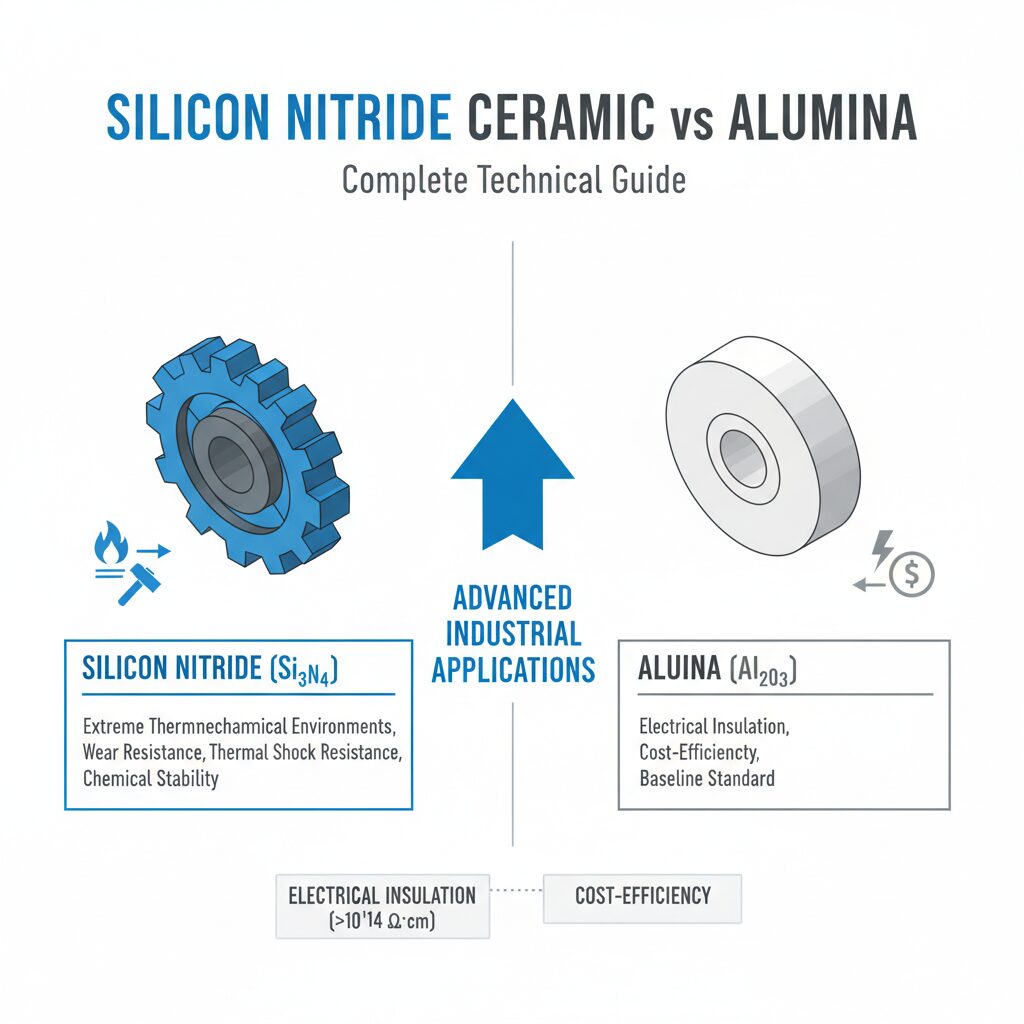
Quando si progettano dispositivi medici, la selezione dei materiali richiede spesso un bilanciamento tra gestione termica, durata meccanica e costi di approvvigionamento. E i costi di approvvigionamento. Mentre allumina/”>allumina (Al₂O₃) rimane lo standard per l'isolamento elettrico generale grazie al suo basso costo e all'elevata stabilità chimica, ma la sua conducibilità termica raggiunge un picco di circa 30 W/m-K. Questo deficit da 5 a 7 volte rispetto all'AlN rende l'allumina inadatta alla dissipazione termica ad alta potenza. Al contrario, un tubo ceramico in nitruro di alluminio per dispositivi medici funge contemporaneamente da dissipatore di calore attivo e da barriera elettrica passiva.
Confronto tra AlN e zirconio (ZrO₂) evidenzia uno stretto compromesso tra dinamica termica e meccanica della frattura. L'ossido di zirconio offre una tenacità alla frattura compresa tra 8,0 e 10,0 MPa-m½, che lo rende altamente resistente agli impatti e alle forze di flessione negli impianti medici strutturali, ma la sua conducibilità termica è un abissale 2,0-3,0 W/m-K. Nitruro di silicio (Si₃N₄) fornisce una soluzione intermedia, offrendo un'eccellente resistenza meccanica (800 MPa) e una moderata conducibilità termica (da 30 a 90 W/m-K), ma manca dei picchi di trasferimento termico richiesti per i diodi laser medicali ad alta densità.
| Proprietà | Nitruro di alluminio | Allumina | Zirconia | Nitruro di silicio |
|---|---|---|---|---|
| Conducibilità termica | 170 - 230 W/m-K | 25 - 35 W/m-K | 2 - 3 W/m-K | 30 - 90 W/m-K |
| Durezza | 1100 - 1200 HV | 1500 - 1650 HV | 1200 - 1300 HV | 1400 - 1500 HV |
| Resistenza alla frattura | 2,8 - 3,5 MPa-m½ | 3,5 - 4,5 MPa-m½ | 8,0 - 10,0 MPa-m½ | 6,0 - 7,0 MPa-m½ |
| Costo | Alto | Basso | Medio | Alto |
Applicazioni
L'impiego di un tubo ceramico in nitruro di alluminio per sistemi medicali è riservato a scenari in cui l'elevato flusso di calore si interseca direttamente con limiti dielettrici rigorosi. Questi tubi sono progettati in spazi ristretti e richiedono tolleranze esatte di concentricità e spessore delle pareti, spesso richiedendo la precisione di lavorazione garantita da Great Ceramic di ±0,005 mm per funzionare all'interno di percorsi ottici o fluidici complessi.
- Tubi laser medicali a cavità: I laser a olmio (Ho:YAG) e a tulio ad alta potenza utilizzati in litotrissia e urologia generano un notevole calore residuo. I tubi di AlN fungono da materiale per il foro, isolando elettricamente la sorgente di eccitazione ad alta tensione (fino a 10 kV) e allontanando l'energia termica in eccesso dal mezzo laser per mantenere la stabilità della lunghezza d'onda a 2100 nm.
- Punte di catetere per ablazione a radiofrequenza (RF): Nell'elettrofisiologia cardiaca e nell'ablazione dei tumori, l'energia RF opera a frequenze comprese tra 400 e 500 kHz. Il tubo di AlN agisce come una guaina strutturale che isola il cablaggio ma dissipa rapidamente il calore generato all'interfaccia del tessuto (spesso superiore a 90°C), impedendo la coagulazione del sangue e la carbonizzazione indesiderata del tessuto intorno all'elettrodo.
- Isolatori per tubi a raggi X ad alta potenza: Gli scanner per tomografia computerizzata (TC) utilizzano tubi a raggi X ad anodo rotante che dissipano fino a 100 kW di potenza di picco in raffiche di pochi secondi. Un tubo ceramico in nitruro di alluminio per i sistemi di imaging medicale isola il catodo ad alta tensione (spesso funzionante a 120 kV - 140 kV) estraendo il calore localizzato in un circuito di raffreddamento esterno in olio dielettrico, prevenendo il guasto del catodo e prolungando la durata del tubo di oltre 40%.
- Percorsi di ciclaggio termico della reazione a catena della polimerasi (PCR): L'amplificazione del DNA richiede rapidi cicli di temperatura tra 95°C (denaturazione), 55°C (annealing). e 72°C (estensione) con velocità di rampa fino a 10°C/secondo. I tubi AlN a parete sottile fungono da condotti fluidici o camere di campionamento, fornendo la rapida risposta termica necessaria per l'equilibrio istantaneo della temperatura in un campione fluido di 50 µL.
- Guaine per strumenti elettrochirurgici endoscopici: Gli strumenti chirurgici mini-invasivi richiedono alberi rigidi e bio-inerti in grado di trasportare corrente alternata ad alta frequenza per il taglio e la coagulazione (fino a 300 W). I tubi in AlN offrono una rigidità dielettrica di 15 kV/mm, garantendo che l'accoppiamento capacitivo non danneggi i tessuti del paziente non bersagliati e fornendo al contempo una resistenza alla flessione sufficiente (300 MPa) per sopportare i momenti di flessione operativi.
Processo di produzione
La produzione di un tubo ceramico in nitruro di alluminio ad alta densità e privo di difetti per dispositivi medici richiede un processo metallurgico altamente controllato e in più fasi. Poiché l'AlN è un composto con legami covalenti, non si scioglie, ma sublima a temperature superiori ai 2200°C. Pertanto, è necessario ricorrere a tecniche di sinterizzazione di polveri allo stato solido o in fase liquida. Great Ceramic utilizza polvere di AlN ultra pura sintetizzata tramite riduzione carbotermica dell'allumina (Al₂O₃ + 3C + N₂ → 2AlN + 3CO), garantendo livelli di purezza della polvere di partenza >99,5% con contenuti di ossigeno strettamente limitati al di sotto di 0,8 wt%.
Il processo di produzione richiede una precisione assoluta in ogni fase. Qualsiasi porosità residua agisce come sito di diffusione dei foni, riducendo drasticamente la conduttività termica finale del tubo. Per contrastare questo fenomeno, vengono introdotti ausiliari di sinterizzazione a base di ossido di ittrio (Y₂O₃) o di ossido di calcio (CaO), in percentuali comprese tra 2% e 5% in peso. Questi additivi reagiscono con le impurità di ossigeno sulle superfici delle particelle di AlN per formare una fase liquida di alluminato (come Y₃Al₅O₁₂) durante la cottura, che unisce le particelle di polvere per azione capillare e purifica il reticolo di AlN.
Metodi di formatura
- Pressatura isostatica a freddo (CIP): Per i tubi che richiedono pareti spesse e gradienti di densità minimi, la polvere di AlN e il sistema legante vengono incapsulati in uno stampo di poliuretano e sottoposti a una pressione idraulica omnidirezionale tra 200 e 300 MPa. Questo metodo produce corpi verdi con densità altamente uniforme (in genere 60% della densità teorica), riducendo al minimo il ritiro anisotropo durante la sinterizzazione.
- Estrusione: Per tubi lunghi e ad alto rapporto d'aspetto. Per tubi di AlN lunghi e a parete sottile, la polvere viene composta con plastificanti organici, leganti di metilcellulosa e acqua per formare una pasta rigida. E acqua per formare una pasta rigida, simile a un impasto. Questa pasta viene forzata attraverso una matrice e un mandrino in carburo di tungsteno ad alta pressione (fino a 50 MPa). L'estrusione consente la produzione continua di diametri interni fino a 1,0 mm, ma richiede protocolli di essiccazione meticolosi per evitare la deformazione.
Sinterizzazione
La sinterizzazione rappresenta la trasformazione metallurgica più critica nella fabbricazione di un tubo ceramico in nitruro di alluminio per applicazioni mediche. I tubi verdi sono sottoposti a un preciso profilo di deceraggio termico fino a 600°C per volatilizzare i leganti organici a una velocità di 1-2°C al minuto, evitando microfratture. I tubi vengono quindi collocati in crogioli di tungsteno o grafite e trasferiti in un forno discontinuo ad alta temperatura. La sinterizzazione avviene in un'atmosfera fluida di azoto di elevata purezza a temperature comprese tra 1700°C e 1900°C per 2-6 ore. L'ambiente di azoto è fondamentale per sopprimere la dissociazione dell'AlN. Durante questa fase, i tubi subiscono un ritiro volumetrico da 15% a 20%, raggiungendo una densità teorica finale >99% (in genere 3,26 g/cm³).
Lavorazione finale
Dopo la sinterizzazione, il tubo AlN presenta una finitura superficiale “as-fired” e tolleranze dimensionali comprese tra ±2% e ±3%. Le applicazioni mediche vietano rigorosamente tali variazioni. La fase finale di produzione prevede una lavorazione sottrattiva aggressiva e di alta precisione. A causa dell'elevata durezza (1200 HV) e della natura fragile dell'AlN, gli utensili da taglio tradizionali sono inefficaci. Lavorazione di precisione della ceramica È necessario utilizzare centri di rettifica CNC multiasse dotati di abrasivi diamantati a legame resinoso e a legame metallico. Great Ceramic eccelle in questa fase, impiegando mole diamantate da 400 a 800 grane che operano a velocità superficiali da 25 a 35 m/s per ottenere diametri esterni ultraprecisi, concentricità interna del foro. E rugosità superficiale (Ra) fino a 0,2 µm. Per garantire configurazioni specializzate, contattate Great Ceramic per assicurarvi che i vostri componenti soddisfino la soglia di ±0,005 mm richiesta per la conformità medica.
Vantaggi e limiti
Vantaggi
- Gestione termica eccezionale: Funzionando a 170-230 W/m-K, un tubo di AlN equilibra rapidamente gli squilibri termici nei dispositivi medici ad alta potenza, prevenendo la fuga termica nei sensori microelettronici e la necrosi dei tessuti nelle applicazioni chirurgiche.
- Alta rigidità dielettrica: Con una tensione di rottura dielettrica di 15-20 kV/mm e una resistività di volume superiore a 10¹⁴ Ω-cm, l'AlN isola in modo sicuro l'elettronica di controllo sensibile dalle fonti di energia ad alta tensione presenti nei defibrillatori e negli eccitatori laser.
- Biocompatibilità e non tossicità: L'AlN di grado medico è generalmente riconosciuto come bioinerte e non tossico. A differenza dell'ossido di berillio (BeO), che offre proprietà termiche simili ma presenta gravi rischi di tossicità respiratoria, l'AlN offre un profilo di manipolazione sicuro sia per il personale di produzione che per gli ambienti clinici di utilizzo finale.
- Stabilità termomeccanica: Il CTE di 4,4 x 10-⁶/K consente la brasatura diretta o l'incollaggio a substrati di silicio e metalli refrattari (come tungsteno e molibdeno) con il minimo rischio di fatica termica o delaminazione interfacciale durante il funzionamento continuo fino a 1100°C.
Limitazioni
- Suscettibilità all'idrolisi: La polvere di AlN non rivestita e le superfici porose non passivate possono reagire con acqua liquida o ambienti ad alta umidità a temperature elevate, formando idrossido di alluminio (Al(OH)₃) e rilasciando gas ammoniaca (NH₃). Mentre i pezzi sinterizzati completamente densi sono altamente resistenti all'umidità ambientale, i componenti medicali esposti al raffreddamento diretto con liquidi o alla sterilizzazione a vapore ad alta pressione (autoclave) spesso richiedono una glassivazione secondaria o rivestimenti metallici a film sottile per sigillare la superficie.
- Bassa resistenza alla frattura: Con una tenacità alla frattura compresa tra 2,8 e 3,5 MPa-m½, l'AlN è suscettibile di cedimenti catastrofici in presenza di carichi d'urto improvvisi o di forti sollecitazioni puntuali. Deve essere progettato con smussi e raggi appropriati. E meccanismi di montaggio conformi (come gli O-ring elastomerici) per distribuire le sollecitazioni meccaniche.
Considerazioni sulla lavorazione
La fabbricazione di un tubo ceramico in nitruro di alluminio ad alta tolleranza per applicazioni mediche introduce sfide tribologiche e meccaniche estreme. La difficoltà principale consiste nel bilanciare la velocità di rimozione del materiale (MRR) con l'innesco di microcricche sotto la superficie. Poiché l'AlN è altamente fragile, la lavorazione deve operare rigorosamente all'interno del “regime duttile” della rettifica, in cui la profondità di taglio per ogni passata non supera la soglia critica per la frattura fragile. Il superamento di questa soglia comporta la scheggiatura dei bordi e il distacco dei grani. E una grave riduzione della resistenza meccanica del componente.
Per ottenere le tolleranze di ±0,005 mm richieste dagli OEM del settore medicale, Great Ceramic controlla parametri di lavorazione specifici con assoluta rigidità. La rettifica del diametro interno (ID) di tubi di piccolo diametro (ad esempio, ID < 2,0 mm) utilizza mandrini diamantati galvanici ad alta frequenza che girano a velocità di mandrino superiori a 60.000 giri/min. La profondità di taglio è spesso limitata a 0,002 mm - 0,005 mm per passata. Le velocità di avanzamento devono rimanere costanti e regolari. Qualsiasi sosta dell'utensile da taglio induce un riscaldamento localizzato per attrito che può causare shock microtermici nella matrice ceramica.
Inoltre, la citata limitazione dell'idrolisi rappresenta una sfida unica durante la fase di lavorazione. Non è possibile utilizzare i normali refrigeranti per rettifica a base d'acqua, in quanto i sottili trucioli di AlN reagiscono con l'acqua, producendo gas ammoniaca e degradando lo slurry. L'Great Ceramic utilizza fluidi dielettrici specializzati non acquosi o refrigeranti sintetici fortemente inibiti ad alta pressione (da 70 a 100 bar) per lavare la zona di rettifica. Ciò garantisce che la matrice diamantata rimanga pulita dai detriti, evitando il caricamento della mola e mantenendo costanti le forze di taglio. I nostri rigorosi protocolli metrologici, che impiegano micrometri laser e macchine di misura a coordinate (CMM), garantiscono che le tolleranze geometriche, come la rettilineità (0,01 mm/100 mm) e la circolarità (0,005 mm), siano rigorosamente conformi al disegno tecnico.
FAQ
Che cos'è un tubo ceramico in nitruro di alluminio per applicazioni mediche?
Un tubo ceramico in nitruro di alluminio per applicazioni mediche è un componente cilindrico di precisione utilizzato principalmente per la sua combinazione unica di elevata conduttività termica (fino a 230 W/m-K) ed eccellente isolamento elettrico (>10¹⁴ Ω-cm). Questi tubi sono utilizzati nei dispositivi medici che richiedono una rapida dissipazione del calore lontano da fonti di energia ad alta potenza, come i laser chirurgici e i tubi a raggi X. e punte di ablazione a radiofrequenza, impedendo al contempo che la corrente elettrica raggiunga altri componenti o i tessuti biologici. La densità del materiale (3,26 g/cm³) e la struttura dei grani strettamente controllata ne consentono la lavorazione con tolleranze dimensionali rigorose, necessarie per assemblaggi medici complessi.
Quali sono le principali applicazioni di un tubo ceramico in nitruro di alluminio per uso medico?
Le applicazioni principali riguardano le apparecchiature diagnostiche e terapeutiche ad alta potenza. Sono ampiamente utilizzati come cavità laser nei laser chirurgici a olmio e a tulio, garantendo stabilità termica e isolamento elettrico. Nei cateteri per elettrofisiologia a radiofrequenza fungono da guaine protettive per la dissipazione del calore, per evitare la carbonizzazione dei tessuti durante le procedure di ablazione. Inoltre, questi tubi servono come distanziatori ad alta tensione e condotti di raffreddamento nei gruppi di tubi a raggi X degli scanner CT. E come camere di reazione miniaturizzate in apparecchiature diagnostiche a ciclo termico rapido, come le macchine PCR ad alta velocità. In tutti questi casi, il componente deve gestire flussi di calore che gli isolanti standard non sono in grado di gestire.
Come si colloca un tubo ceramico in nitruro di alluminio per applicazioni mediche rispetto ad altre ceramiche?
Rispetto all'allumina (lo standard industriale per l'isolamento economico), l'AlN offre un aumento da 5 a 7 volte della conduttività termica (170 W/m-K contro 30 W/m-K), rendendolo nettamente superiore per i dissipatori di calore attivi. Rispetto all'ossido di zirconio. Questo materiale è meccanicamente robusto (tenacità alla frattura di 8,0 MPa-m½) ma termicamente isolante (2 W/m-K), l'AlN sacrifica una certa resistenza agli urti per un'enorme capacità di trasferimento termico. Il nitruro di silicio offre un equilibrio intermedio tra resistenza e conducibilità termica, ma è inferiore al potenziale di dissipazione termica dell'AlN. L'AlN è preferito all'ossido di berillio (BeO), che ha caratteristiche termiche simili, perché è atossico ed evita i gravi rischi respiratori associati alla polvere di berillio.
Quali sono i vantaggi dell'utilizzo del nitruro di alluminio rispetto ai materiali tradizionali?
Il vantaggio principale è l'eliminazione dei colli di bottiglia termici nell'elettronica medicale ad alta densità. I materiali tradizionali costringono gli ingegneri a scegliere tra un buon isolante elettrico (come la plastica o la ceramica standard) che trattiene il calore, o un buon conduttore termico (come il rame o l'alluminio) che conduce l'elettricità e richiede ingombranti strati isolanti secondari. Un tubo in AlN svolge intrinsecamente entrambe le funzioni. Ulteriori vantaggi sono il basso coefficiente di espansione termica (4,4 x 10-⁶/K) che eguaglia quello del silicio e di metalli specifici, consentendo giunzioni brasate altamente affidabili e prive di tensioni, in grado di sopportare migliaia di cicli termici o ripetute sterilizzazioni in autoclave senza affaticamento meccanico.
Come viene lavorato un tubo ceramico in nitruro di alluminio per applicazioni mediche?
Poiché il nitruro di alluminio è estremamente duro (1200 HV) e fragile, non può essere lavorato con i tradizionali strumenti per il taglio dei metalli. Richiede una lavorazione lavorazione di precisione della ceramica utilizzando smerigliatrici CNC multiasse dotate di utensili diamantati resinati o galvanici. Il processo richiede un controllo meticoloso delle velocità del mandrino, profondità di taglio ridotte (da 0,002 mm a 0,005 mm per passata). E l'utilizzo di specifici refrigeranti non acquosi per evitare l'idrolisi chimica dei trucioli ceramici. Great Ceramic eccelle in questa fase di produzione sottrattiva altamente tecnica, offrendo servizi di rettifica, levigatura e lappatura su misura. E servizi di lappatura che producono in modo affidabile finiture superficiali di grado medicale fino a Ra 0,2 µm e tolleranze geometriche strettissime di ±0,005 mm.
Avete bisogno di un tubo ceramico in nitruro di alluminio personalizzato per le parti mediche? Contatto Great Ceramic per servizi di lavorazione di precisione con tolleranze ristrette, oppure inviate un'e-mail a [email protected].
Il tubo ceramico in nitruro di alluminio per uso medico è ampiamente utilizzato nelle applicazioni ceramiche avanzate.
Per saperne di più Tubo ceramico del nitruro di alluminio per il medico e i nostri servizi di lavorazione della ceramica di precisione.