









High-Performance Aluminum Nitride Ceramic Ring for Electronics: The Ultimate Technical Guide
In the rapidly evolving landscape of high-power electronics, thermal management has transitioned from a design consideration to a critical performance bottleneck. As components shrink and power densities soar, traditional insulating materials like allumina (Al2O3) often fall short of the rigorous thermal demands. This is where the nitruro di alluminio ceramic ring emerges as a cornerstone technology. Combining exceptional thermal conductivity with superior electrical insulation, Aluminum Nitride (AlN) is the material of choice for demanding electronic environments.
Great Ceramic specializes in the precision CNC machining of AlN components, providing the electronics industry with high-purity aluminum nitride ceramic rings designed for reliability and longevity. This guide explores the technical properties, manufacturing complexities. And diverse applications of AlN rings in modern electronics.
What is Aluminum Nitride (AlN)?
Aluminum Nitride (AlN) is a technical ceramic material with a hexagonal (wurtzite) crystal structure. It is unique among ceramics because it offers a combination of high thermal conductivity and high electrical resistivity. While most materials that conduct heat well (like copper or aluminum) are also electrical conductors, AlN acts as an electrical insulator, making it ideal for heat sinks and substrates in electronic circuits where short circuits must be avoided.
The thermal conductivity of AlN is typically 7 to 10 times higher than that of high-purity alumina. Furthermore, its Coefficient of Thermal Expansion (CTE) is closely matched to that of silicon (Si) and gallium nitride (GaN). This is vital for maintaining structural integrity during thermal cycling in semiconductor devices.
Technical Properties of Aluminum Nitride Ceramic Rings
To understand why an aluminum nitride ceramic ring is superior for electronic applications, one must look at its material data sheet. The following tables outline the physical, thermal. And electrical characteristics of AlN compared to other common technical ceramics.
Table 1: Physical and Mechanical Properties of AlN
| Proprietà | Unità | Valore (tipico) |
|---|---|---|
| Densità | g/cm³ | 3.26 - 3.30 |
| Resistenza alla flessione | MPa | 300 – 450 |
| Modulo elastico | Media dei voti | 310 – 330 |
| Durezza (Vickers) | kg/mm² | 1100 – 1200 |
| Durezza alla frattura (K1c) | MPa-m½ | 2.6 – 3.5 |
| Rapporto di Poisson | – | 0.24 |
Tabella 2: Proprietà termiche ed elettriche
| Proprietà | Unità | Valore (tipico) |
|---|---|---|
| Thermal Conductivity (at 25°C) | W/m-K | 170 - 230 |
| Coeff. of Thermal Expansion (20-400°C) | 10-⁶/°C | 4.5 – 4.8 |
| Rigidità dielettrica | kV/mm | >15 |
| Dielectric Constant (at 1MHz) | – | 8.5 – 9.0 |
| Dissipation Factor (at 1MHz) | – | < 0.001 |
| Resistività volumetrica | Ω-cm | >10¹⁴ |
Why Use AlN Ceramic Rings in Electronics?
Gestione termica superiore
The primary driver for using an aluminum nitride ceramic ring is its ability to dissipate heat. In high-power LED arrays, power modules (IGBTs). And RF amplifiers, the heat generated by the semiconductor die can lead to catastrophic failure if not moved away efficiently. AlN facilitates rapid heat transfer from the active component to the heat sink, lowering the junction temperature and extending the device’s lifespan.
CTE Matching
In electronics, components are often bonded together using solder or adhesives. If the ceramic ring and the silicon chip have vastly different rates of thermal expansion, the resulting stress during heating and cooling cycles will cause delamination or cracking. AlN’s CTE (approx. 4.5 x 10⁻⁶/°C) is remarkably close to that of Silicon (approx. 3.5-4.0 x 10⁻⁶/°C), ensuring mechanical stability in high-reliability applications.
Low Dielectric Loss
For high-frequency applications, such as 5G infrastructure and satellite communications, the dielectric loss of the housing or substrate is critical. AlN exhibits very low dielectric loss across a wide frequency range, minimizing signal attenuation and maintaining the efficiency of RF systems.
Common Industry Applications
1. Semiconductor Processing Equipment
Aluminum nitride ceramic rings are frequently used as “focus rings” or “edge rings” in plasma etching and CVD (Chemical Vapor Deposition) chambers. Their resistance to plasma erosion and high thermal stability ensure consistent wafer processing. The high purity of AlN also prevents contamination of the semiconductor environment.
2. Power Electronics and IGBT Modules
In Electric Vehicle (EV) inverters and renewable energy converters, Insulated Gate Bipolar Transistors (IGBTs) generate significant heat. AlN rings or substrates provide the necessary electrical isolation between the high-voltage circuit and the cooling system while acting as a high-speed thermal bridge.
3. High-Power LED Lighting
LEDs are sensitive to heat. their efficiency and color temperature shift as they get hotter. AlN rings are used in the packaging of high-wattage LEDs to ensure that the heat is drawn away from the diode, allowing for smaller, brighter. And longer-lasting lighting solutions.
4. RF and Microwave Components
Due to its low dielectric constant and high thermal conductivity, AlN is the standard for microwave windows, RF terminations. And power resistors in telecommunications. Aluminum nitride ceramic rings are often used as spacers or structural supports in vacuum electronic devices (VEDs).
5. Laser Technology
High-power laser diodes require advanced cooling. AlN ceramic components serve as sub-mounts and heat spreaders that can withstand the intense local heat of the laser beam without deforming or losing insulating properties.
CNC Machining of Aluminum Nitride Ceramic Rings
Aluminum nitride is a difficult-to-machine material due to its hardness and brittleness. Achieving the tight tolerances required for electronic components demands specialized equipment and expertise. Great Ceramic utilizes advanced CNC machining techniques to produce AlN rings with complex geometries.
The Machining Process
The production of an aluminum nitride ceramic ring typically follows these stages:
- Powder Preparation: High-purity AlN powder is mixed with sintering aids.
- Green Body Forming: The powder is pressed (isostatic or dry pressing) into a “green” state.
- Sintering: The green part is fired at temperatures exceeding 1800°C in a nitrogen atmosphere to achieve full density.
- CNC Diamond Grinding: After sintering, the AlN is extremely hard. Precision dimensions, such as inner and outer diameters, flatness. And parallelism, are achieved using diamond-tipped CNC tools.
- Lapping and Polishing: For applications requiring a mirror finish or ultra-flat surfaces (for better thermal contact), the rings undergo lapping processes.
Machining Challenges and Solutions
AlN is sensitive to moisture. during the machining process, specialized coolants must be used to prevent the surface of the ceramic from reacting with water to form aluminum hydroxide and ammonia. Furthermore, because AlN is brittle, edge chipping is a risk. Great Ceramic uses high-speed spindles and optimized feed rates to ensure clean edges and high surface integrity.
Achievable Tolerances
At Great Ceramic, we can achieve the following specifications for aluminum nitride ceramic rings:
- Diameter Tolerance: Up to ±0.005 mm
- Flatness: < 0.001 mm
- Surface Roughness (Ra): Down to 0.1 μm
- Concentricity: Within 0.01 mm
Metallization of AlN Ceramic Rings
For many electronic applications, the aluminum nitride ceramic ring must be “metallized” so it can be soldered to other components. Common metallization methods include:
- Thin-Film Metallization: Sputtering layers of Ti, Pt, or Au for high-precision circuits.
- Thick-Film Metallization: Screen printing silver or palladium-silver pastes.
- DBC (Direct Bond Copper): Bonding a thick layer of copper to the ceramic for high-current applications.
- Mo-Mn Metallization: Molybdenum-Manganese coating followed by nickel plating, ideal for brazing ceramics to metals.
Comparison: AlN vs. Alumina (Al2O3) vs. Beryllia (BeO)
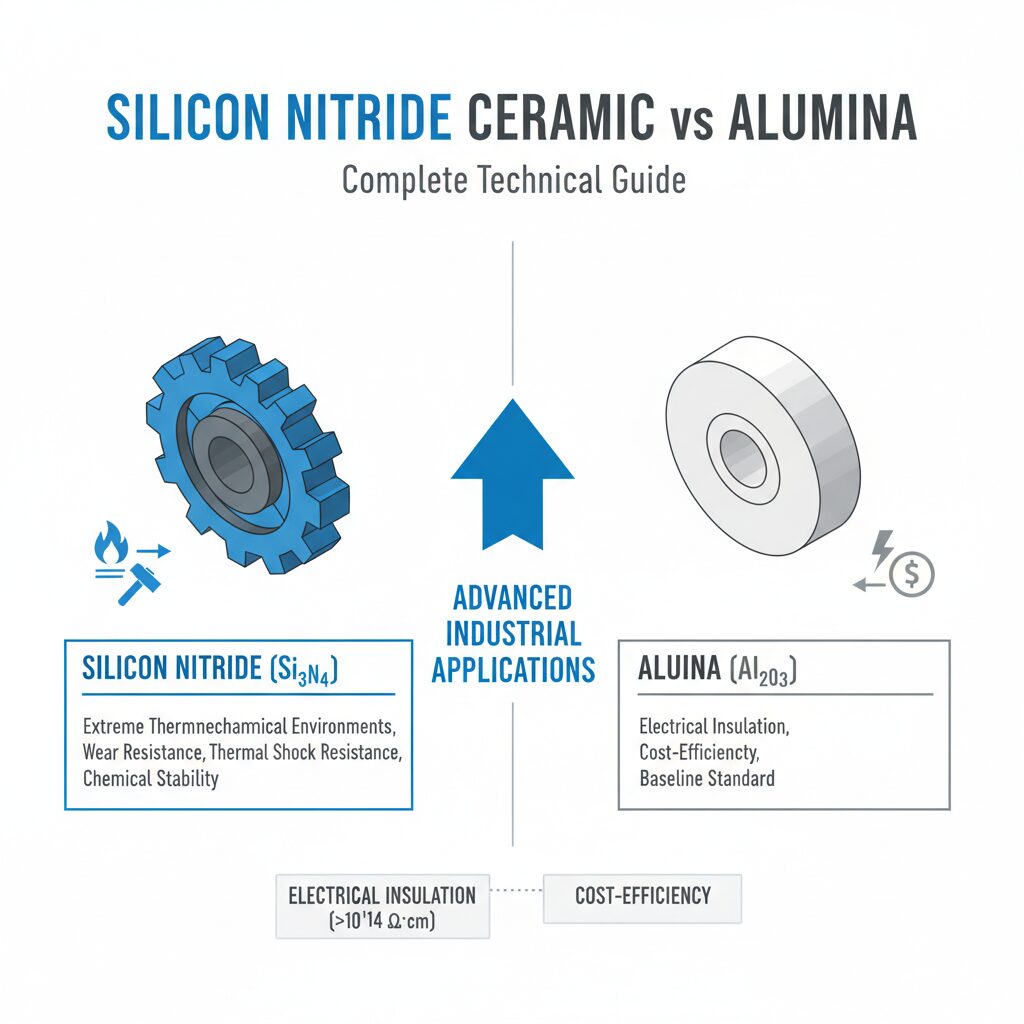
Designers often compare AlN with Alumina and Beryllia when selecting a ceramic ring. While Alumina is more cost-effective, its thermal conductivity (approx. 25-30 W/m·K) is insufficient for high-power densities. Beryllia (BeO) offers even higher thermal conductivity than AlN (up to 280 W/m·K), but BeO powder is highly toxic, leading to strict regulatory hurdles and high handling costs. AlN provides the “sweet spot” of high performance and safety.
Table 3: Material Comparison
| Materiale | Conducibilità termica (W/m·K) | CTE (ppm/°C) | Tossicità | Cost Index |
|---|---|---|---|---|
| Alumina (96% Al2O3) | 24 | 7.2 | Non-toxic | Basso |
| Nitruro di alluminio (AlN) | 170 - 230 | 4.5 | Non-toxic | Medium-High |
| Berillia (BeO) | 280 | 8.0 | High (Toxic) | Molto alto |
Design Guidelines for AlN Ceramic Rings
When designing an aluminum nitride ceramic ring for electronics, consider the following to optimize performance and reduce costs:
- Spessore della parete: Avoid excessively thin walls (less than 0.5mm) to prevent breakage during handling or thermal shock.
- Radii: Incorporate small radii in corners rather than sharp 90-degree angles to reduce stress concentrations.
- Standard Dimensions: Where possible, design around standard powder pressing sizes to reduce the amount of diamond grinding required.
- Finitura superficiale: Specify the surface finish based on the contact method. If using thermal grease, a standard ground finish is fine. If soldering, a polished and metallized surface is necessary.
Domande frequenti (FAQ)
Q1: Is aluminum nitride ceramic fragile?
A: Like all technical ceramics, AlN is brittle and has low fracture toughness compared to metals. However, it has high flexural strength and can withstand significant compressive loads. It is perfectly durable for electronic housings and spacers when handled correctly.
Q2: How does moisture affect AlN rings?
A: In its bulk form, AlN is stable. However, in high-humidity environments at elevated temperatures, the surface can slowly react with water. For long-term reliability in non-hermetic packages, a protective coating or metallization is often applied.
Q3: Why is AlN more expensive than alumina?
A: The raw material cost of high-purity AlN powder is significantly higher than Al2O3. Additionally, AlN must be sintered in a high-temperature nitrogen atmosphere (non-oxidizing). This increases energy and equipment costs.
Q4: Can Great Ceramic produce custom shapes?
A: Yes. While rings are common, we can machine AlN into substrates, blocks, tubes. And complex custom geometries using our multi-axis CNC machines.
Q5: Can AlN be brazed to metal components?
A: Yes, through the Mo-Mn metallization process, AlN ceramic rings can be brazed to Kovar or Copper-Tungsten components to create vacuum-tight seals and robust electronic assemblies.
Conclusione
Il aluminum nitride ceramic ring is an essential component for the next generation of high-power electronics. Its ability to dissipate massive amounts of heat while maintaining electrical isolation and mechanical stability makes it indispensable for semiconductors, RF communications. And EV technology. While the material presents machining challenges, the expertise of a specialized manufacturer ensures that these components meet the highest standards of precision.
As power densities continue to rise, the transition from alumina to aluminum nitride will become more prevalent. Investing in high-quality AlN components is an investment in the reliability and efficiency of your electronic systems.
Contattare Great Ceramic per informazioni personalizzate lavorazione della ceramica soluzioni su misura per le vostre applicazioni. Our team of engineers is ready to assist with material selection, design optimization. And high-precision manufacturing of aluminum nitride ceramic rings and other technical ceramic components.
aluminum nitride ceramic ring for electronics is widely used in advanced ceramic applications.