









Aluminum Nitride Ceramic Insulator for Automotive: Complete Technical Guide
The rapid transition from 400V to 800V and 1000V electric vehicle (EV) architectures has drastically elevated the thermal and electrical demands placed on power electronics. Managing junction temperatures in high-power Silicon Carbide (SiC) MOSFETs and Insulated-Gate Bipolar Transistors (IGBTs)—which frequently generate heat fluxes exceeding 250 W/cm²—requires advanced thermal management solutions. Enter the nitruro di alluminio ceramic insulator for automotive applications. This advanced ceramic material provides the critical combination of massive thermal conductivity (170–200 W/m·K) and exceptionally high dielectric strength (15 kV/mm), effectively solving the dual challenge of rapid heat dissipation and high-voltage electrical isolation. By matching the coefficient of thermal expansion (CTE) of silicon semiconductors at roughly 4.5 x 10⁻⁶ /K, nitruro di alluminio significantly reduces thermo-mechanical fatigue in Direct Bonded Copper (DBC) and Active Metal Brazed (AMB) substrates. For engineering teams developing next-generation traction inverters, on-board chargers (OBC). And high-density battery management systems, partnering with Great Ceramic for precision-machined AlN components guarantees dimensional tolerances down to ±0.005mm. Ready to optimize your EV power module? Contact Great Ceramic today to discuss your specific thermal management requirements.
Proprietà dei materiali
Understanding the thermomechanical and electrical baseline of an aluminum nitride ceramic insulator for automotive engineering requires a rigorous look at its datasheet values. In an automotive environment where ambient under-hood temperatures reach up to 140°C and power semiconductor junction temperatures peak at 175°C, standard polymeric insulators rapidly degrade. Aluminum nitride operates flawlessly under continuous thermal cycling from -40°C to +150°C required by AEC-Q101 standards. Its theoretical density of 3.26 g/cm³ ensures a compact, lightweight dielectric layer critical for reducing overall EV curb weight. Electrically, its volume resistivity exceeds 10¹⁴ Ω·cm at 25°C, preventing leakage currents in high-voltage DC circuits operating between 800V and 1200V. Furthermore, with a dielectric constant of 8.9 at 1 MHz, it minimizes parasitic capacitance in high-frequency switching operations (>100 kHz). This is vital for the efficiency of SiC-based inverters.
| Proprietà | Valore | Unità |
|---|---|---|
| Densità | 3.26 | g/cm³ |
| Durezza | 1100 | HV |
| Resistenza alla flessione | 300 – 320 | MPa |
| Resistenza alla frattura | 2.6 – 3.0 | MPa-m½ |
| Conducibilità termica | 170 - 200 | W/m-K |
| Resistività elettrica | >10¹⁴ | Ω-cm |
| Coefficient of Thermal Expansion (20-400°C) | 4.5 x 10⁻⁶ | /K |
| Rigidità dielettrica | 15 – 17 | kV/mm |
| Max Working Temperature (Inert Atmosphere) | 1800 | °C |
Confronto con altre ceramiche
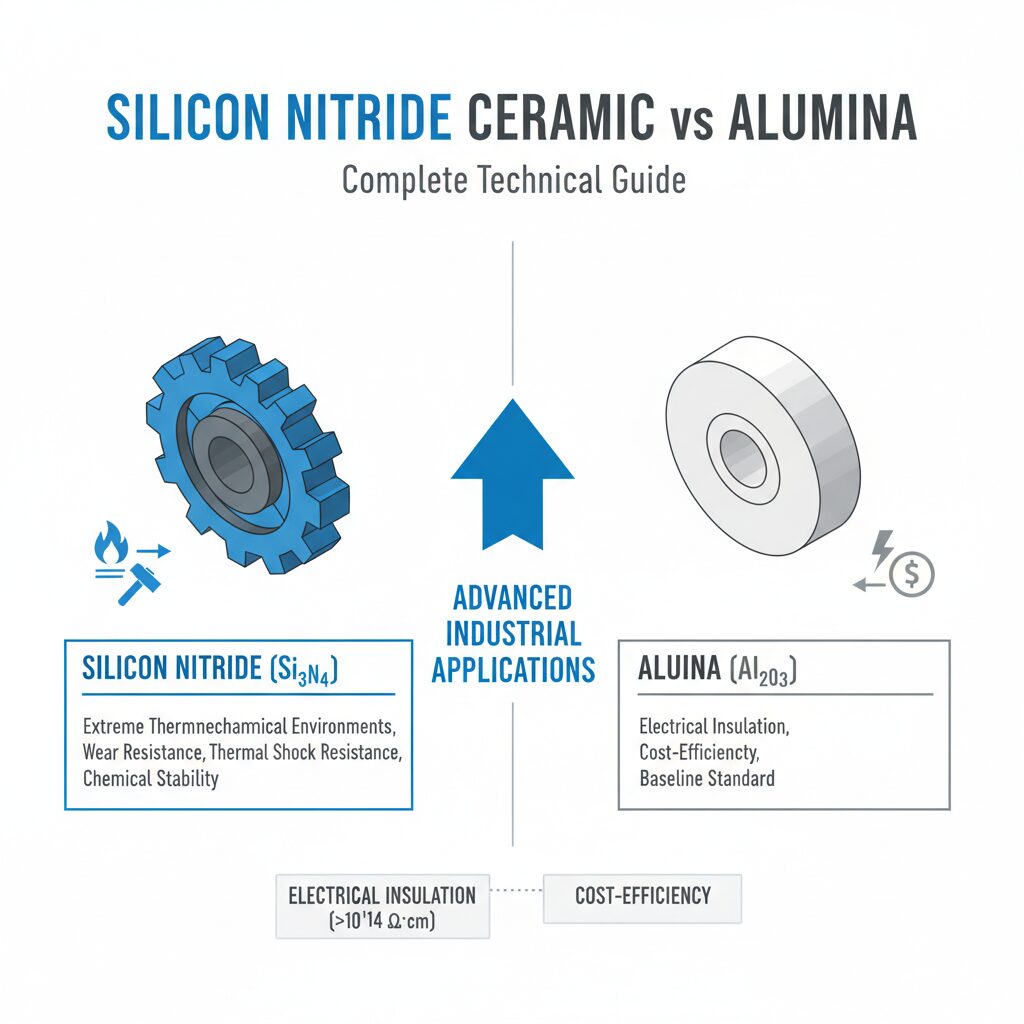
When selecting a ceramic substrate for automotive electronics, engineers primarily evaluate AlN against three competing materials: allumina/”>allumina (Al₂O³), zirconio (ZrO₂). And nitruro di silicio (Si₃N₄). Alumina is the legacy standard due to its low cost. however, its thermal conductivity peaks at roughly 24-30 W/m·K. This is insufficient for high-density EV power modules where heat fluxes surpass 150 W/cm², causing an unacceptable temperature gradient (ΔT) across the substrate. In contrast, an aluminum nitride ceramic insulator for automotive use delivers 170-200 W/m·K—nearly 7 times the thermal conductivity of alumina—allowing for junction temperature reductions of up to 30°C in identical form factors.
Silicon nitride offers a superior fracture toughness of 6.0 to 8.0 MPa·m½, making it highly resilient to extreme mechanical shock and vibration (up to 50G profiles in automotive testing). However, its thermal conductivity is generally limited to 90 W/m·K. While Si₃N₄ dominates in mechanical durability, AlN remains the undisputed leader in sheer thermal transfer efficiency for stationary or rigid-mounted power packages. Meanwhile, zirconia offers unparalleled mechanical toughness (up to 10 MPa·m½) and bending strength (>1000 MPa), but acts as a thermal insulator with a conductivity of just 2-3 W/m·K, completely disqualifying it as a heat-dissipating substrate for active power semiconductors. For ultra-high frequency or specialized high-temperature applications, engineers may also consider carburo di silicio o nitruro di boro, though AlN strikes the most balanced cost-to-performance ratio for EV thermal management.
| Proprietà | Nitruro di alluminio | Alumina (96%) | Zirconia (Y-TZP) | Nitruro di silicio |
|---|---|---|---|---|
| Conducibilità termica (W/m·K) | 170 - 200 | 24 – 30 | 2 – 3 | 80 – 90 |
| Durezza (HV) | 1100 | 1500 | 1200 | 1500 |
| Durezza alla frattura (MPa-m½) | 2.6 | 4.0 | 9.0 – 10.0 | 6.5 - 8.0 |
| Resistenza alla flessione (MPa) | 320 | 350 | 1000 | 850 |
| CTE (x 10⁻⁶ /K) | 4.5 | 7.2 | 10.3 | 3.2 |
| Costo | Alto | Basso | Medio | Molto alto |
Applicazioni
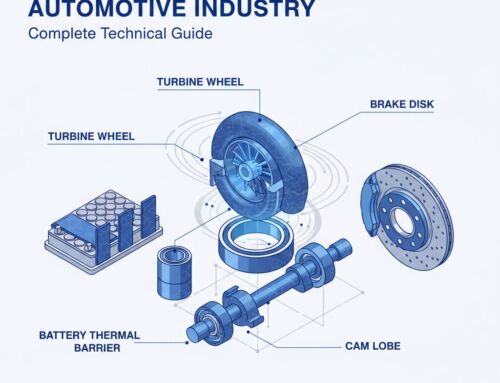
The deployment of an aluminum nitride ceramic insulator for automotive systems is expanding rapidly as original equipment manufacturers (OEMs) demand higher power densities, reduced footprint sizes. And longer operational lifespans from their electrified powertrains. Below are the five primary applications driving AlN adoption.
- Traction Inverter IGBT & SiC MOSFET Modules: As the heart of an EV powertrain, the traction inverter converts 800V DC battery power into 3-phase AC power to drive the motor. Switching currents routinely exceed 400A, generating massive thermal loads. AlN is selected as the Direct Bonded Copper (DBC) or Active Metal Brazed (AMB) substrate because its 170 W/m·K thermal conductivity allows this heat to be transferred to the liquid cooling plate with extremely low thermal resistance (Rth). Furthermore, its CTE of 4.5 x 10⁻⁶ /K closely matches the silicon (4.0 x 10⁻⁶ /K) and SiC (4.2 x 10⁻⁶ /K) chips, drastically reducing solder joint fatigue over 100,000+ thermal cycles.
- DC-DC Converters: High-voltage to low-voltage (e.g., 800V to 12V or 48V) conversion systems require compact planar transformers and power switches. An aluminum nitride ceramic insulator for automotive converters is used as a heat sink interface pad. Its >15 kV/mm dielectric strength ensures absolute galvanic isolation between the high voltage traction network and the sensitive 12V low-voltage vehicle network, meeting strict automotive safety integrity levels (ASIL-D).
- On-Board Chargers (OBC): Modern bidirectional OBCs process AC grid power into DC battery power at rates of 11 kW to 22 kW. The dense packaging of these modules leads to localized hot spots exceeding 120°C. AlN substrates are utilized beneath the power factor correction (PFC) diodes and switching transistors to spread heat laterally and vertically, preventing thermal runaway and increasing the charging efficiency by 2-3% by keeping semiconductors within their optimal temperature curve.
- High-Power LED Headlight Thermal Management: Automotive matrix LED and laser headlight assemblies push significant current through tiny die areas (often less than 2mm x 2mm), creating extreme heat flux densities. AlN sub-mounts are chosen over standard Metal Core Printed Circuit Boards (MCPCB) because they provide a direct, metallic-free thermal path. By reducing the junction-to-board thermal resistance to below 0.5 K/W, AlN prolongs LED lifespan beyond 50,000 hours and prevents color shifting.
- Battery Management System (BMS) High-Voltage Sensors: In 800V battery packs, monitoring voltage and current with micro-ohm shunts generates heat. AlN isolation plates are used to mechanically support and thermally cool these shunts while providing meg-ohm electrical isolation. The material ensures that the 0.1% accuracy requirement of the ADC (Analog-to-Digital Converter) sensing circuits is not corrupted by thermal drift caused by self-heating.
Processo di produzione
Producing a high-purity aluminum nitride ceramic insulator for automotive standards is a highly controlled, multi-stage metallurgical and chemical process. Raw AlN powder is inherently challenging to process because it is highly susceptible to hydrolysis—reacting with ambient moisture to form aluminum hydroxide and releasing ammonia gas. To achieve the rigorous 170 W/m·K thermal specification, oxygen impurities in the crystalline lattice must be strictly minimized (typically below 1.0 weight percent). This necessitates handling the sub-micron powder (average particle size 1.0 to 1.5 µm) in heavily dehumidified or inert environments.
Metodi di formatura
- Tape Casting (Doctor Blade Method): This is the primary method for producing thin AlN substrates (typically 0.38mm, 0.635mm. And 1.0mm thick) used in DBC and AMB automotive modules. The AlN powder is mixed with organic binders, plasticizers. And solvents to create a viscous slurry. This slurry is precisely cast onto a moving carrier belt using a micrometer-controlled blade, resulting in a flexible “green tape” that is then laser-cut into modular dimensions.
- Dry Pressing / Isostatic Pressing: For thicker, 3D structural insulators such as high-voltage standoffs, sensor housings, or custom heat sink geometries, the powder is spray-dried into flowable granules. These granules are compacted in precision steel dies at pressures ranging from 100 MPa to 200 MPa. Cold Isostatic Pressing (CIP) at 250 MPa may be used for complex, uniform-density billets prior to green machining.
Sinterizzazione
Sintering AlN requires ultra-high temperatures and careful atmospheric control. Because pure AlN features strong covalent bonds and low self-diffusion rates, sintering aids—typically Yttrium Oxide (Y₂O₃) or Calcium Oxide (CaO) at 2 to 5 weight percent—are added. The process takes place in a specialized furnace under a strict nitrogen (N₂) atmosphere at temperatures ranging between 1750°C and 1850°C for 2 to 6 hours. During this phase, the Y₂O₃ reacts with the detrimental alumina/oxygen impurities on the surface of the AlN particles, forming a liquid yttrium aluminate phase (such as Y₃Al₅O₁₂) that promotes densification up to >99% of theoretical density. More importantly, this scavenging process purifies the AlN lattice, driving the thermal conductivity from a poor 50 W/m·K in the green state up to the targeted 170-200 W/m·K.
Lavorazione finale
After sintering, the ceramic undergoes roughly 15% to 20% linear shrinkage. Because automotive packaging demands strict dimensional accuracy, the sintered “as-fired” ceramic must undergo rigorous hard machining. Using specialized diamond abrasive wheels and tools, the material is ground, lapped. And polished. Substrates intended for metallization are typically lapped to a flatness of less than 3 µm per 100mm and a surface roughness (Ra) of ≤ 0.5 µm. Finally, the AlN components may undergo metallization (such as Ti/Pt/Au physical vapor deposition or thick film printing) to prepare them for integration into power modules.
Vantaggi e limiti
Vantaggi
- Unmatched Thermal Conductivity: Delivering 170 to 200 W/m·K, an aluminum nitride ceramic insulator for automotive use offers thermal transfer rates up to 700% higher than standard 96% alumina, eliminating thermal bottlenecks in EV traction inverters.
- CTE Match to Semiconductors: With a CTE of 4.5 x 10⁻⁶ /K, AlN expands and contracts at a rate nearly identical to Silicon (4.0 x 10⁻⁶ /K) and Silicon Carbide (4.2 x 10⁻⁶ /K). This eliminates shear stress on solder layers, increasing power module lifespan to over 20 years in automotive environments.
- Exceptional Electrical Isolation: Providing >15 kV/mm dielectric strength and >10¹⁴ Ω·cm resistivity, it safely isolates sensitive low-voltage control circuits from the massive 800V+ DC bus architectures found in modern EVs.
- Non-Toxic Alternative to BeO: Historically, Beryllium Oxide (BeO) was used for high thermal conductivity (250 W/m·K), but BeO dust is highly toxic and heavily restricted. AlN provides comparable thermal performance while remaining 100% non-toxic and compliant with automotive RoHS and REACH regulations.
Limitazioni
- High Manufacturing Cost: The raw powder synthesis (carbothermal reduction), reliance on expensive yttria sintering aids. And the necessity of 1800°C nitrogen-atmosphere sintering furnaces make AlN approximately 3 to 5 times more expensive than standard alumina substrates.
- Brittleness and Low Fracture Toughness: With a fracture toughness of just 2.6 to 3.0 MPa·m½, AlN is relatively brittle. It is highly susceptible to chipping during machining and handling. And it underperforms silicon nitride (which hits 8.0 MPa·m½) in extreme high-vibration applications.
Considerazioni sulla lavorazione
Processing an aluminum nitride ceramic insulator for automotive applications after it has been fully sintered presents substantial engineering challenges. Due to its hardness of 1100 HV and innate brittleness, standard high-speed steel or carbide tooling cannot be used. attempted use will result in immediate catastrophic tool failure and part fracture. Hard machining requires specialized lavorazione di precisione della ceramica techniques utilizing resin-bonded and electroplated diamond tooling.
To achieve the ±0.005mm dimensional tolerances frequently demanded by Tier-1 automotive suppliers, CNC grinding parameters must be tightly controlled. Spindle speeds typically range from 10,000 to 30,000 RPM, while feed rates are kept exceptionally low—often between 10 mm/min and 50 mm/min—to prevent micro-cracking propagation beneath the cut surface. For ultra-flat automotive substrates, double-sided planetary lapping using diamond slurry (typically 1 to 3 µm particle size) is employed, ensuring parallelism of ≤ 0.002mm and surface roughness down to Ra 0.1 µm. Great Ceramic’s Advanced CNC Machining Center specializes in overcoming these exact challenges. We utilize custom water-based, rust-inhibiting coolants specifically formulated to prevent AlN hydrolysis during wet grinding. By managing tool wear and utilizing 5-axis ultrasonic-assisted CNC machines, Great Ceramic consistently delivers zero-defect AlN components ready for direct EV module integration. If your EV application requires complex AlN geometries, tight tolerances. And flawless edge-chipping control, partner with our engineering team for reliable scale-up.
FAQ
What is an aluminum nitride ceramic insulator for automotive?
An aluminum nitride ceramic insulator for automotive is a highly specialized technical ceramic component used to isolate high-voltage electrical circuits while simultaneously dissipating massive amounts of heat. Engineered from synthesized AlN powder and sintered at 1800°C, it possesses a unique combination of high thermal conductivity (170-200 W/m·K) and excellent dielectric strength (>15 kV/mm). In automotive contexts, it is primarily used in electric vehicle powertrains to manage the extreme thermal loads generated by 800V SiC traction inverters, DC-DC converters. And on-board chargers, replacing traditional, lower-performing materials like alumina or polymeric thermal pads.
What are the main applications of an aluminum nitride ceramic insulator for automotive?
The primary applications revolve around power electronics in battery electric vehicles (BEVs) and plug-in hybrid electric vehicles (PHEVs). The largest volume application is as the base substrate in Direct Bonded Copper (DBC) or Active Metal Brazed (AMB) layouts for IGBT and SiC MOSFET traction inverter modules. It is also used as a heat-spreading dielectric pad in high-power DC-DC converters processing up to 22 kW of power, thermal sub-mounts for automotive matrix LED headlights requiring 0.5 K/W thermal resistance. And high-voltage isolation plates within 800V Battery Management System (BMS) current sensing arrays.
How does aluminum nitride compare to other ceramics?
When evaluated against standard technical ceramics, AlN stands out for its thermal conductivity. It transfers heat at 170-200 W/m·K. This is nearly 7 times faster than standard 96% alumina (24 W/m·K) and vastly superior to zirconia (2-3 W/m·K). While silicon nitride (Si₃N₄) offers more than double the fracture toughness (up to 8.0 MPa·m½ compared to AlN’s 2.6 MPa·m½), Si₃N₄’s thermal conductivity maxes out around 90 W/m·K. Therefore, AlN is the superior choice for static applications prioritizing absolute maximum heat removal, while silicon nitride is selected when extreme mechanical shock resistance is deemed more critical than peak thermal efficiency.
What are the advantages of aluminum nitride in EV design?
The foremost advantage is the reduction of thermal resistance. This allows power modules to run up to 30°C cooler under peak load, thereby increasing switching efficiency and extending the vehicle’s driving range. Additionally, AlN’s Coefficient of Thermal Expansion (4.5 x 10⁻⁶ /K) perfectly mirrors that of the silicon chips mounted on it. This means as the EV accelerates and the chips rapidly heat up and cool down, the substrate expands at the exact same rate. This synchronization eliminates shear stress on the microscopic solder joints, drastically reducing the failure rate of the inverter over the lifespan of the vehicle.
How is aluminum nitride machined to automotive tolerances?
Machining fully sintered AlN is a complex process due to its 1100 HV hardness and low fracture toughness. It is machined using precision CNC grinding, lapping. And polishing equipment fitted with industrial diamond abrasives. To achieve the typical automotive requirement of ±0.005mm tolerance, engineers must carefully balance spindle speeds (>10,000 RPM) and extremely slow feed rates (10-50 mm/min) to prevent edge chipping and subsurface micro-cracking. Great Ceramic employs state-of-the-art ultrasonic-assisted CNC machining and specialized coolant systems that prevent material hydrolysis during the cut, delivering fully validated, defect-free insulators tailored to your specific AMB or DBC packaging requirements.
Need custom aluminum nitride ceramic insulator for automotive parts? Contatto Great Ceramic per servizi di lavorazione di precisione con tolleranze ristrette, oppure inviate un'e-mail a [email protected].
aluminum nitride ceramic insulator for automotive is widely used in advanced ceramic applications.
Per saperne di più Isolante ceramico del nitruro di alluminio per l'automobile e i nostri servizi di lavorazione della ceramica di precisione.