









Aluminum Nitride Ceramic for Vacuum Industry: Complete Technical Guide
In ultra-high vacuum (UHV) environments—spanning 10⁻⁹ to 10⁻¹² Torr—engineers face severe thermal management and dielectric challenges. Because convective heat transfer is physically impossible in a vacuum, components must rely entirely on conductive and radiative cooling. Traditional insulators often fail under these extreme conditions due to thermal bottlenecks, catastrophic thermal shock, or unacceptable outgassing rates that contaminate the vacuum chamber. Nitruro di alluminio (AlN) has emerged as the definitive engineering solution for these bottlenecks. Offering an exceptional thermal conductivity exceeding 170 W/m·K coupled with profound electrical insulation (>10¹⁴ Ω·cm), AlN bridges the gap between thermal metallic conductors and dielectric ceramics. This comprehensive technical guide details the thermomechanical properties, complex manufacturing methodologies. And strict precision machining parameters required to implement nitruro di alluminio ceramic for vacuum industry applications successfully.
Ready to optimize your UHV components? Contattate il nostro team di ingegneri for an immediate manufacturability analysis and RFQ.
Proprietà dei materiali
The performance of aluminum nitride in high-vacuum systems is inherently tied to its wurtzite crystal structure. Unlike metals, where free electrons facilitate heat transfer, AlN relies on phonon propagation (lattice vibrations) for thermal conductivity. In high-purity, fully dense AlN components, phonon scattering is minimized, resulting in a thermal conductivity theoretically approaching 320 W/m·K, with commercial grades consistently yielding 170 to 230 W/m·K. This is complemented by ultra-low outgassing rates (< 10⁻¹⁰ Torr·L/s·cm²) which are mandatory for UHV applications where molecular contamination can derail sensitive semiconductor or high-energy physics processes. Below is the strict data profile of standard engineering-grade AlN utilized at Great Ceramic.
| Proprietà | Valore | Unità |
|---|---|---|
| Densità | 3.26 - 3.30 | g/cm³ |
| Durezza | 1100 - 1200 | HV |
| Resistenza alla flessione | 300 – 350 | MPa |
| Resistenza alla frattura | 2.6 – 3.2 | MPa-m½ |
| Conducibilità termica | 170 - 230 | W/m-K |
| Resistività elettrica | > 10¹⁴ | Ω-cm |
| Max Working Temperature (Vacuum/Inert) | 1900 | °C |
| Max Working Temperature (Air) | 1000 | °C |
| Rigidità dielettrica | 15 – 17 | kV/mm |
| Coefficiente di espansione termica (CTE) | 4.5 x 10⁻⁶ | /°C (20-400°C) |
Confronto con altre ceramiche
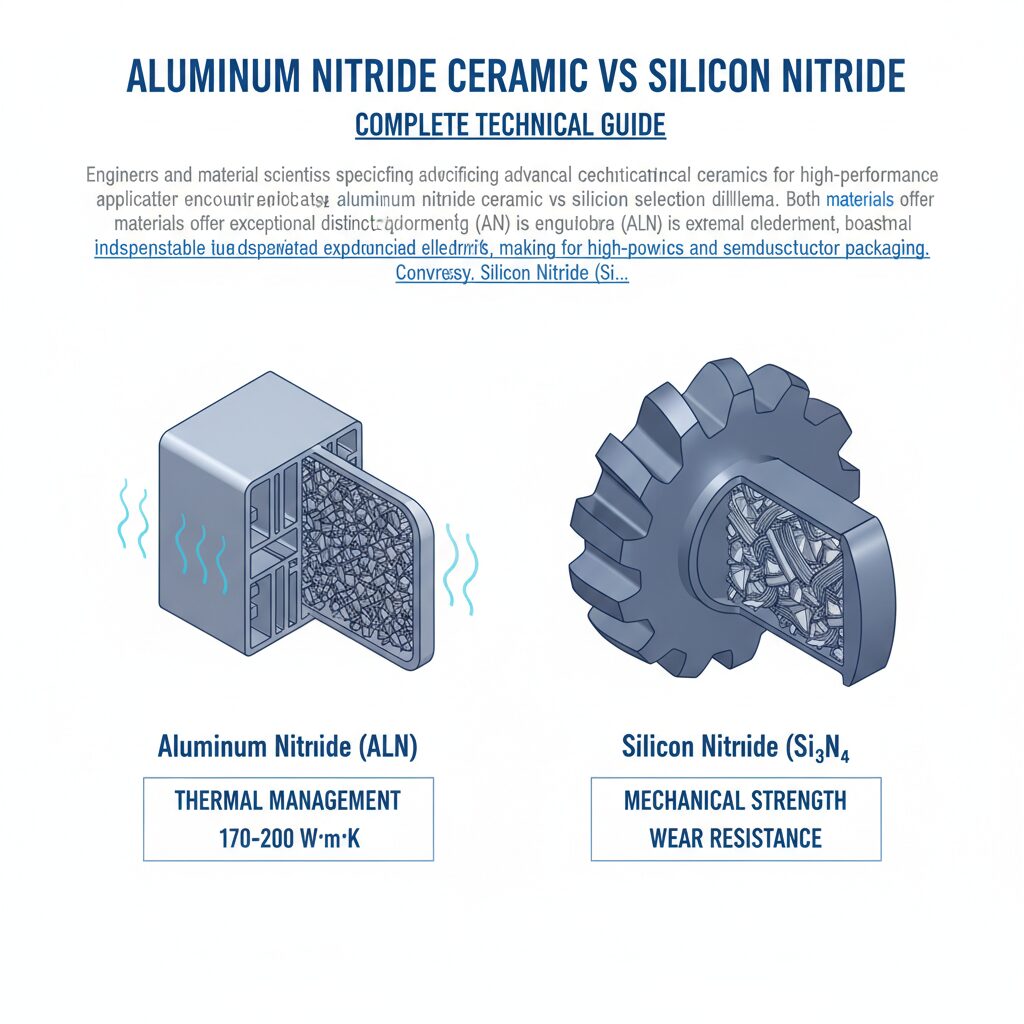
Selecting the correct advanced ceramic for vacuum applications requires balancing thermal dissipation, mechanical strength. And material cost. While AlN excels in thermal management, evaluating it against other technical ceramics clarifies its unique engineering position.
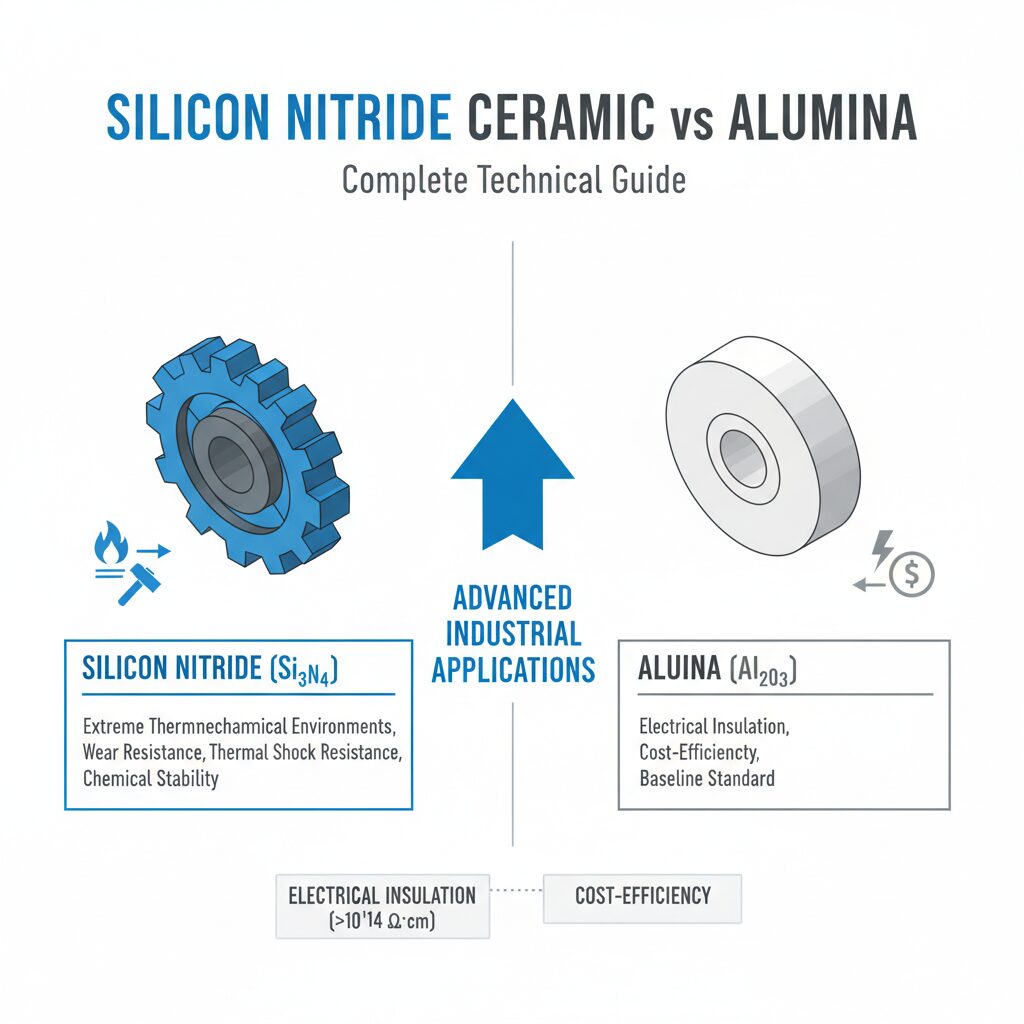
| Proprietà | Nitruro di alluminio | Allumina (99,5%) | Zirconia (Y-TZP) | Nitruro di silicio |
|---|---|---|---|---|
| Conducibilità termica | 170 - 230 W/m-K | 24 – 35 W/m·K | 2 - 3 W/m-K | 20 - 30 W/m-K |
| Durezza | 1100 HV | 1500 HV | 1200 HV | 1500 HV |
| Resistenza alla frattura | 3,0 MPa-m½ | 4,0 MPa-m½ | 8,0 MPa-m½ | 6,0 - 7,0 MPa-m½ |
| Espansione termica (CTE) | 4.5 x 10⁻⁶ /°C | 8.0 x 10⁻⁶ /°C | 10.3 x 10⁻⁶ /°C | 3.2 x 10⁻⁶ /°C |
| Costo | Alto | Basso | Medio | Alto |
Compared to allumina/”>allumina, AlN provides roughly seven times the thermal conductivity, making it strictly necessary where rapid heat dissipation in a vacuum is required to prevent device failure. While zirconio offers superior fracture toughness and impact resistance, its extremely low thermal conductivity acts as an absolute thermal insulator, rendering it unsuitable for heat sinks or high-power feedthroughs. Conversely, nitruro di silicio boasts incredible mechanical strength and thermal shock resistance due to its low CTE, but it lacks the necessary thermal transport capabilities required for rapid cooling cycles in UHV environments. Lastly, while carburo di silicio offers comparable thermal conductivity, its nature as a semiconductor makes it electrically conductive, automatically disqualifying it from applications requiring high-voltage isolation. Therefore, AlN remains the undisputed choice for thermally conductive electrical insulation.
Applicazioni
- Electrostatic Chucks (E-Chucks) in Wafer Processing: Utilized in semiconductor vacuum chambers for plasma etching and chemical vapor deposition (CVD). AlN is selected because it enables rapid, uniform thermal cycling across 300mm silicon wafers. Its plasma resistance ensures minimal particle generation, while its specific volume resistivity enables optimized Johnsen-Rahbek or Coulombic clamping forces at elevated temperatures.
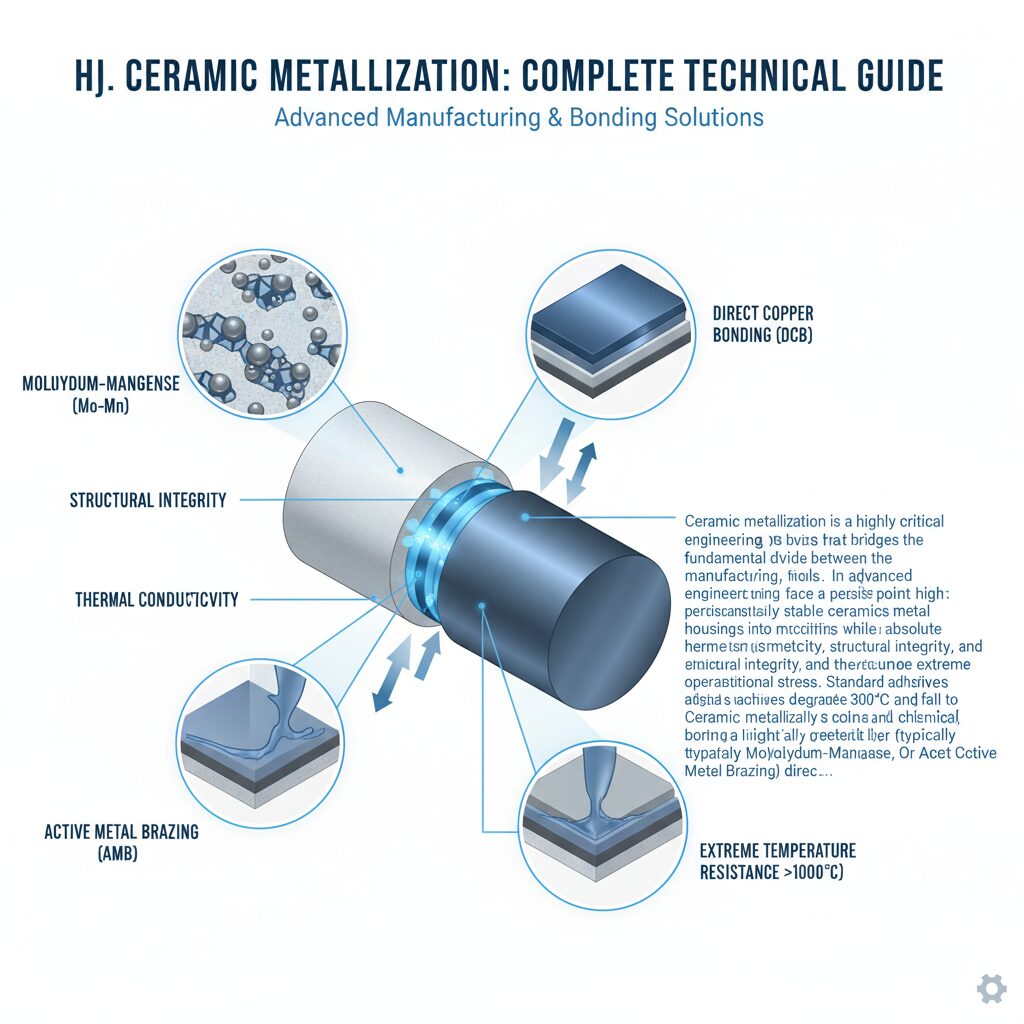
- Ultra-High Vacuum (UHV) Electrical Feedthroughs: Operating at pressures below 10⁻⁹ Torr, feedthroughs require hermetic seals between ceramics and metals. AlN is chosen because its coefficient of thermal expansion (4.5 ppm/K) closely matches that of critical transition metals like molybdenum and titanium. This allows for stress-free active metal brazing (AMB), preventing micro-cracking and catastrophic vacuum leaks during bake-out cycles exceeding 400°C.
- High-Power Microwave and RF Windows: Used in vacuum tubes, klystrons. And traveling-wave tubes (TWTs). Aluminum nitride is selected due to its exceptionally low dielectric loss tangent (<0.0003 at 1MHz) and low dielectric constant (~8.9). This ensures that high-frequency electromagnetic waves pass through the window with minimal absorption, preventing severe thermal gradients that would otherwise shatter the window in a vacuum.
- Optoelectronic Heat Sinks for Spacecraft: Laser diodes and high-power LEDs operating in the vacuum of space face absolute thermal isolation. AlN is selected as the sub-mount material because its high thermal conductivity effectively pulls heat away from the active junction. Furthermore, its CTE perfectly matches silicon (2.6 ppm/K) and gallium arsenide (5.8 ppm/K), preventing delamination of the semiconductor die during extreme orbital temperature fluctuations.
- Electron Beam and Ion Implantation Insulators: Deployed in high-energy physics and material doping equipment. AlN is specified because it provides a massive dielectric strength (up to 17 kV/mm), preventing high-voltage arcing in hard vacuums, while simultaneously dissipating the secondary heat generated by scattered ion bombardment.
Processo di produzione
Producing defect-free aluminum nitride ceramic for vacuum industry applications requires stringent control over oxygen contamination. Even microscopic levels of oxygen substituting for nitrogen in the AlN crystal lattice will scatter phonons, drastically reducing thermal conductivity. Therefore, the entire manufacturing process—from raw powder synthesis to final densification—must be meticulously engineered.
Metodi di formatura
- Pressatura isostatica a freddo (CIP): For large, complex bulk components like high-voltage insulators, raw AlN powder is mixed with yttria (Y₂O₃) sintering aids and organic binders. The mixture is enclosed in a flexible mold and subjected to uniform hydrostatic pressures exceeding 200 MPa. This ensures a highly homogenous green body density. This is critical to preventing warping during the extreme shrinkage of the sintering phase.
- Colata di nastro: For thin-film substrates and feedthrough washers, an AlN slurry is continuously cast onto a moving carrier belt using a precision doctor blade. This method yields extremely uniform “green” sheets ranging from 0.1 mm to 1.5 mm in thickness. This are subsequently laser-cut or stamped prior to firing.
Sinterizzazione
The sintering of AlN is arguably the most critical and metallurgically complex step. The green bodies undergo a slow thermal debinding process at 400-600°C to volatilize all organic binders. This must be strictly controlled to prevent residual carbon. This causes outgassing in vacuum operations. Following debinding, the components are sintered in high-temperature furnaces ranging from 1800°C to 1900°C under a high-purity nitrogen atmosphere to prevent oxidation. Because pure AlN is highly covalent and resists densification, yttria (Y₂O₃) is added as a sintering aid. At 1800°C, the yttria reacts with the inherent alumina (Al₂O₃) impurities on the surface of the AlN particles to form a liquid aluminate phase (such as YAG, Y₃Al₅O₁₂). This liquid phase not only promotes full densification through capillary action but crucially “sweeps” oxygen out of the AlN lattice, precipitating it at the grain boundaries and preserving the high thermal conductivity of the primary AlN grains.
Lavorazione finale
Because sintered AlN exhibits a hardness exceeding 1100 HV, traditional cutting tools are entirely ineffective. Final dimensional accuracy is achieved exclusively through diamond abrasive machining. This includes surface grinding, CNC diamond milling, core drilling. And double-sided planetary lapping. For UHV components, the surface must often be lapped to an Ra < 0.1 µm finish to minimize the actual surface area available for outgassing and to ensure hermetic metal-to-ceramic seals.
Vantaggi e limiti
Vantaggi
- Exceptional Heat Transfer: With thermal conductivity ranges from 170 to 230 W/m·K, AlN rapidly equalizes thermal gradients, preventing hot spots in high-power vacuum electronics without the toxicity associated with beryllium oxide (BeO).
- Matched Thermal Expansion: Its CTE of 4.5 x 10⁻⁶ /°C allows for robust, stress-free bonding directly to semiconductor materials (Si, GaAs) and critical refractory metals (Mo, W), reducing mechanical fatigue in cyclic thermal vacuum environments.
- Ultra-Low Outgassing: High-density sintered AlN possesses zero open porosity, meaning it will not trap atmospheric gases or moisture, safely achieving < 10⁻¹⁰ Torr·L/s·cm² outgassing rates during UHV bake-outs.
- Plasma Erosion Resistance: In semiconductor vacuum chambers utilizing fluorinated plasmas (CF₄, SF₆), AlN significantly outlasts standard alumina, reducing particulate generation and extending maintenance intervals for critical chucks and chamber rings.
Limitazioni
- Susceptibility to Hydrolysis: Raw AlN powder. And to a lesser extent, unfinished sintered surfaces, are vulnerable to hydrolysis when exposed to high-humidity environments. The reaction with water forms aluminum hydroxide [Al(OH)₃] and ammonia gas (NH₃). Consequently, AlN parts must be stored in desiccated environments or vacuum-sealed bags prior to final chamber installation.
- High Machining and Material Costs: Due to the necessity of inert-atmosphere sintering at 1900°C, rare-earth sintering aids. And intensive diamond grinding protocols, AlN components carry a higher initial procurement cost compared to standard 99.5% Alumina.
Considerazioni sulla lavorazione
Translating theoretical material properties into functional UHV components requires mastery over lavorazione di precisione della ceramica. Aluminum nitride presents unique tribological challenges due to its extreme brittleness (fracture toughness of ~3.0 MPa·m½) paired with high hardness. When a diamond grinding wheel engages an AlN surface, material removal occurs primarily through micro-fracturing rather than plastic deformation. If the localized cutting forces exceed the critical threshold, unpredictable sub-surface damage, edge chipping. And micro-cracking will propagate through the component.
In vacuum applications, a single micro-crack acts as a virtual leak—a trapped pocket of atmospheric gas that slowly bleeds into the UHV chamber, making it impossible for the system to reach base pressure. To prevent this, engineers must strictly control the Depth of Cut (DOC), feed rates. And spindle RPMs. Multi-stage grinding is mandatory: beginning with coarse diamond grits (e.g., D151) for bulk removal, stepping down incrementally to ultra-fine grits (D15 or D9). And concluding with sub-micron diamond lapping compounds.
Coolant application is equally critical. High-pressure, heavily filtered (to < 1 µm) synthetic coolants must flood the cutting zone to remove AlN swarf. If swarf loads the diamond wheel, friction spikes exponentially, inducing severe thermal shock that can shatter the workpiece mid-cycle.
Great Ceramic Precision Machining Capabilities
| Parametro di lavorazione | Tolerance / Capability | UHV Significance |
|---|---|---|
| Dimensional Tolerance | ± 0,005 mm | Ensures precise fitment in critical UHV metal flange assemblies. |
| Surface Flatness | ≤ 0.002 mm | Mandatory for uniform thermal transfer in electrostatic chucks. |
| Rugosità superficiale (Ra) | 0.05 – 0.1 µm | Minimizes effective surface area for trapped outgassing particles. |
| Concentricity / Runout | 0.01 mm | Critical for balanced rotation in vacuum pump shafts and rotors. |
| Thread Machining | Internal/External (M2+) | Enables direct mechanical fastening without outgassing adhesives. |
At Great Ceramic, we employ 5-axis CNC ultrasonic machining centers that superimpose high-frequency (20+ kHz) axial vibrations onto the rotating diamond tool. This advanced kinematic interaction drastically reduces cutting forces, virtually eliminates edge chipping. And allows us to consistently hold tight tolerances of ±0.005mm on complex geometries. Our proprietary processes ensure zero sub-surface damage, guaranteeing hermetic integrity for your most demanding vacuum applications.
Need advanced machining solutions? Submit your CAD files to Great Ceramic for a comprehensive engineering review.
FAQ
What is aluminum nitride ceramic for vacuum industry?
Aluminum nitride (AlN) is an advanced technical ceramic engineered specifically for environments requiring both massive heat dissipation and high-voltage electrical insulation. In the vacuum industry, where convective cooling via air is absent, components rely solely on thermal conduction. AlN provides an extraordinary thermal conductivity (up to 230 W/m·K)—comparable to metallic aluminum—while maintaining a dielectric strength of over 15 kV/mm. It is dense, non-porous. And features ultra-low outgassing characteristics, making it indispensable for Ultra-High Vacuum (UHV) systems, semiconductor fabrication equipment. And space-flight optoelectronics.
What are the main applications of aluminum nitride ceramic for vacuum industry?
The primary applications revolve around thermal management and electrical isolation in enclosed, low-pressure environments. Critical use cases include electrostatic chucks (E-Chucks) used in semiconductor plasma chambers to hold and cool silicon wafers uniformly. It is also extensively used in UHV electrical feedthroughs via active metal brazing, allowing power to pass through vacuum chamber walls without compromising hermetic seals. Other applications include high-power microwave windows for klystrons, heat sinks for satellite laser diodes. And high-voltage insulators for ion implantation and electron beam welding systems.
How does aluminum nitride compare to other ceramics?
Aluminum nitride’s defining feature is its superior thermal conductivity. This is 7 to 10 times higher than that of standard 99.5% allumina. While zirconio offers much higher fracture toughness (up to 8.0 MPa·m½), its extremely poor thermal conductivity (2-3 W/m·K) disqualifies it from heat sink applications. Nitruro di silicio is mechanically stronger and possesses superior thermal shock resistance, but its thermal conductivity peaks around 30 W/m·K. Carburo di silicio matches AlN thermally, but is electrically conductive, meaning it cannot be used for high-voltage isolation. Furthermore, AlN represents a non-toxic, safe alternative to beryllium oxide (BeO). This poses severe health hazards during machining.
What are the advantages of aluminum nitride ceramic for vacuum industry?
The core advantages include rapid, uniform heat extraction in the absence of air convection, preventing catastrophic overheating of internal chamber components. Furthermore, fully dense sintered AlN exhibits near-zero open porosity, ensuring ultra-low outgassing rates (< 10⁻¹⁰ Torr·L/s·cm²) critical for maintaining vacuums beyond 10⁻⁹ Torr. It features a coefficient of thermal expansion (4.5 ppm/K) that closely mimics silicon and crucial refractory metals like molybdenum, ensuring that bonded assemblies do not sheer or fracture during extreme thermal cycling up to 400°C. Finally, it demonstrates high resistance to halogen-based plasmas used in modern etching processes.
How is aluminum nitride machined?
Because sintered aluminum nitride has a Vickers hardness of over 1100 HV and is inherently brittle, it cannot be machined using conventional high-speed steel or carbide tooling. It is processed exclusively through precision diamond grinding, CNC diamond milling. And lapping. For vacuum applications, extreme care must be taken to control spindle speeds, feed rates. And coolant flow to prevent micro-cracking and edge chipping. This can act as virtual leaks in a UHV chamber. Great Ceramic specializes in lavorazione di precisione della ceramica, utilizing state-of-the-art ultrasonic CNC technology to deliver complex AlN components with flawless surface finishes (Ra 0.1 µm) and strict dimensional tolerances down to ±0.005mm, ensuring absolute reliability in your vacuum systems.
Need custom aluminum nitride ceramic for vacuum industry parts? Contatto Great Ceramic per servizi di lavorazione di precisione con tolleranze ristrette, oppure inviate un'e-mail a [email protected].
aluminum nitride ceramic for vacuum industry is widely used in advanced ceramic applications.
Per saperne di più Aluminum Nitride Ceramic For Vacuum Industry e i nostri servizi di lavorazione della ceramica di precisione.