








Boron Nitride Ceramic vs Steel: Complete Technical Guide
When engineering components for extreme industrial environments, the debate of bor nitrür ceramic vs steel is a critical material selection crossroad. Engineers and procurement managers frequently encounter operational thresholds where traditional metal alloys, including 316L stainless steel and H13 tool steels, suffer from catastrophic failure due to thermal degradation, galling, electrical conductivity, or chemical attack. At temperatures exceeding 600°C, steel begins to lose its yield strength, whereas advanced technical ceramics maintain their structural integrity and exhibit unique thermophysical properties.
This technical guide provides a rigorous, data-driven comparison of boron nitride (specifically hexagonal boron nitride, or h-BN) against conventional steels and other advanced ceramics. We will explore mechanical properties, thermal dynamics, manufacturing constraints. And critical application parameters. If your application demands uncompromised precision, Great Ceramic specializes in hassas serami̇k i̇şleme, delivering complex architectures with strict ±0.005mm tolerances designed to outlast and outperform traditional metal alternatives.
Malzeme Özellikleri
To fundamentally understand the boron nitride ceramic vs steel paradigm, we must analyze their baseline thermophysical and mechanical properties. Hexagonal boron nitride—often referred to as “white graphite”—features a unique crystalline structure that imparts exceptional thermal shock resistance, high thermal conductivity. And profound electrical insulation. Below is the standard property matrix for high-purity, hot-pressed hexagonal boron nitride.
| Mülkiyet | Değer | Birim |
|---|---|---|
| Yoğunluk | 2.10 – 2.25 | g/cm³ |
| Sertlik | 20 – 40 | HV |
| Eğilme Dayanımı | 30 – 85 | MPa |
| Kırılma Tokluğu | 1.0 – 1.5 | MPa-m½ |
| Termal İletkenlik | 30 – 60 | W/m-K |
| Elektriksel Dirençlilik | > 10^14 | Ω-cm |
| Maksimum Çalışma Sıcaklığı | 1900 (Inert/Vacuum) | °C |
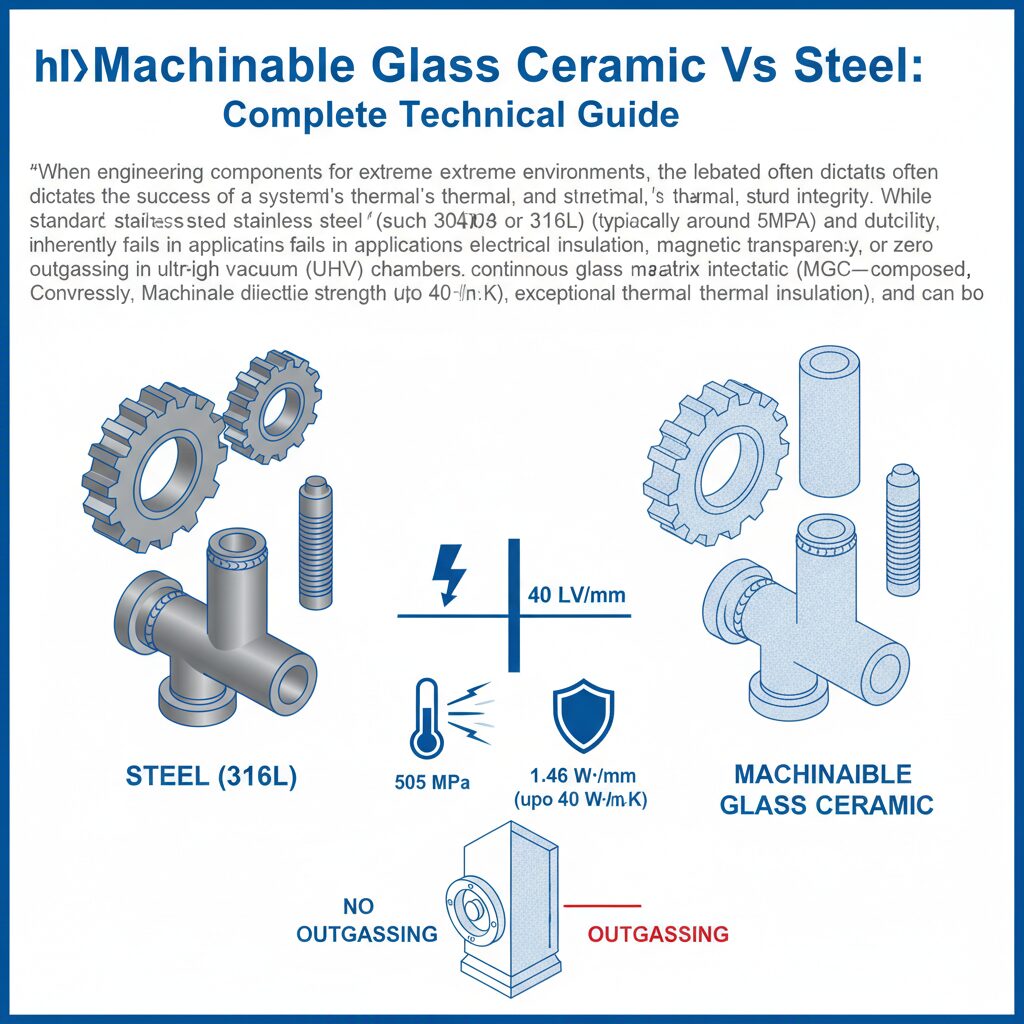
When executing a direct engineering evaluation of boron nitride ceramic vs steel, the physical differences are stark. Standard industrial steels, such as 304/316 stainless or high-carbon tool steels, possess a density averaging 7.85 g/cm³. Utilizing bor nitrür provides a mass reduction of over 73%, an essential factor for aerospace and rapidly actuating robotic assemblies where minimizing the moment of inertia is paramount.
Thermally, steel begins to experience severe oxidation and creep at temperatures between 500°C and 800°C, eventually melting at approximately 1370°C to 1500°C depending on the specific alloy composition. In contrast, hexagonal boron nitride remains structurally stable up to 900°C in oxidizing atmospheres. And an astonishing 1900°C in vacuum or inert gas environments (such as argon or nitrogen). Furthermore, while steel is intrinsically conductive (electrical resistivity around 7.2 × 10^-5 Ω·cm), boron nitride acts as a superior dielectric insulator (> 10^14 Ω·cm), making it indispensable for high-voltage thermal management systems where steel would cause immediate short circuits.
Boron Nitride vs Typical Industrial Steels
To further contextualize the engineering choices, consider the following data comparing h-BN with two common industrial metals: 316L Stainless Steel and H13 Tool Steel.
| Mülkiyet | Bor Nitrür (h-BN) | 316L Stainless Steel | H13 Tool Steel |
|---|---|---|---|
| Yoğunluk (g/cm³) | 2.15 | 7.99 | 7.80 |
| Thermal Expansion (µm/m·K) | 1.0 – 4.0 | 16.0 | 11.0 |
| Melting/Failure Point (°C) | 1900 (Sublimes in vacuum) | 1370-1400 (Melts) | 1427 (Melts) |
| Electrical Conductivity | Insulator (Dielectric) | Conductor | Conductor |
This empirical data highlights why transitioning from metal to ceramic is necessary for advanced high-temperature applications. Steel’s high coefficient of thermal expansion (CTE) leads to severe warpage and binding in high-temperature assemblies, whereas boron nitride’s near-zero CTE ensures absolute dimensional stability. If you require expert guidance on material replacement, contact Great Ceramic for a comprehensive material consultation.
Diğer Seramiklerle Karşılaştırma
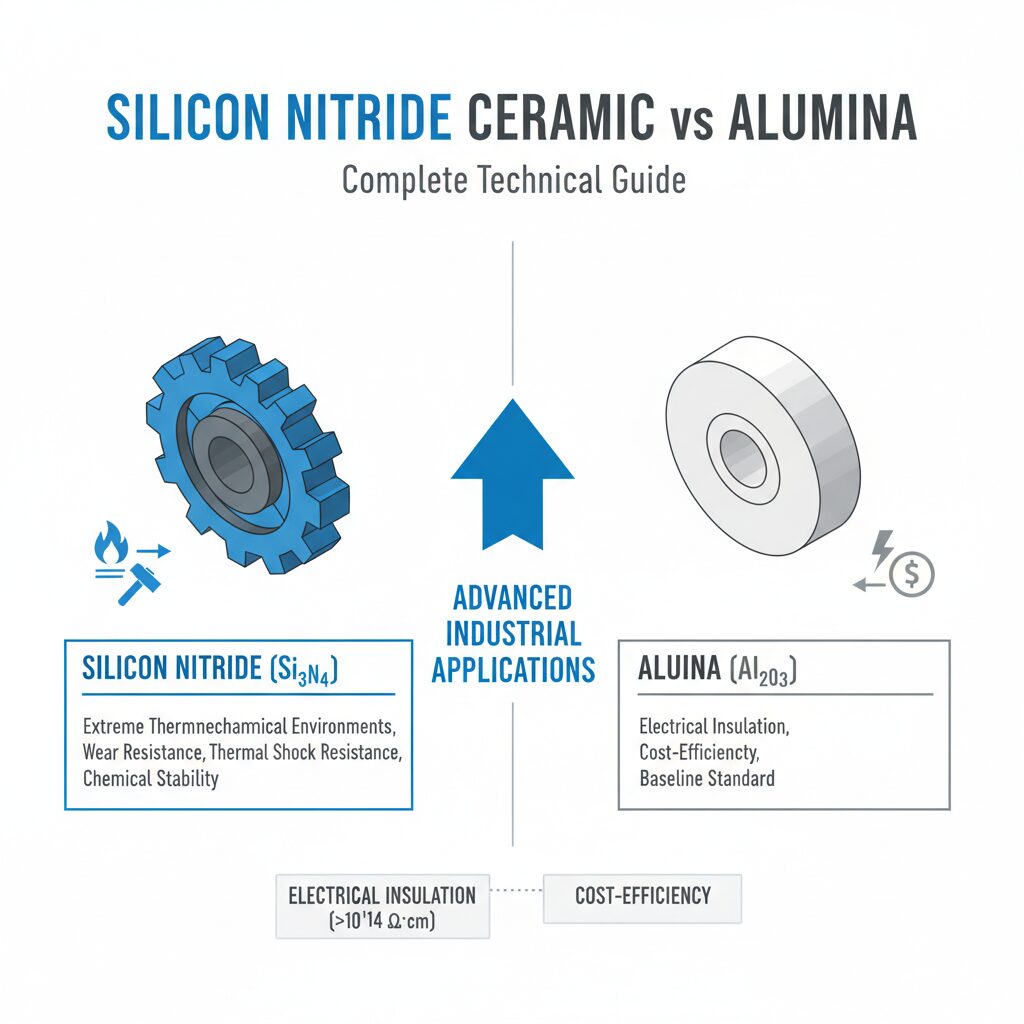
While the boron nitride ceramic vs steel comparison dictates the shift from metal to technical ceramics, engineers must also evaluate boron nitride against other structural ceramics to ensure optimal performance. Unlike harder, structural materials, h-BN prioritizes machinability, lubricity. And thermal shock resistance over raw mechanical yield strength.
| Mülkiyet | Bor Nitrür | Alümina | Zirkonya | Silisyum Nitrür |
|---|---|---|---|---|
| Termal İletkenlik | 30-60 W/m·K | 25-35 W/m·K | 2-3 W/m·K | 20-30 W/m-K |
| Sertlik | 20-40 HV | 1500-1650 HV | 1200-1300 HV | 1500-1600 HV |
| Kırılma Tokluğu | 1.0-1.5 MPa·m½ | 3,5-4,5 MPa-m½ | 8.0-10.0 MPa-m½ | 6,0–7,0 MPa·m½ |
| Maliyet | Yüksek | Düşük | Orta | Yüksek |
When reviewing the data above, alümina/”>alümina provides a highly cost-effective, high-hardness solution for wear applications, but lacks the exceptional machinability and extreme thermal shock resistance of boron nitride. If extreme mechanical impact or cyclic fatigue is a concern, Zirkonya offers the highest fracture toughness (up to 10.0 MPa·m½), making it a viable alternative for heavy load-bearing structural components where h-BN would fail mechanically.
However, for dynamic high-temperature environments subjected to rapid thermal cycling, silisyum nitrür and boron nitride remain the premier choices. Silicon nitride offers an excellent balance of high mechanical strength and thermal resistance, but hexagonal boron nitride remains completely unmatched when combining electrical insulation, thermal conductivity. And solid-state lubrication without outgassing in vacuum furnaces.
Uygulamalar
The decision to leverage boron nitride ceramic vs steel is entirely driven by application environment constraints. Standard steel alloys are fundamentally limited by their metallurgical properties in the following extreme scenarios, where boron nitride excels.
- Molten Metal Handling Components (Crucibles and Nozzles): In metallurgy, molten aluminum, magnesium. And zinc aggressively attack, dissolve. And wet to steel components, causing rapid degradation and contamination of the melt. Hexagonal boron nitride is completely non-wetting to these non-ferrous metals. Crucibles, break rings. And atomization nozzles machined from h-BN withstand temperatures over 1000°C without reacting, ensuring ultra-pure metal casting that steel simply cannot achieve.
- High-Temperature Vacuum Furnace Insulators: Steel structural supports and fixtures in vacuum furnaces operating at 1500°C will suffer from extreme creep, outgassing. And electrical arcing. Boron nitride remains structurally inert up to 1900°C in a vacuum. It acts as a flawless electrical insulator while providing necessary thermal conductivity to ensure even heat distribution, preventing the catastrophic short circuits that conductive steel fixtures would cause.
- PVD and CVD Masking Fixtures: Physical and Chemical Vapor Deposition processes require fixtures that can endure plasma environments and high thermal loads. Steel fixtures warp due to high thermal expansion (16.0 µm/m·K) and allow deposited materials to permanently bond to them. Boron nitride has an ultra-low CTE (1.0 – 4.0 µm/m·K) and its graphite-like surface prevents permanent adhesion of sputtered materials, allowing for easy cleaning and high-precision masking without dimensional shift.
- Thermal Management in High-Power Electronics: Modern semiconductors and high-power diodes generate immense localized heat. Using a steel heatsink introduces unacceptable electrical conductivity and parasitic capacitance. Boron nitride components serve as ideal dielectric heat sinks, rapidly dissipating heat (30-60 W/m·K) away from sensitive microelectronics while maintaining an absolute electrical barrier (> 10^14 Ω·cm) to prevent cross-talk and shorting.
- Solid-State Lubrication Components in Aerospace: In deep space or extreme cryogenic/high-heat environments, liquid lubricants fail. And metal-on-metal steel components experience cold welding or severe galling. Boron nitride features a layered hexagonal crystalline lattice that shears easily at the microscopic level, providing a dry friction coefficient of 0.15 to 0.70. It operates as an intrinsic solid lubricant, replacing steel bearings and thrust washers in environments where traditional lubrication is impossible.
Üretim Süreci
Unlike traditional steel metallurgy—which involves smelting, continuous casting, forging. And conventional metal-cutting—the manufacturing of technical boron nitride ceramics requires specialized powder metallurgy and high-temperature densification. The transformation from raw synthesized powder to a functional, ±0.005mm tolerance component is a highly controlled engineering process.
Şekillendirme Yöntemleri
- Hot Pressing (HP): The most critical forming method for structural hexagonal boron nitride. High-purity h-BN powder is placed into graphite dies and subjected to simultaneous high temperature (up to 2000°C) and uniaxial hydraulic pressure (15 to 30 MPa). This method compacts the powder, aligning the hexagonal basal planes to produce a highly dense, anisotropic ceramic billet.
- Soğuk İzostatik Presleme (CIP): For complex pre-forms or different grades of BN, powder is sealed in an elastomeric mold and subjected to uniform hydrostatic pressure from all directions (up to 300 MPa) at room temperature. This creates a “green” compact with uniform density. This is later sintered.
Sinterleme
While metals rely on phase transformations during cooling, ceramics must be sintered to bond the particles at the atomic level. Hexagonal boron nitride is generally sintered in inert atmospheres (argon or nitrogen) at temperatures ranging from 1800°C to 2000°C. Depending on the required grade, binding agents like boric oxide (B2O3) or calcium borate may be utilized to aid liquid-phase sintering, enhancing the final material’s density and mechanical integrity. Strict atmospheric control is mandatory to prevent oxidation and ensure the final product maintains its exceptional dielectric and thermal properties.
Son İşleme
The final machining phase is where the boron nitride ceramic vs steel comparison becomes highly distinct. Steel is machined using high-torque milling with flood coolant to evacuate metal chips and manage heat. Conversely, hexagonal boron nitride is highly machinable (often compared to machining dense brass, Teflon, or graphite) but must be machined completely dry. Because certain grades of h-BN are hygroscopic, exposing the billet to liquid coolant causes moisture absorption. This can lead to catastrophic spalling or explosive outgassing when the component is later exposed to rapid high temperatures. High-speed, high-precision CNC routing with specialized dust extraction systems is utilized to achieve the final geometry.
Avantajlar ve Sınırlamalar
Every engineering material represents a compromise. Understanding the specific advantages and limitations of boron nitride is essential for successful system integration, especially when replacing legacy steel assemblies.
Avantajlar
- Unmatched Thermal Shock Resistance: Due to its low thermal expansion coefficient and high thermal conductivity, h-BN can survive instantaneous temperature differentials (ΔT) exceeding 1000°C. A steel component subjected to the same rapid quench would suffer severe metallurgical warping, micro-cracking, or catastrophic failure.
- Simultaneous Thermal Conductivity and Electrical Insulation: This dual-property nature is highly rare. It actively dissipates heat away from critical zones while acting as an absolute electrical barrier, outperforming both conductive steels and insulating-but-thermally-restrictive plastics.
- Chemical Inertness to Non-Ferrous Melts: Boron nitride exhibits absolute non-wetting behavior against molten aluminum, magnesium, copper. And zinc. It does not react, dissolve, or contaminate the melt, providing significantly longer operational lifespans than steel crucibles or ladles.
- Superior Machinability: Unlike harder advanced ceramics (such as alumina or silisyum karbür) that require expensive and time-consuming diamond grinding, hexagonal boron nitride can be cut, milled. And turned using standard high-speed steel (HSS) or carbide tooling, allowing for rapid prototyping and highly complex internal geometries.
Sınırlamalar
- Low Mechanical Strength: With a flexural strength of 30 to 85 MPa and fracture toughness around 1.0 MPa·m½, h-BN is mechanically fragile compared to steel alloys that boast tensile strengths of 400 to 2000 MPa. It cannot be used for primary structural load-bearing components or high-impact environments.
- Moisture Sensitivity: Certain binder-heavy grades of boron nitride are susceptible to moisture absorption from ambient humidity. If a moisture-laden h-BN part is rapidly heated, the trapped water converts to steam, causing internal pressure that shatters the ceramic. Strict dry storage and pre-baking protocols are required.
İşleme ile İlgili Hususlar
Achieving tight-tolerance geometry in boron nitride requires an entirely different approach than machining steel. When analyzing boron nitride ceramic vs steel in the CNC environment, engineers must account for the ceramic’s brittleness and lack of plasticity. While steel forms continuous chips during the shearing process of milling or turning, h-BN material removal occurs via micro-fracture. This fundamentally changes tool engagement dynamics.
The primary challenge in precision machining boron nitride is preventing edge breakout or chipping during tool exit. To mitigate this, CNC programmers must utilize climb milling strategies, ultra-sharp solid carbide or diamond-coated micro-endmills. And specialized backing plates or sacrificial fixtures to support the material edges. Spindle speeds must be exceptionally high (frequently exceeding 20,000 RPM) paired with relatively low feed rates (e.g., 50 to 100 mm/min) to minimize tool pressure against the workpiece.
Furthermore, because the material must be machined entirely dry to prevent hygroscopic degradation, thermal build-up at the cutting edge and abrasive dust management become critical. High-velocity vacuum extraction systems are mandatory to remove abrasive ceramic particulate that would otherwise destroy machine guideways. Great Ceramic employs state-of-the-art multi-axis CNC centers and specialized tooling geometry to consistently achieve extreme tight tolerances of ±0.005mm on complex h-BN components. If your project demands this level of micro-precision without the risk of edge chipping or dimensional deviation, Great Ceramic is your definitive manufacturing partner.
FAQ
What is boron nitride ceramic vs steel?
The comparison of boron nitride ceramic vs steel centers on replacing traditional metal alloys with an advanced technical ceramic in environments where metals fail. While steel offers high mechanical strength and ductility, it suffers from high thermal expansion, electrical conductivity, oxidation. And a relatively low melting point. Boron nitride (specifically hexagonal BN) offers extreme thermal shock resistance, survives up to 1900°C in vacuum, acts as a profound electrical insulator. And is non-wetting to molten metals. It is the superior choice for high-temperature, high-voltage. And harsh chemical environments where structural steel would warp, melt, or cause electrical shorts.
What are the main applications of boron nitride?
Boron nitride is predominantly used in extreme industrial applications where traditional materials fail. Main applications include crucibles, nozzles. And break rings for continuous casting of molten non-ferrous metals (due to its non-wetting properties). high-temperature insulators and structural supports in vacuum furnaces (up to 1900°C). thermal management heat sinks in high-power microelectronics (due to its high thermal conductivity and dielectric nature). and solid-state lubrication components in high-vacuum aerospace assemblies where liquid lubricants vaporize.
How does boron nitride compare to other ceramics?
Compared to other advanced ceramics, hexagonal boron nitride is exceptionally soft and highly machinable, similar to graphite. While materials like alumina and zirconia offer vastly superior hardness (up to 1600 HV) and fracture toughness (up to 10.0 MPa·m½), making them ideal for heavy wear and structural load-bearing applications, they are difficult and expensive to machine. Boron nitride excels where uncompromised thermal shock resistance, absolute electrical insulation paired with thermal conductivity. And complex geometries are required, trading raw mechanical strength for extreme thermal and electrical stability.
What are the advantages of boron nitride?
The primary advantages of boron nitride include its unmatched thermal shock resistance, allowing it to withstand instantaneous temperature changes over 1000°C without cracking. It provides a rare combination of high thermal conductivity (30-60 W/m·K) and excellent electrical insulation (> 10^14 Ω·cm). Additionally, it acts as a dry solid lubricant, possesses a very low coefficient of thermal expansion for high-temperature dimensional stability. And is highly machinable, allowing for the rapid fabrication of complex geometries using standard cutting tools.
How is boron nitride machined?
Unlike steel. This utilizes flood coolant and rigid tapping, boron nitride is machined completely dry to prevent moisture absorption. Because it is a friable ceramic rather than a ductile metal, it is prone to edge chipping. Machining requires high-speed CNC routing (>20,000 RPM spindle speeds), low feed rates. And ultra-sharp solid carbide or diamond tooling. Great Ceramic utilizes specialized dry-machining protocols, bespoke fixturing to prevent edge breakout. And strict environmental controls to deliver custom boron nitride components with extreme precision, maintaining strict tolerances down to ±0.005mm.
Need custom boron nitride ceramic vs steel replacement parts? Great Ceramic ile iletişime geçin for precision ceramic machining services with tight tolerances, or email [email protected].
boron nitride ceramic vs steel is widely used in advanced ceramic applications.
Hakkında daha fazla bilgi edinin Boron Nitride Ceramic Vs Steel ve hassas seramik işleme hizmetlerimiz.