








Alumina Ceramic Seal Ring for Chemical: Complete Technical Guide
In the highly demanding chemical processing industry, the reliability of mechanical seals is directly tied to plant safety and operational efficiency. Pump failures due to seal degradation can cost facilities upwards of $10,000 per hour in unexpected downtime, while fugitive emissions pose severe environmental and safety hazards. The alümina ceramic seal ring for chemical applications provides an engineered barrier against aggressive media, abrasive slurries. And extreme thermal environments. Unlike traditional metallic seals or standard elastomers that degrade when exposed to harsh acids or volatile organic compounds (VOCs), high-purity alumina (Al2O3) offers near-universal chemical inertness across a pH range of 0 to 14, excluding only hydrofluoric acid. Operating at pressures frequently exceeding 2.5 MPa and shaft speeds of 3600 RPM, these seal faces demand exceptional tribological performance and structural integrity. At Great Ceramic, we engineer these critical components with tight-tolerance hassas serami̇k i̇şleme, achieving dimensional accuracies of ±0.005mm and optical flatness critical for zero-leakage performance. If your facility requires custom mechanical seal solutions, contact our engineering team for immediate technical consultation.
Malzeme Özellikleri
The operational lifespan of a mechanical seal is dictated by its fundamental material properties. For an alumina ceramic seal ring for chemical service, high-purity grades (typically 99.5% to 99.8% Al2O3) are utilized to eliminate grain boundary impurities, particularly silica phases. This can be preferentially attacked by corrosive fluids. The theoretical density of 99.8% alumina approaches 3.98 g/cm³, but practical sintered densities range from 3.85 to 3.92 g/cm³, resulting in an apparent porosity of less than 0.1%. This virtually zero-porosity structure is critical. interconnected porosity greater than 0.5% would lead to fluid weepage and internal corrosion under high hydrostatic pressures (e.g., 3.0 MPa). Furthermore, the extreme hardness of 1500 HV provides exceptional resistance against three-body abrasion caused by suspended solids, such as catalyst fines or crystallized salts frequently found in chemical slurries. The specific parameters that govern the tribological and mechanical performance of these rings are detailed below.
| Mülkiyet | Değer | Birim |
|---|---|---|
| Yoğunluk | 3.90 – 3.95 | g/cm³ |
| Sertlik | 1500 - 1650 | HV |
| Eğilme Dayanımı | 350 – 400 | MPa |
| Kırılma Tokluğu | 4.0 - 5.0 | MPa-m½ |
| Termal İletkenlik | 25.0 – 35.0 | W/m-K |
| Elektriksel Dirençlilik | > 10^14 | Ω-cm |
| Maksimum Çalışma Sıcaklığı | 1600 | °C |
Thermal management is a critical factor in dynamic sealing. As the stationary and rotating faces interact under boundary or mixed lubrication regimes, frictional heat is generated at the interface. High-purity alümina provides a thermal conductivity of approximately 30 W/m·K at 20°C. This, while lower than silicon carbide, is sufficient to dissipate heat into the surrounding flush fluid, preventing thermal distortion of the seal face. The coefficient of thermal expansion (CTE) is roughly 8.1 x 10^-6 /°C (from 20°C to 1000°C), meaning dimensional changes are predictable and can be engineered into the gland design. Additionally, the flexural strength of 380 MPa ensures that the seal ring can withstand the compressive loads of the pusher springs and hydraulic pressure without catastrophic brittle failure.
Diğer Seramiklerle Karşılaştırma
Selecting the correct ceramic for a mechanical seal face requires analyzing the Pressure-Velocity (PV) limits, the chemical nature of the process fluid. And the thermal shock parameters. While an alumina ceramic seal ring for chemical applications is highly cost-effective and chemically inert, engineers must frequently benchmark it against other advanced technical ceramics to ensure optimal material selection for specific operational parameters.
| Mülkiyet | Alumina Ceramic Seal Ring for Chemical (99.8%) | Alümina (95%) | Zirkonya (Y-TZP) | Silisyum Nitrür (Si3N4) |
|---|---|---|---|---|
| Termal İletkenlik (W/m-K) | 30.0 | 20.0 | 2.5 | 25.0 – 30.0 |
| Sertlik (HV) | 1500 | 1350 | 1200 | 1600 |
| Kırılma Tokluğu (MPa-m½) | 4.5 | 3.5 | 8.0 - 10.0 | 6.0 – 7.0 |
| Maliyet | Low-Medium | Düşük | Medium-High | Yüksek |
When comparing materials, standard 95% alumina is often insufficient for highly corrosive chemical seals due to the 5% glass-phase binders (comprising SiO2, CaO. And MgO). This dissolve rapidly in strong alkalis (pH > 11) or aggressive acids like hot sulfuric acid (H2SO4 at 98% concentration, 120°C). By upgrading to a 99.8% alumina ceramic seal ring for chemical applications, the dissolution rate drops by a factor of 10x, extending the Mean Time Between Failures (MTBF) from 2,000 hours to over 15,000 hours in identical environments.
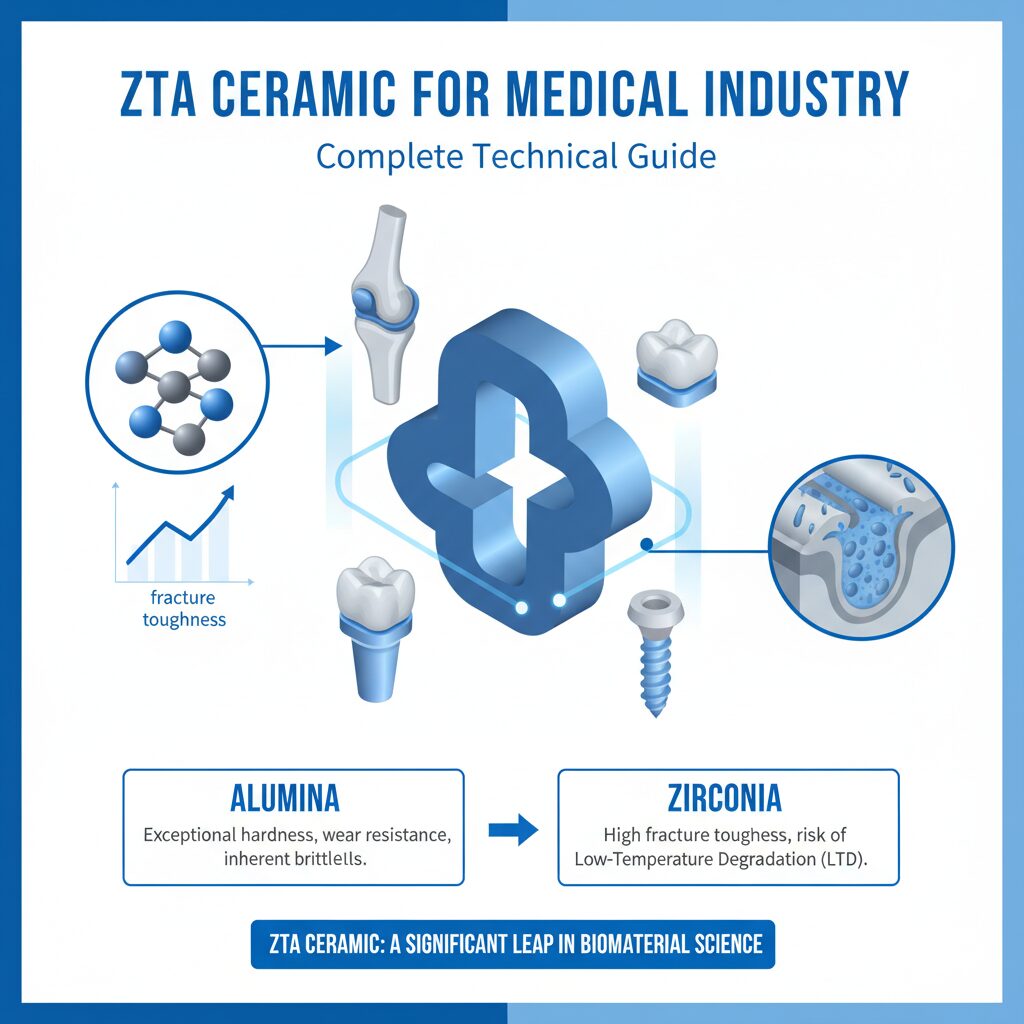
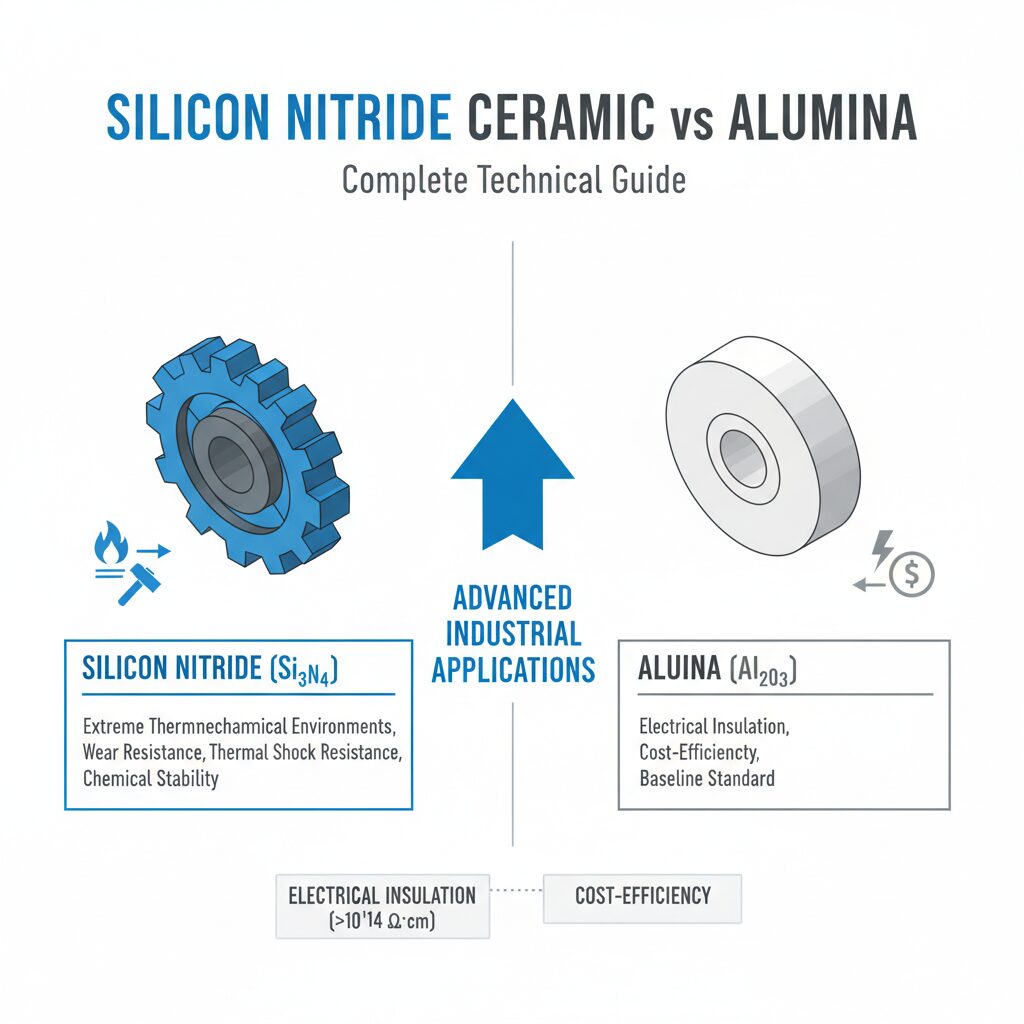
Compared to Zirkonya, alumina boasts significantly higher hardness (1500 HV vs 1200 HV) and superior thermal conductivity. However, Zirconia’s transformation toughening gives it a fracture toughness of up to 10.0 MPa·m½, making it preferable for applications subject to extreme mechanical shock. On the other hand, silisyum nitrür offers excellent thermal shock resistance (ΔT > 600°C) and higher fracture toughness than alumina, but comes at a material cost 3 to 4 times higher. While silisyum karbür remains the premium standard for extreme PV applications (> 50 MPa·m/s), high-purity alumina covers approximately 70% of standard chemical processing requirements at a fraction of the cost, handling PV values up to 15 MPa·m/s effectively when paired with a carbon-graphite opposing face.
Uygulamalar
The integration of an alumina ceramic seal ring for chemical fluid containment spans multiple sub-sectors of the processing industry. The material’s unique combination of dimensional stability, wear resistance. And chemical neutrality makes it the specified choice for the following critical engineering applications:
- Centrifugal Chemical Pumps: Utilized in single and double mechanical seal configurations to handle aggressive inorganic acids (e.g., 37% Hydrochloric acid, 65% Nitric acid). The 99.8% purity alumina prevents grain-boundary leaching that would otherwise cause seal face pitting and catastrophic leakage at operational pressures of 1.6 MPa and speeds of 2900 RPM.
- Reactor Agitators and Mixers: Installed in top-entry, side-entry. And bottom-entry agitators where dynamic shaft deflection occurs. The high compressive strength (>2000 MPa) of the alumina seal rings ensures that the faces remain optically flat (within 2 Helium light bands) even under eccentric shaft runout of up to 0.05mm, maintaining a secure vapor barrier for volatile solvent extraction processes.
- Petrochemical Fluid Handling: Deployed in refining processes handling multiphase fluids containing abrasive catalyst fines (e.g., fluid catalytic cracking bottoms). The high hardness (1500 HV) of the alumina seal face resists the micro-cutting and plowing mechanisms of aluminum oxide and zeolite particulates, extending seal life by up to 300% compared to standard tungsten carbide faces.
- Flue Gas Desulfurization (FGD) Pumps: Essential in coal-fired power plants and chemical incinerators for pumping limestone and gypsum slurries with solid concentrations reaching 30% by weight. The alumina ring provides unparalleled erosion-corrosion resistance in this low-pH (pH 3-5), high-chloride. And highly abrasive environment.
- Pharmaceutical and Bioprocessing Equipment: Chosen for its complete biological inertness and lack of extractables/leachables. Alumina seal rings meet FDA and USP Class VI requirements. They withstand aggressive Clean-In-Place (CIP) and Sterilize-In-Place (SIP) protocols involving 3% Sodium Hydroxide (NaOH) at 85°C and saturated steam at 135°C without surface degradation or outgassing.
Üretim Süreci
Producing an alumina ceramic seal ring for chemical applications requires a meticulously controlled manufacturing workflow. Variances of even 1% in temperature, pressure, or binder composition can lead to residual stresses, porosity, or grain growth, all of which compromise the tribological performance of the seal. At Great Ceramic, our manufacturing protocols are engineered to produce zero-defect structural ceramics capable of holding ±0.005mm tolerances in the final machined state.
Şekillendirme Yöntemleri
- Soğuk İzostatik Presleme (CIP): For high-performance seal rings, spray-dried alumina powder (sub-micron particle size, typically 0.5 to 1.5 µm) is loaded into a flexible polyurethane mold and subjected to omnidirectional hydraulic pressure ranging from 150 to 250 MPa. This method ensures completely uniform green density (typically ~60% of theoretical density), eliminating the density gradients that cause warping during the sintering phase.
- Kuru presleme: For seal rings with simpler geometries and higher production volumes, uniaxial dry pressing is employed. Utilizing pressures of 50 to 100 MPa in tungsten carbide dies, this method allows for rapid net-shape forming. However, to ensure chemical integrity, the binder systems (such as PVA or PEG, typically 2-4% by weight) must be completely volatilized during the subsequent debinding phase at 400°C to 600°C.
Sinterleme
The green alumina rings are sintered in high-temperature, computer-controlled atmospheric or gas-fired kilns. For a 99.8% alumina ceramic seal ring for chemical service, the sintering temperature profile peaks between 1600°C and 1650°C. The heating rate must be carefully controlled at 1°C to 3°C per minute to prevent thermal shock and ensure complete binder burnout. During the dwell time of 4 to 12 hours at peak temperature, solid-state diffusion occurs, consolidating the powder into a dense, monolithic structure. Linear shrinkage during this phase is substantial—typically between 15% and 20%—requiring precise engineering calculations to design the green molds oversized. Advanced grain-growth inhibitors, such as trace amounts of MgO (typically 0.05%), are often added to maintain a fine microstructural grain size of 2 to 5 µm. This is essential for achieving a high-quality surface finish during final lapping.
Son İşleme
Because the sintered alumina has a hardness of 1500 HV, final shaping cannot be done with conventional cutting tools. The oversized sintered blanks undergo rigorous diamond grinding to meet the exact dimensional specifications. Outer diameters (OD) and inner diameters (ID) are machined using cylindrical grinders with metal-bonded diamond wheels (grit sizes ranging from D126 for roughing to D46 for finishing). The critical seal faces are processed through multi-stage lapping and polishing using boron carbide or diamond pastes. The final process achieves an optical flatness of less than 2 Helium Light Bands (0.58 µm) and a surface roughness (Ra) of < 0.2 µm, ensuring that the hydrodynamic fluid film (typically 0.5 to 1.5 µm thick) can form evenly across the interface without leakage. Great Ceramic's capabilities ensure these parameters are met consistently, yielding components ready for immediate integration into high-performance chemical pumps.
Avantajlar ve Sınırlamalar
Engineering mechanical systems requires a clear understanding of material constraints. While the alumina ceramic seal ring for chemical usage is highly versatile, it must be matched to appropriate operational parameters to function effectively.
Avantajlar
- Olağanüstü Kimyasal İnertlik: Alumina is unaffected by almost all industrial chemicals. In tests involving 98% H2SO4 at 100°C for 500 hours, high-purity (99.8%) alumina exhibits a mass loss of less than 0.1 mg/cm²·year, ensuring the seal geometry remains completely unaltered throughout its operational life.
- Extreme Tribological Wear Resistance: With a Vickers hardness of 1500 to 1650 HV, alumina easily resists scratching and abrasion from common environmental particulates like quartz/silica sand (approx. 1000 HV), preventing the formation of leakage paths on the seal face.
- Yüksek Basınç Dayanımı: Operating mechanical seals generate immense axial loads. Alumina boasts a compressive strength exceeding 2200 MPa, preventing micro-yielding or dimensional creep under pressures up to 5.0 MPa in deep-well chemical extraction pumps.
- Cost-to-Performance Superiority: For applications operating under a PV limit of 15 MPa·m/s, alumina delivers the necessary chemical and wear resistance at approximately 40% to 60% of the raw material and processing cost of sintered silicon carbide (SSiC), offering significant ROI for large-scale chemical processing plants.
Sınırlamalar
- Low Thermal Shock Resistance: Due to a relatively high coefficient of thermal expansion (8.1 x 10^-6 /°C) and moderate thermal conductivity (30 W/m·K), alumina has a thermal shock parameter (ΔT) of approximately 200°C to 250°C. Sudden loss of pump flush fluid leading to a dry-run condition will rapidly elevate face temperatures, causing surface heat checking (micro-cracking) and catastrophic brittle failure upon re-introduction of cold fluid.
- Düşük Kırılma Tokluğu: With a K1c value of 4.0 to 5.0 MPa·m½, alumina is a fundamentally brittle material. It is susceptible to chipping during installation or if subjected to severe mechanical impact and vibration (e.g., pump cavitation). Proper elastomeric O-ring mounting is required to isolate the ceramic ring from metallic shaft vibrations.
İşleme ile İlgili Hususlar
Achieving the precise geometrical requirements for an alumina ceramic seal ring for chemical applications is an engineering challenge that requires specialized equipment and process knowledge. The brittle nature of alumina means that any machining operation utilizing a depth of cut exceeding the critical threshold (typically $d_c < 1 \mu m$ for high-purity Al2O3) will shift the material removal mechanism from ductile yielding to brittle fracture, inducing sub-surface micro-cracks that compromise the seal's structural integrity. To mitigate this, CNC grinding must be performed using high-speed spindles (upwards of 10,000 RPM) to maintain low chip loads, paired with high-concentration diamond wheels. Continuous flood cooling using synthetic, water-based coolants at flow rates of 15 to 20 L/min is mandatory to flush away abrasive swarf and prevent localized thermal gradients that could crack the ring.
The lapping process is particularly critical. To achieve the required flatness of < 2 Helium Light Bands, the alumina rings are processed on cast iron or composite lapping plates using precisely graded diamond slurries. The lapping pressure must be strictly controlled between 0.05 and 0.2 MPa. Excessive pressure leads to grain pull-out (pitting), rendering the seal face useless, while insufficient pressure results in non-uniform material removal and extended cycle times. At Great Ceramic, our temperature-controlled lapping environments and proprietary machining kinematics allow us to guarantee surface finishes of Ra < 0.2 µm and dimensional tolerances of ±0.005mm. If you are facing challenges sourcing perfectly flat, defect-free seal rings, explore our precision ceramic machining solutions designed specifically for tight-tolerance industrial applications.
FAQ
What is an alumina ceramic seal ring for chemical?
An alumina ceramic seal ring for chemical is a high-precision, structurally dense mechanical component used primarily as the stationary or rotating face in a mechanical seal assembly. Manufactured from high-purity aluminum oxide (typically 99.5% to 99.8% Al2O3), this ring acts as a dynamic barrier to prevent the leakage of corrosive, volatile, or abrasive chemical fluids along the rotating shafts of pumps, mixers. And agitators. Due to its extreme hardness (1500 HV) and near-zero porosity (<0.1%), it provides a reliable, wear-resistant sealing surface that maintains its optical flatness (under 0.58 µm variance) even under continuous friction, high pressures (up to 3.0 MPa). And exposure to aggressive media with pH levels ranging from 0 to 14.
What are the main applications of an alumina ceramic seal ring for chemical?
These components are integral to fluid handling systems across diverse industrial sectors. Their primary application is within centrifugal chemical pumps handling strong inorganic acids, aggressive alkalis. And organic solvents at elevated temperatures. They are also widely used in petrochemical refining for slurry pumps dealing with abrasive catalyst fines. And in environmental engineering for Flue Gas Desulfurization (FGD) pumps handling abrasive, low-pH limestone and gypsum slurries. Furthermore, due to their biological inertness and FDA compliance, they are heavily utilized in pharmaceutical manufacturing and food processing equipment where harsh Clean-In-Place (CIP) chemicals like hot sodium hydroxide and nitric acid are flushed through the system daily.
How does an alumina ceramic seal ring for chemical compare to other ceramics?
When evaluated against other advanced ceramics, high-purity alumina offers an optimal balance of chemical resistance and cost-efficiency. Compared to standard 95% alumina, the 99.8% purity variant provides 10x the resistance to chemical leaching because it lacks the silica-glass grain boundaries that dissolve in acids and bases. Compared to silisyum karbür (SiC), alumina has lower thermal conductivity (30 W/m·K vs 120 W/m·K) and lower thermal shock resistance, making SiC better for extreme pressure-velocity (PV) and high-heat applications. However, alumina is significantly more cost-effective. Compared to Zirkonya, alumina boasts higher hardness and superior wear resistance, though it lacks zirconia’s high fracture toughness (4.5 vs 9.0 MPa·m½). Ultimately, for moderate PV limits (< 15 MPa·m/s) in highly corrosive environments, high-purity alumina remains the industry standard.
What are the advantages of an alumina ceramic seal ring for chemical?
The core advantages revolve around its chemical, mechanical. And economic profile. First, its universal chemical inertness ensures a corrosion rate of less than 0.1 mg/cm²·year in almost all aggressive media (excluding hydrofluoric acid), guaranteeing dimensional stability. Second, its extreme hardness of up to 1650 HV provides exceptional defense against three-body abrasive wear caused by suspended solids, drastically extending the Mean Time Between Failures (MTBF) compared to metal alloys or carbon-graphite seals. Third, its high compressive strength (>2200 MPa) prevents structural deformation under extreme hydraulic loads. Finally, from a procurement perspective, it delivers tier-one chemical performance at a fraction of the cost of premium silicon carbide or silisyum nitrür components.
How is an alumina ceramic seal ring for chemical machined?
Machining sintered alumina requires specialized diamond-abrasive technology due to the material’s extreme hardness (1500 HV) and inherent brittleness. The process begins with precision CNC grinding using metal-bonded diamond wheels (D126 to D46 grit sizes) operating at high spindle speeds (10,000+ RPM) and low feed rates to maintain a sub-micron depth of cut, thereby preventing subsurface micro-cracking. To achieve the critical seal face geometry, the rings undergo rigorous multi-stage lapping and polishing using diamond or boron carbide slurries on cast iron plates under strictly controlled pressures (0.05 to 0.2 MPa). This ensures an optical flatness of less than 2 Helium Light Bands and a surface roughness of Ra < 0.2 µm. At Great Ceramic, our advanced hassas serami̇k i̇şleme facilities utilize temperature-controlled environments and proprietary kinematics to consistently deliver alumina seal rings with tight tolerances down to ±0.005mm, ensuring zero-leakage performance for your critical chemical applications.
Need custom alumina ceramic seal ring for chemical parts? Great Ceramic ile iletişime geçin dar toleranslara sahip hassas işleme hizmetleri için veya e-posta [email protected].
alumina ceramic seal ring for chemical is widely used in advanced ceramic applications.
Hakkında daha fazla bilgi edinin Kimyasal Uygulamalar İçin Alümina Seramik Sızdırmazlık Halkası ve hassas seramik işleme hizmetlerimiz.