









ZTA ceramic properties: Complete Technical Guide
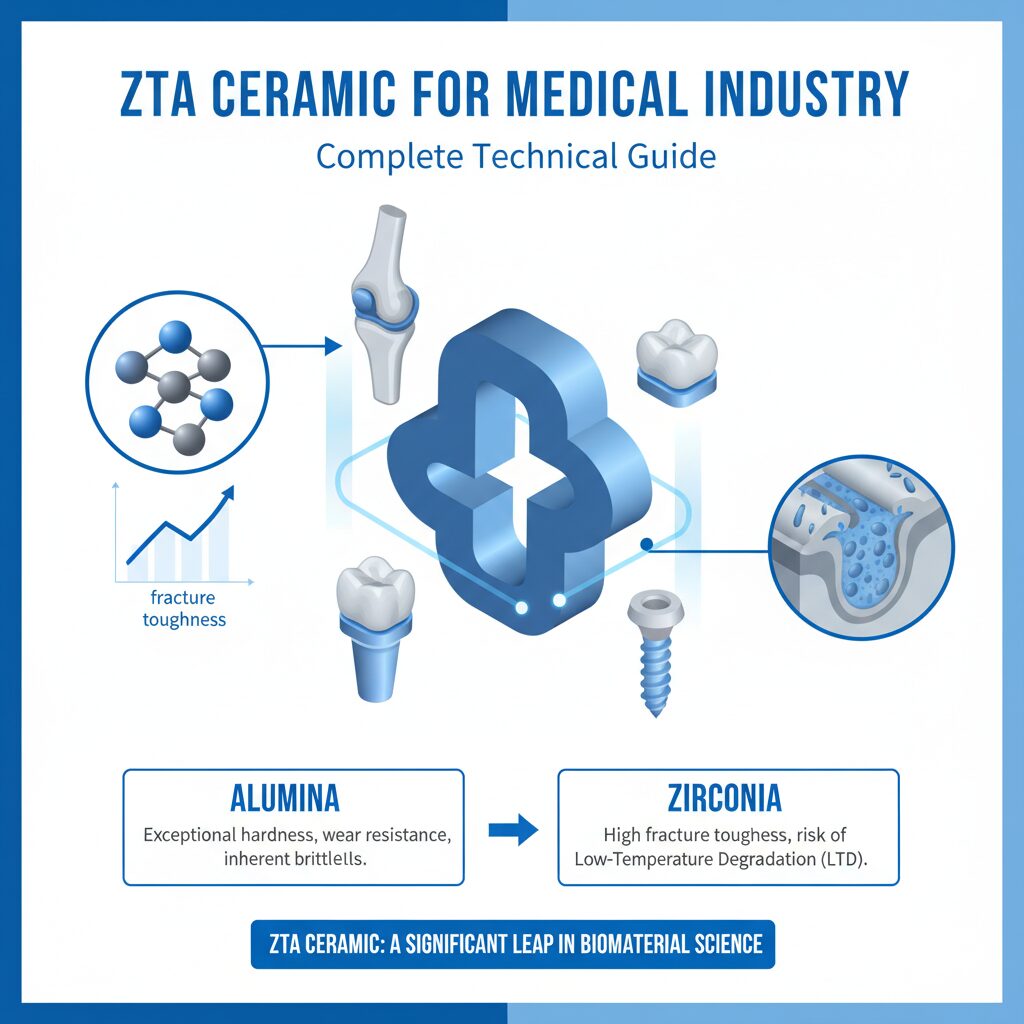
For engineers and procurement managers operating in high-wear, high-stress industrial environments, selecting the optimal advanced ceramic is a critical path to reliability. Pure aluminum oxide often lacks the fracture toughness required for dynamic load applications, while pure zirconium oxide can be cost-prohibitive or lack sufficient hardness. Understanding ZTA ceramic properties—Zirconia Toughened Alumina—provides the definitive solution to this materials engineering challenge. ZTA bridges the gap between these two technical ceramics, offering a composite microstructure that leverages stress-induced transformation toughening. By dispersing 10% to 20% by weight of microscopic tetragonal zirconia particles into an alpha-tlenek glinu matrix, ZTA achieves a fracture toughness of 5.0 to 7.0 MPa·m½, representing a 50% to 70% increase over standard alumina.
This guide delivers a comprehensive, data-driven analysis of ZTA ceramic properties, comparing it against alternative materials and detailing its manufacturing processes. For projects requiring exact specifications, integrating ZTA with precyzyjna obróbka ceramiki ensures components meet strict dimensional requirements. Great Ceramic specializes in machining these advanced composites to tight tolerances of ±0.005mm, converting high-performance raw materials into ready-to-install engineering solutions for aerospace, fluid handling. And medical device sectors.
Właściwości materiałów
The outstanding ZTA ceramic properties originate from its engineered dual-phase microstructure. The primary phase, consisting of 80% to 90% rigid alpha-alumina grains (typically 1.0 to 2.0 µm in diameter), provides exceptional hardness and structural stability. The secondary phase consists of sub-micron (0.2 to 0.5 µm) yttria-stabilized zirconia particles located at the alumina grain boundaries or within the grains themselves. When an advancing crack encounters these metastable tetragonal zirconia particles, the localized stress field triggers a martensitic phase transformation into the monoclinic state. This transformation is accompanied by a 3% to 5% volumetric expansion and a 1% to 2% shear strain. This exerts massive compressive forces (up to 1,000 MPa) against the crack tip, effectively arresting its propagation.
This microstructural engineering yields a unique set of thermo-mechanical and electrical parameters, making ZTA highly desirable for structural components. The material achieves an elastic modulus of 310 to 350 GPa, ensuring minimal deformation under high mechanical loads. Furthermore, its compressive strength routinely exceeds 2,000 MPa, allowing it to withstand extreme compressive stresses in bearing and valve applications. The following table details the standard physical, mechanical. And thermal values associated with industrial-grade ZTA.
| Nieruchomość | Wartość | Jednostka |
|---|---|---|
| Gęstość | 4.10 - 4.30 | g/cm³ |
| Twardość | 1,500 – 1,600 | HV |
| Wytrzymałość na zginanie | 600 - 800 | MPa |
| Wytrzymałość na złamania | 5.0 – 7.0 | MPa-m½ |
| Przewodność cieplna | 20.0 – 24.0 | W/m-K |
| Rezystywność elektryczna | > 10¹⁴ | Ω-cm |
| Maksymalna temperatura robocza | 1,400 – 1,500 | °C |
Porównanie z innymi materiałami ceramicznymi
To fully contextualize ZTA ceramic properties, it is essential to conduct a data-driven comparison with baseline advanced ceramics. Material selection dictates not only component lifespan but also the economic feasibility of the overall system. While ZTA represents a highly optimized composite, engineers frequently evaluate it alongside standard tlenek glinu, pure cyrkonia. And non-oxide alternatives like azotek krzemu.
Compared to high-purity (99.5%) alumina, ZTA offers drastically improved fracture toughness (up to 7.0 MPa·m½ versus 4.0 MPa·m½) and flexural strength (up to 800 MPa versus 400 MPa) at a moderate cost premium. This makes ZTA the superior choice when standard alumina parts experience catastrophic brittle failure from impact or cyclic fatigue. Conversely, when compared to Yttria-Stabilized Zirconia (Y-TZP), ZTA provides higher hardness (1,600 HV versus 1,200 HV) and lower density (4.15 g/cm³ versus 6.05 g/cm³). ZTA is also significantly less susceptible to Low-Temperature Degradation (LTD)—a phenomenon where pure zirconia loses structural integrity in humid environments between 200°C and 300°C.
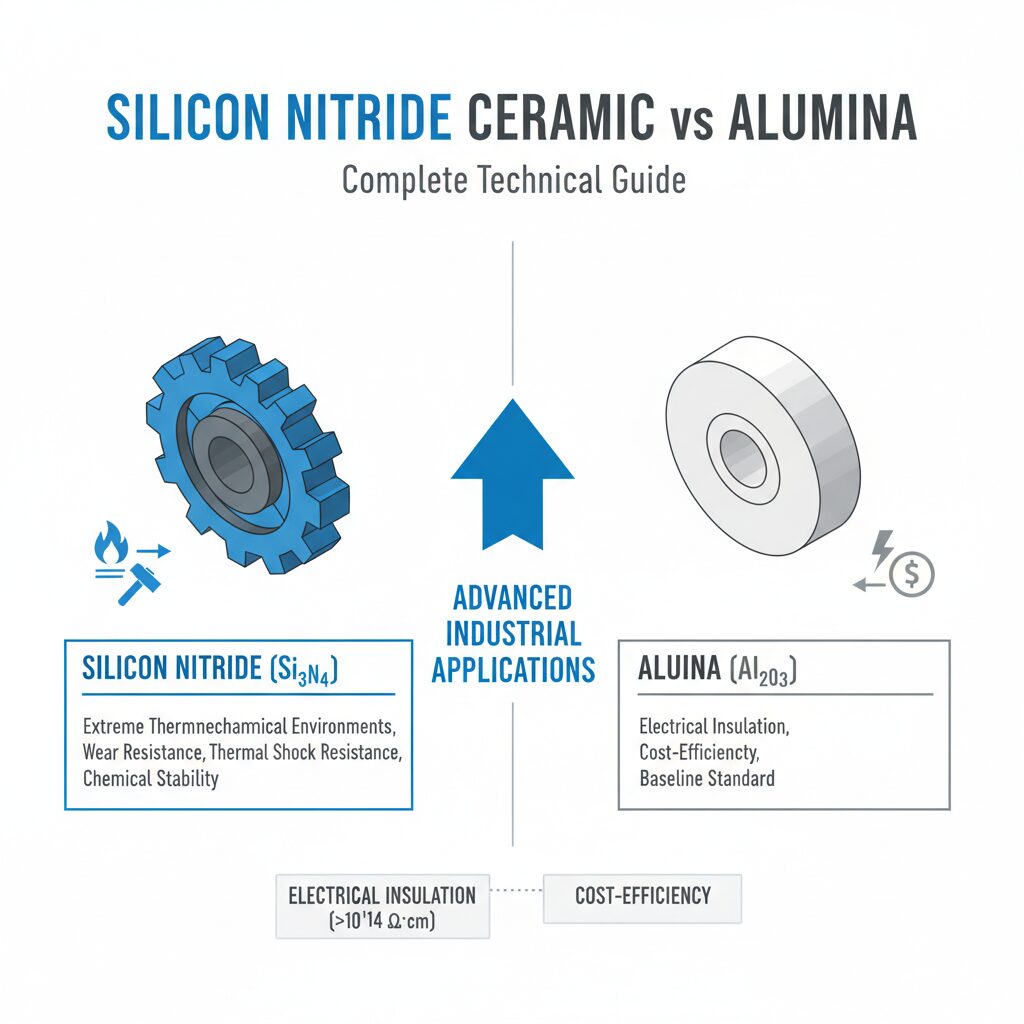
When evaluated against silicon nitride, ZTA offers a more cost-effective solution for applications not requiring extreme high-temperature strength. Silicon nitride maintains its flexural strength beyond 1,000°C and possesses unparalleled thermal shock resistance due to its low coefficient of thermal expansion (3.2 x 10⁻⁶/°C). However, ZTA remains the preferred choice for room-to-medium temperature wear applications due to its higher chemical inertness in certain acidic environments and significantly lower raw material and sintering costs.
| Nieruchomość | ZTA Ceramic | Tlenek glinu (99.5%) | Tlenek cyrkonu (Y-TZP) | Azotek krzemu |
|---|---|---|---|---|
| Przewodność cieplna (W/m-K) | 20 - 24 | 28 – 35 | 2.0 - 3.0 | 25 - 30 |
| Hardness (HV10) | 1,500 – 1,600 | 1,500 – 1,650 | 1,200 – 1,300 | 1,500 – 1,600 |
| Wytrzymałość na złamanie (MPa-m½) | 5.0 – 7.0 | 3.5 - 4.5 | 8.0 - 10.0 | 6.0 - 7.0 |
| Koszt | Średni | Niski | Wysoki | Bardzo wysoka |
Aplikacje
- Centrifugal Pump Shafts and Seals: Fluid handling systems transferring abrasive slurries require components that withstand continuous tribological wear. ZTA is selected because its specific wear rate is consistently below 10⁻⁶ mm³/N·m in unlubricated sliding conditions. The material handles pump speeds exceeding 10,000 RPM while maintaining exact geometric tolerances, drastically reducing maintenance downtime compared to metal alloys or pure alumina seals.
- Metal Forming and Cutting Tools: In high-speed machining and wire drawing processes, cutting inserts and drawing dies must resist plastic deformation and thermal shock. ZTA is specified due to its combination of high compressive strength (over 2,000 MPa) and a thermal limit of 1,400°C. The dispersion of zirconia prevents the micro-chipping at the cutting edge that typically plagues standard aluminum oxide inserts, extending tool life by up to 300% in cast iron machining.
- Valve Trim for Oil & Gas Extraction: Choke valves and control valves in upstream oil and gas encounter high-velocity particulate erosion and corrosive multiphase fluids (often containing H2S and chlorides at pressures up to 15,000 psi). ZTA components are chosen because they deliver superior cavitation resistance and fracture toughness, preventing catastrophic valve failure in aggressive subsea or surface environments.
- Medical Implants and Prosthetics: Orthopedic applications, specifically femoral heads and acetabular cups in total hip replacements, demand exceptional biocompatibility and ultra-low wear rates to prevent osteolysis. ZTA ceramics provide a surface roughness (Ra) capabilities down to 0.01 µm when precision polished. The material’s high fracture toughness (up to 7.0 MPa·m½) significantly reduces the risk of in-vivo fracture compared to monolithic alumina implants.
- Industrial Wear Liners and Chutes: Mining and bulk material handling equipment require robust protection against heavy impact and sliding abrasion from ores. ZTA tiles are utilized because their transformation toughening mechanism absorbs the kinetic energy of falling bulk materials (impact forces up to several kilo-Newtons) without shattering, providing a cost-to-performance ratio that far exceeds that of pure zirconia or hardened steel liners.
Proces produkcji
The optimization of ZTA ceramic properties relies entirely on stringent control over the manufacturing process. The production cycle begins with the synthesis of sub-micron powders. High-purity alpha-alumina powder is intimately milled with 10% to 20% (by weight) of yttria-stabilized zirconia. This process typically utilizes attrition milling or ball milling with zirconia media for 24 to 48 hours to ensure a homogenous dispersion of particles and to reduce the average particle size (D50) to below 0.5 µm. Organic binders (such as PVA, typically 2% to 4% by weight), dispersants. And plasticizers are added to create a stable slurry. This is subsequently spray-dried into free-flowing spherical granules sized between 50 µm and 150 µm, optimizing them for high-density compaction.
Metody formowania
- Prasowanie izostatyczne na zimno (CIP): The spray-dried powder is loaded into elastomeric molds and subjected to multi-directional fluid pressure ranging from 200 MPa to 300 MPa. This method yields high-density green bodies (typically 55% to 60% of theoretical density) with uniform isotropic shrinkage characteristics. This is essential for producing complex, thick-walled components like pump housings or large wear cylinders.
- Ceramiczne formowanie wtryskowe (CIM): For high-volume production of intricate, near-net-shape components weighing less than 100 grams, the ZTA powder is compounded with thermoplastic binders. The feedstock is injected into steel cavities at pressures between 50 MPa and 100 MPa. Following an extensive catalytic or thermal debinding process (ranging from 150°C to 400°C), the parts achieve exceptional geometric complexity with standard green-state tolerances of ±0.5%.
Spiekanie
The thermal consolidation, or sintering, of ZTA is the most critical phase for defining its final mechanical properties. Green bodies are fired in highly controlled atmospheric or electric furnaces. The temperature profile typically includes a slow ramp rate of 1°C to 3°C per minute up to 600°C to ensure complete binder burnout without inducing micro-cracks. The temperature is then elevated to the final sintering range of 1,500°C to 1,600°C, with a holding or dwell time of 2 to 4 hours. Exact temperature control is vital. exceeding 1,600°C can cause abnormal grain growth in the alumina matrix. This heavily degrades the fracture toughness and nullifies the benefits of the zirconia dispersion. Upon cooling, the material achieves a sintered density exceeding 99% of its theoretical maximum (≥ 4.10 g/cm³).
Obróbka końcowa
Because sintered ZTA achieves a hardness of up to 1,600 HV, final shaping cannot be accomplished with conventional high-speed steel or carbide tooling. Final machining requires advanced diamond abrasive technology. This stage includes precision diamond grinding, ultrasonic-assisted machining, honing. And lapping to achieve final dimensional requirements. Kinematic precision is paramount, as aggressive material removal rates can introduce subsurface micro-cracks that compromise the structural integrity of the ceramic. For engineering applications requiring perfect fit and sealing, Great Ceramic employs multi-axis CNC grinding centers to consistently deliver final components with dimensional tolerances of ±0.005mm and surface finishes down to Ra 0.05 µm.
Zalety i ograniczenia
Zalety
- Zwiększona odporność na pękanie: By incorporating 15% to 20% zirconia, ZTA increases the fracture toughness of pure alumina from ~4.0 MPa·m½ up to 7.0 MPa·m½. This phase-transformation toughening actively closes propagating cracks, massively improving the material’s survival rate in applications subject to mechanical shocks and cyclic fatigue forces.
- Wyjątkowa odporność na zużycie: Due to an alumina matrix that maintains a hardness of 1,500 to 1,600 HV, ZTA exhibits exceptional abrasion resistance. In tribological tests, ZTA demonstrates a wear coefficient significantly lower than hardened steel (Rc 60) and pure zirconia, making it ideal for high-friction continuous-duty environments like mechanical seal faces operating at 15 m/s surface velocities.
- Zoptymalizowany stosunek kosztów do wydajności: Pure high-performance zirconia (Y-TZP) requires expensive raw materials and complex stabilization processes. ZTA utilizes cost-effective alumina as its bulk matrix (up to 90% by volume), delivering near-zirconia toughness at a fraction of the raw material cost, bridging the economic gap for large-scale industrial deployments.
- Stabilność w wysokich temperaturach: ZTA maintains excellent mechanical integrity and oxidation resistance up to 1,400°C. Unlike polymer composites or standard metals, its elastic modulus (approx. 330 GPa) remains remarkably stable under high thermal loads, ensuring dimensional stability in high-temperature fluid handling and semiconductor manufacturing equipment.
Ograniczenia
- Hard Machining Difficulties: The very properties that make ZTA desirable—extreme hardness and high toughness—make it notoriously difficult to machine post-sintering. Shaping sintered ZTA requires specialized resin-bonded or metal-bonded diamond grinding wheels, precise coolant delivery at 50+ bar pressure. And slow feed rates (often below 500 mm/min). This can increase the cost of geometrically complex parts.
- Lower Thermal Shock Resistance than Non-Oxides: While tougher than alumina, ZTA has a coefficient of thermal expansion (CTE) of approximately 8.0 x 10⁻⁶/°C. When subjected to rapid temperature drops (ΔT > 250°C), thermal gradients can induce tensile stresses that exceed the material’s flexural strength. For applications experiencing severe thermal shock, non-oxide ceramics like węglik krzemu or silicon nitride are necessary alternatives.
Rozważania dotyczące obróbki
Translating optimal ZTA ceramic properties from raw material data into functional B2B components hinges entirely on mastery of precision machining. The inherent phase-transformation toughening that arrests cracks in the field also heavily resists the shearing action of diamond grinding tools. When the localized stress of a diamond grit (e.g., D64 or D46 size) hits the ZTA surface, the tetragonal-to-monoclinic expansion actually increases the material’s resistance to removal, accelerating tool wear and generating excessive localized heat. If cutting speeds exceed 35 m/s or if feed rates are too aggressive, the resulting thermal stress can induce severe sub-surface damage, significantly lowering the Weibull modulus of the final part.
To overcome these challenges, structural ceramic manufacturers must deploy highly rigid machine tools with vibration-damping polymer-concrete bases, advanced spindle cooling. And precisely directed high-pressure coolant systems. The grinding kinematics must be optimized to ensure minimal depth of cut (often 0.001mm to 0.005mm per pass) while maintaining high spindle speeds to reduce cutting forces. The following table outlines the precision tolerances achievable when these parameters are expertly controlled.
| Machining Feature | Standard Tolerance (mm) | Precision Tolerance (mm) | Surface Finish (Ra) |
|---|---|---|---|
| Outer Diameter (OD) Grinding | ± 0.020 | ± 0.005 | 0.2 – 0.4 µm |
| Inner Diameter (ID) Honing | ± 0.025 | ± 0.005 | 0.1 – 0.2 µm |
| Flatness / Parallelism | 0.010 | 0.002 | 0.05 – 0.1 µm |
| Concentricity | 0.015 | 0.003 | NIE DOTYCZY |
Great Ceramic excels in navigating these complex machining dynamics. By utilizing state-of-the-art multi-axis CNC grinding, ultrasonic machining. And proprietary lapping protocols, Great Ceramic routinely achieves tight-tolerance requirements of ±0.005mm on ZTA components. This ensures perfect interchangeability and sealing performance for mission-critical engineering applications, seamlessly taking parts from prototype to high-volume production without compromising the intrinsic mechanical integrity of the composite.
FAQ
What is ZTA ceramic?
ZTA (Zirconia Toughened Alumina) is an advanced composite structural ceramic consisting of an aluminum oxide (alpha-alumina) matrix reinforced with a dispersion of 10% to 20% by weight yttria-stabilized zirconium oxide particles. This dual-phase microstructure utilizes a mechanism called stress-induced phase transformation toughening. This significantly enhances the material’s fracture toughness (up to 7.0 MPa·m½) while maintaining the extreme hardness (up to 1,600 HV) and chemical inertness of traditional high-purity alumina.
What are the main applications of ZTA ceramic?
ZTA ceramic is primarily specified for industrial applications where components face simultaneous heavy mechanical impact, severe abrasion. And corrosive environments. Major applications include centrifugal pump shafts, mechanical seal faces, high-speed cutting tool inserts, oil and gas choke valve trims, industrial wear liners for mining. And orthopedic medical implants (such as hip replacement joints). In these environments, ZTA reliably withstands high rotational speeds (e.g., 10,000 RPM) and heavy compressive loads exceeding 1,000 MPa.
How does ZTA ceramic compare to other ceramics?
ZTA serves as a highly optimized midpoint between standard alumina and pure zirconia. It possesses 50% to 70% higher fracture toughness than 99.5% purity alumina, making it far less prone to catastrophic shattering. Compared to pure Y-TZP zirconia, ZTA is significantly harder, lighter in density (approx. 4.2 g/cm³ vs 6.0 g/cm³). And more cost-effective for large components. While it cannot match the thermal shock resistance or extreme high-temperature strength (above 1,000°C) of non-oxide ceramics like silicon nitride, ZTA provides the best cost-to-performance ratio for rigorous room-to-medium temperature wear applications.
What are the advantages of ZTA ceramic?
The core advantages of ZTA include exceptional fracture toughness and impact resistance driven by the tetragonal-to-monoclinic volumetric expansion of its zirconia particles when subjected to mechanical stress. It also provides superior wear resistance, exhibiting specific wear rates below 10⁻⁶ mm³/N·m. Additionally, ZTA maintains high compressive strength (over 2,000 MPa), a high elastic modulus (~330 GPa), excellent chemical inertness against acids and alkalis. And dimensional stability at operating temperatures up to 1,400°C.
Jak obrabiana jest ceramika ZTA?
Because the sintered material reaches hardness levels up to 1,600 HV, traditional metal cutting tools cannot machine ZTA. Shaping post-sintering requires advanced diamond abrasive technology, including CNC diamond grinding, ultrasonic machining, lapping. And honing. Machining parameters must be strictly controlled (such as depths of cut below 0.005mm and high-pressure coolant) to avoid inducing micro-cracks. Great Ceramic utilizes advanced, rigid multi-axis machining centers to process ZTA, offering highly specialized manufacturing capabilities that routinely achieve precision dimensional tolerances of ±0.005mm and surface roughness profiles down to Ra 0.05 µm.
Need custom ZTA ceramic properties parts? Kontakt Great Ceramic w przypadku usług precyzyjnej obróbki skrawaniem o wąskich tolerancjach lub wyślij wiadomość e-mail na adres [email protected].
ZTA ceramic properties is widely used in advanced ceramic applications.
Dowiedz się więcej o Zta Ceramic Properties i nasze usługi precyzyjnej obróbki ceramiki.