









“`html
Technical Guide to Machinable Glass Ceramic Ceramic Block for Electronics
In the rapidly evolving landscape of electronic manufacturing, the demand for materials that combine the insulation properties of ceramics with the versatility of metals has never been higher. The machinable glass ceramic ceramic block for electronics represents a pinnacle of material science, offering engineers a unique solution for prototyping and high-precision production. Unlike traditional technical ceramics like Tlenek glinu lub Cyrkon. This require diamond grinding and post-sintering, machinable glass ceramics (MGC) can be machined using standard high-speed steel or carbide tools. This article explores the technical properties, CNC machining intricacies. And critical electronics applications of this specialized material.
What is Machinable Glass Ceramic?
Machinable glass ceramic is a sophisticated composite material, most commonly composed of a borosilicate glass matrix embedded with fluorophlogopite mica crystals. It is these interlocking mica platelets that give the material its unique “machinability.” When a cutting tool interacts with the ceramic, the mica crystals cause microscopic fractures to localize and arrest, preventing the catastrophic shattering associated with standard glass or ceramics. This allows for the creation of complex geometries, thin walls. And threaded holes—features that are traditionally difficult to achieve in ceramic components.
For the electronics industry, the machinable glass ceramic ceramic block for electronics is prized for its exceptional dielectric strength, zero porosity. And thermal stability. It serves as an ideal substrate and insulator in environments ranging from ultra-high vacuum (UHV) chambers to high-voltage power distribution systems.
Technical Property Tables
To understand why machinable glass ceramic is preferred for electronic applications, we must analyze its physical, thermal. And electrical data. Below are the technical specifications for a standard high-performance machinable glass ceramic block.
Table 1: Physical and Mechanical Properties
| Nieruchomość | Jednostka | Wartość (typowa) |
|---|---|---|
| Gęstość | g/cm³ | 2.52 |
| Porowatość | % | 0 (Zero) |
| Twardość (Knoop) | HK₀.₁ | 250 |
| Wytrzymałość na zginanie | MPa | 94 |
| Wytrzymałość na ściskanie | MPa | 345 |
| Moduł sprężystości | GPa | 67 |
| Współczynnik Poissona | – | 0.29 |
Table 2: Thermal Properties
| Nieruchomość | Jednostka | Wartość (typowa) |
|---|---|---|
| Współczynnik rozszerzalności cieplnej (CTE) | 10⁻⁶/°C (25–400°C) | 9.3 – 11.4 |
| Przewodność cieplna | W/(m-K) | 1.46 |
| Ciepło właściwe | J/(kg·K) | 0.79 |
| Maximum Operating Temp (No Load) | °C | 1000 (continuous 800) |
| Odporność na szok termiczny | – | Doskonały |
Table 3: Electrical Properties
| Nieruchomość | Jednostka | Wartość (typowa) |
|---|---|---|
| Wytrzymałość dielektryczna (AC) | kV/mm | 40 |
| Stała dielektryczna (1 MHz) | – | 5.67 – 6.03 |
| Dissipation Factor (1 MHz) | – | 0.0047 |
| Rezystywność objętościowa | Ω-cm | >10¹⁴ |
Why Electronics Manufacturers Choose Machinable Glass Ceramic Blocks
The electronics industry operates under strict tolerances regarding outgassing, thermal expansion. And electrical interference. A machinable glass ceramic ceramic block for electronics addresses these concerns through several key advantages:
1. Ultra-High Vacuum (UHV) Compatibility
Unlike many plastics or low-grade ceramics, MGC is completely non-porous. It does not absorb water or gases, meaning it will not outgas when placed in a vacuum. This makes it a staple material for semiconductor manufacturing equipment, ion beam sources. And space-borne electronics where maintaining vacuum integrity is critical.
2. Thermal Expansion Matching
The Coefficient of Thermal Expansion (CTE) of machinable glass ceramic is approximately 9.3 to 11.4 x 10⁻⁶/°C. This range is remarkably close to most metals and sealing glasses used in electronic packaging. When the ceramic is bonded to metal components, it minimizes the risk of mechanical failure due to thermal cycling, ensuring long-term reliability in power electronics.
3. High Dielectric Strength
With a dielectric strength of 40 kV/mm, MGC is an exceptional high-voltage insulator. It prevents arcing and electrical breakdown in compact electronic designs. This is particularly useful in the design of insulators for medical imaging equipment (MRI/CT scanners) and high-power laser systems.
4. No Post-Firing Shrinkage
Traditional ceramics are shaped in a “green” state and then fired in a kiln, where they shrink by 15-20%. This shrinkage makes achieving micron-level tolerances nearly impossible without expensive post-fire diamond grinding. Machinable glass ceramic blocks are fully densified. Once machined, they are dimensionally stable, eliminating the need for further heat treatment.
Core Industry Applications
Semiconductor Fabrication
In the semiconductor industry, purity and precision are paramount. Machinable glass ceramic blocks are used to create wafer handling equipment, probe cards. And plasma chamber insulators. The material’s resistance to chemical erosion and its ability to withstand high temperatures make it ideal for the harsh environments of etch and deposition processes.
Aerospace and Defense Electronics
Electronic components in aerospace must endure extreme vibrations and temperature fluctuations. MGC blocks are machined into custom standoffs, coil bobbins. And microwave windows. Its radiation resistance also makes it a primary choice for satellite electronics and deep-space probes.
Medical Device Components
The biocompatibility and sterilizability of glass-ceramics are leveraged in medical electronics. Specifically, MGC is used in high-frequency surgical tools and diagnostic equipment where electrical isolation from the patient is a safety requirement.
High-Power Laser Systems
Laser systems generate significant heat and require precise alignment of optical components. Machinable glass ceramic provides the necessary thermal stability and electrical insulation for laser diode housings and reflector mounts.
CNC Machining Specifics for Glass Ceramic Blocks
While the material is “machinable,” it is still a ceramic and requires specific protocols to ensure high-quality surface finishes and tool longevity. Here are the CNC machining guidelines for a machinable glass ceramic ceramic block for electronics.
Tooling Selection
Standard High-Speed Steel (HSS) tools can be used for short runs, but for production or high-precision work, Tungsten Carbide tools are recommended. Carbide tools offer better wear resistance against the abrasive nature of the mica and glass matrix. Diamond-coated tools are preferred for high-volume manufacturing to maintain consistent tolerances over long periods.
Speeds and Feeds
Machining glass ceramics requires a “gentle” approach compared to aluminum or steel.
- Turning: Cutting speeds should be around 30-50 surface feet per minute (SFM). Feed rates should be kept low, typically 0.002 to 0.005 inches per revolution (IPR).
- Milling: Spindle speeds should be moderate. A 1/2-inch end mill might run at 1000-1500 RPM with a chip load of 0.001-0.002 inches per tooth.
- Drilling: Use sharp carbide drills. Frequent “pecking” is necessary to clear ceramic dust and prevent heat buildup.
Coolant and Lubrication
While MGC can be machined dry, the use of a water-soluble coolant is highly recommended. Coolant serves two purposes: it washes away the abrasive ceramic powder (which can act like a grinding paste) and it protects the tool from overheating. If machining dry, a vacuum system must be used to remove the fine dust. This is hazardous to machine ways and human lungs.
Achieving Tight Tolerances
Because there is no post-firing shrinkage, machinable glass ceramic can hold tolerances of +/- 0.013 mm (0.0005 inches). To achieve these results, it is vital to use sharp tools. dull tools can cause “break-out” or chipping at the edges of the workpiece where the tool exits the cut.
Comparative Analysis: Glass Ceramic vs. Other Ceramics
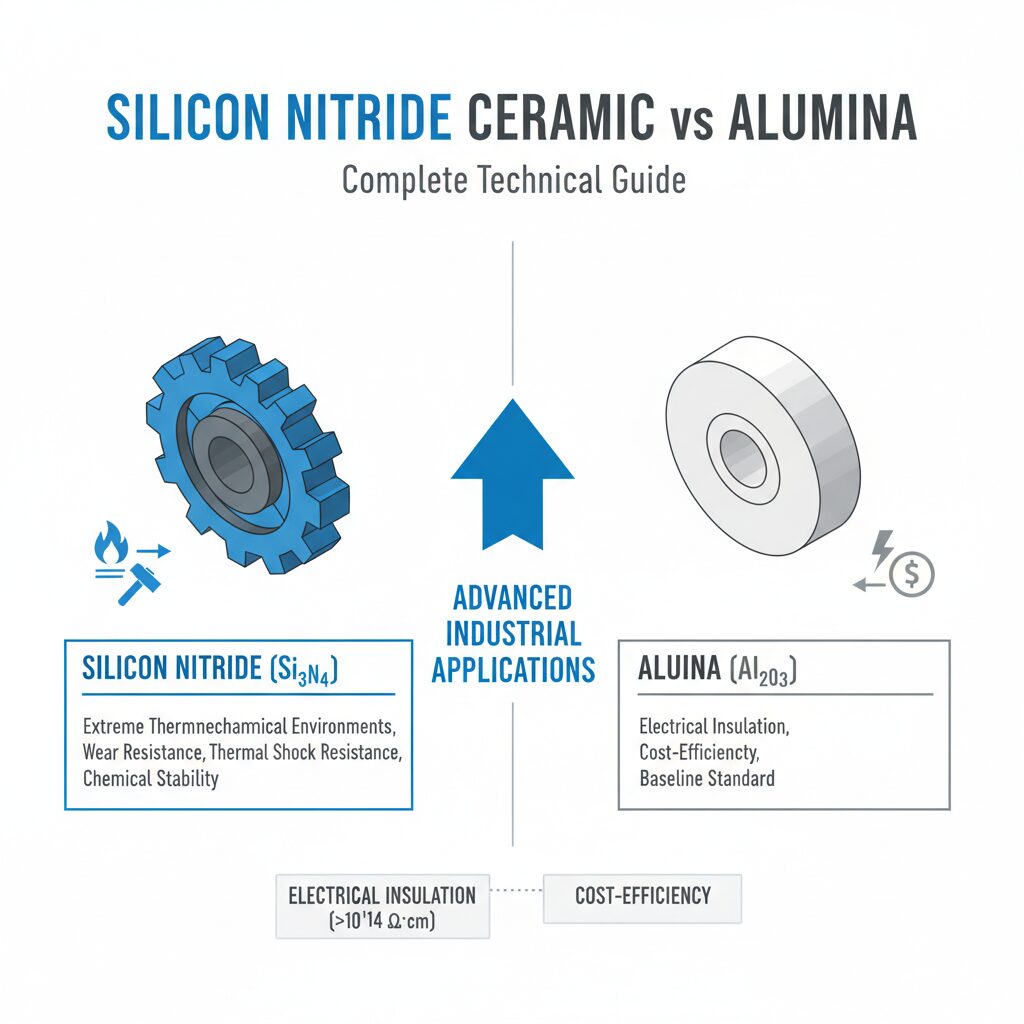
When selecting a material for an electronic application, engineers often weigh MGC against Alumina (Al₂O₃) or Alumina Nitride (AlN).
MGC vs. Alumina
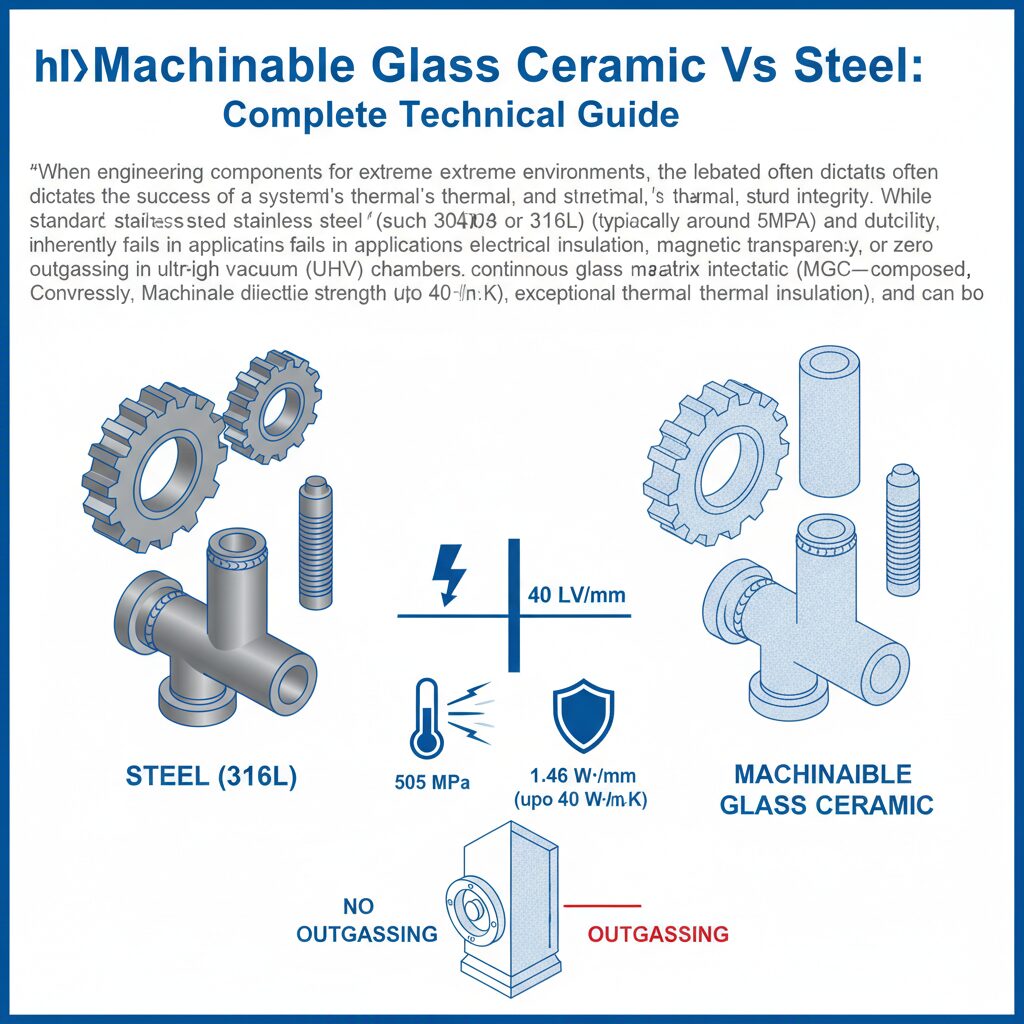
Alumina is harder and has higher thermal conductivity. However, Alumina requires specialized diamond grinding, making complex prototypes extremely expensive and slow to produce. MGC is chosen when lead time and complex geometry are more important than maximum hardness.
MGC vs. Plastics (PEEK/PTFE)
High-performance plastics like PEEK are often used for insulation. However, PEEK can deform under heat and outgas in vacuums. MGC offers far superior dimensional stability and a much higher operating temperature (800°C vs 250°C for PEEK).
Uwagi projektowe dla inżynierów
When designing a part to be machined from a machinable glass ceramic ceramic block for electronics, consider the following:
- Unikaj ostrych narożników wewnętrznych: Use radii in corners to reduce stress concentrations.
- Wall Thickness: While MGC can be machined thin, try to maintain a minimum wall thickness of 0.5mm to prevent fragility during handling.
- Threaded Holes: MGC takes threads very well. However, use a slightly larger tap drill than you would for steel to prevent the tap from binding in the abrasive material.
- Wykończenie powierzchni: As-machined surface finish is typically around 0.8-1.6 μm Ra. It can be polished to a mirror finish if required for vacuum seals.
The Great Ceramic Advantage
At Great Ceramic, we specialize in the precision CNC machining of glass ceramic blocks. Our facility is equipped with specialized dust extraction and high-precision CNC centers dedicated to technical ceramics. We understand the nuances of brittle material machining, ensuring that your electronic components are delivered without micro-cracks or edge chipping.
Whether you require a single prototype for a research project or high-volume production for a semiconductor line, our expertise ensures that the unique properties of the machinable glass ceramic ceramic block for electronics are fully realized in your final product.
FAQ Section
1. Is machinable glass ceramic the same as Macor?
Macor is the most famous brand name for machinable glass ceramic, developed by Corning. There are other formulations available, but “Macor” is often used as a generic term in the industry. Great Ceramic works with both Macor and equivalent high-performance glass ceramics.
2. Can I use standard metalworking lathes to machine these blocks?
Yes, that is one of the primary benefits. You do not need specialized ceramic grinding equipment. However, the machine must be cleaned thoroughly afterward, as the ceramic dust is abrasive.
3. Does the material need to be heat-treated after machining?
No. Machinable glass ceramic is “ready to use” immediately after machining. This significantly reduces lead times compared to Alumina or Silicon Carbide.
4. What is the maximum temperature it can withstand?
Under a constant load, it is recommended to stay below 800°C. For applications with no mechanical load, it can withstand peaks up to 1000°C.
5. Is it safe for food or medical contact?
Yes, it is chemically inert, non-toxic. And does not outgas, making it suitable for a variety of medical and sensitive laboratory environments.
Wnioski
The machinable glass ceramic ceramic block for electronics is an indispensable material for modern engineering. Its ability to be precisely shaped using CNC technology, combined with its robust electrical and thermal properties, makes it the go-to choice for high-stakes industries like aerospace, semiconductors. And medical technology.
By understanding the material’s limits and following best practices for machining, engineers can unlock new possibilities in electronic design, achieving levels of precision and reliability that were previously unattainable with standard materials.
Skontaktuj się z Great Ceramic, aby uzyskać obróbka ceramiki rozwiązania dostosowane do aplikacji. Our team of experts is ready to help you select the right grade of material and provide the precision machining your project deserves.
“`
machinable glass ceramic ceramic block for electronics is widely used in advanced ceramic applications.
Dowiedz się więcej o Obrabialny szklano-ceramiczny blok ceramiczny dla elektroniki i nasze usługi precyzyjnej obróbki ceramiki.