








Boron Nitride Ceramic vs Plastic: Complete Technical Guide
When engineering components for extreme thermal, electrical. And vacuum environments, the debate between azotek boru ceramic vs plastic is a critical design juncture. Standard engineering plastics like PEEK and PTFE offer high machinability and low density (typically between 1.30 g/cm³ and 2.20 g/cm³), but they suffer catastrophic structural degradation at temperatures exceeding 250°C to 300°C. Furthermore, in high-vacuum environments exceeding 10⁻⁶ Torr, polymer outgassing contaminates delicate semiconductor and aerospace assemblies. Hexagonal azotek boru (h-BN), often referred to as “white graphite,” bridges this materials gap by offering the extreme machinability of advanced polymers combined with the thermal survivability of advanced technical ceramics. Capable of maintaining dimensional stability up to 1900°C in vacuum conditions and delivering a thermal conductivity of roughly 60 W/m·K, h-BN outperforms polymers in virtually every high-stress metric. This guide provides quantitative data to help R&D teams and procurement managers make the right material selection. Looking for ±0.005mm tight-tolerance components? Kontakt Great Ceramic to request an engineering RFQ today.
Właściwości materiałów
To accurately evaluate boron nitride ceramic vs plastic, engineers must first understand the baseline thermomechanical properties of hot-pressed hexagonal boron nitride. Unlike oxide ceramics, h-BN features a highly directional, graphite-like crystalline structure that yields profound anisotropic properties. The values below represent average baseline metrics for standard hot-pressed h-BN tested at 20°C ambient temperature. Its density of 2.10 g/cm³ closely mimics standard PTFE plastics (2.20 g/cm³), meaning engineers can upgrade from polymer to ceramic without adding significant parasitic weight to aerospace or robotic payload assemblies. The dielectric strength remains consistently high at 35 kV/mm, vastly outperforming standard FR4 or nylon components that typically fail between 15 kV/mm and 20 kV/mm.
| Nieruchomość | Wartość | Jednostka |
|---|---|---|
| Gęstość | 2.10 | g/cm³ |
| Twardość | 30 | HV |
| Wytrzymałość na zginanie | 35 | MPa |
| Wytrzymałość na złamania | 1.2 | MPa-m½ |
| Przewodność cieplna | 60 | W/m-K |
| Rezystywność elektryczna | >10¹⁴ | Ω-cm |
| Max Working Temperature (Vacuum) | 1900 | °C |
When subjected to thermodynamic stress, h-BN exhibits a coefficient of thermal expansion (CTE) ranging from 1.2 x 10⁻⁶ /°C (parallel to the pressing direction) to 4.3 x 10⁻⁶ /°C (perpendicular). This low thermal expansion is an order of magnitude lower than PEEK (which expands at roughly 47 x 10⁻⁶ /°C), ensuring that precision components machined to ±0.005mm tolerances do not warp, bind, or seize when transitioning from a 20°C cleanroom into a 900°C physical vapor deposition (PVD) chamber. The relatively low hardness of 30 HV is the exact reason h-BN is chosen as a plastic replacement. it can be milled, turned. And drilled using standard carbide or diamond tooling at high feed rates without the diamond-wheel grinding required by harder ceramics.
Porównanie z innymi materiałami ceramicznymi
While boron nitride excels as a direct upgrade to plastics due to its unique machinability, its mechanical and thermal properties must be contextualized against other advanced technical ceramics. Engineers frequently pivot between h-BN, tlenek glinu, zirconia. And azotek krzemu depending on the ratio of required structural rigidity to thermal management. The table below illustrates how h-BN prioritizes thermal shock resistance and machinability over sheer brute strength. For instance, its fracture toughness of 1.2 MPa·m½ is significantly lower than cyrkonia (8.0 MPa·m½), making it unsuitable for high-impact ballistic or bearing applications, but perfect for static, high-temperature insulative fixtures.
| Nieruchomość | Azotek boru | Tlenek glinu (99.5%) | Zirconia (YTZP) | Azotek krzemu |
|---|---|---|---|---|
| Przewodność cieplna (W/m-K) | 60 | 25 | 2.2 | 30-90 |
| Twardość (HV) | 30 | 1500 | 1200 | 1600 |
| Wytrzymałość na złamanie (MPa-m½) | 1.2 | 4.0 | 8.0 | 6.0 |
| Koszt | Wysoki | Niski | Średni | Wysoki |
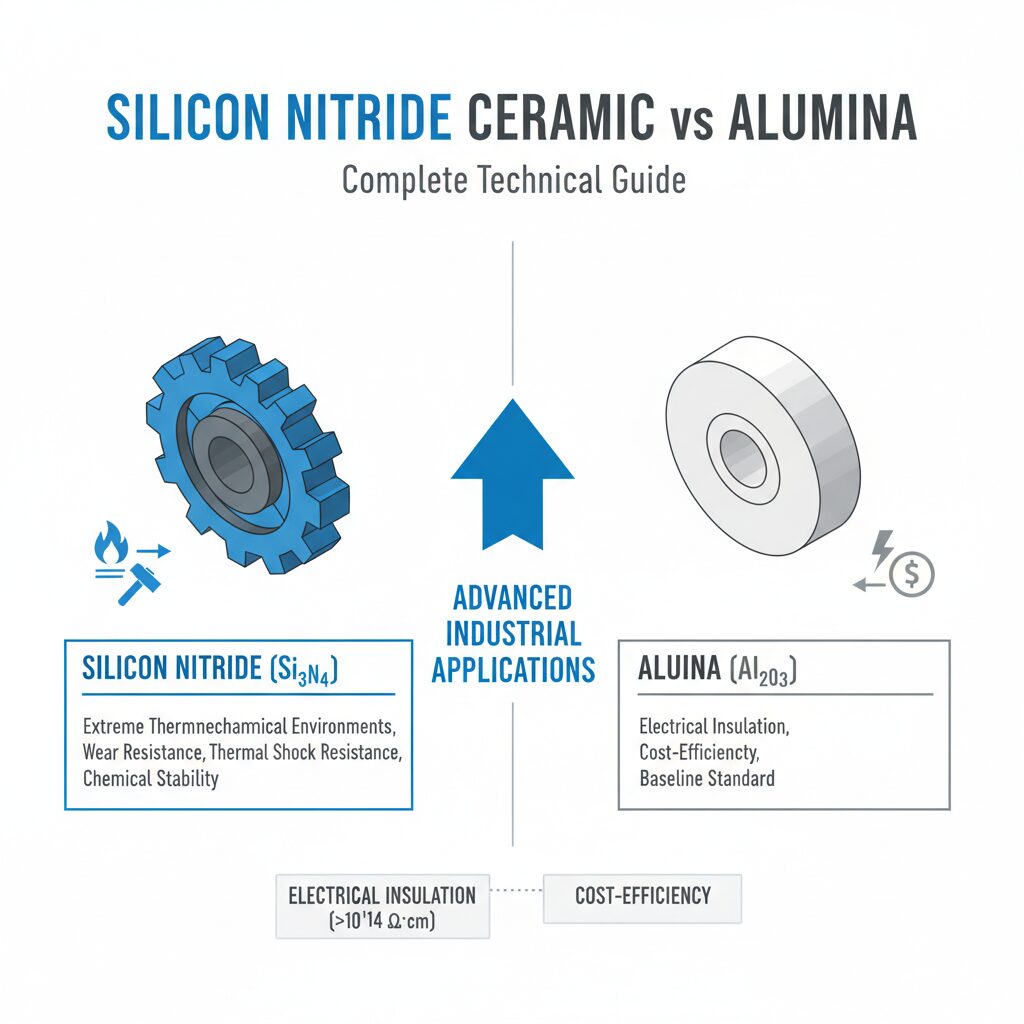
In contrast to tlenek glinu. This provides excellent electrical insulation (>10¹⁴ Ω·cm) but moderate thermal conductivity (25 W/m·K), boron nitride acts as a superior heat sink, dissipating thermal loads 2.4 times faster. Furthermore, while azotek krzemu provides outstanding thermal shock resistance allowing it to survive quenching from 1000°C to 20°C, it requires highly specialized diamond grinding to achieve tight tolerances, driving up prototyping costs. Boron nitride, conversely, can be rapid-prototyped on standard 5-axis CNC centers utilizing spindle speeds of 15,000 RPM and feed rates of 400 mm/min, mirroring the production cycles of engineering plastics.
Boron Nitride vs High-Performance Plastics Data
To fully resolve the boron nitride ceramic vs plastic debate, direct data comparison against industry-standard high-performance polymers (PEEK and PTFE) is mandatory. Plastics rely on carbon-carbon covalent bonds that inherently limit their high-temperature kinetic stability. At temperatures exceeding 250°C, PEEK begins to lose structural rigidity, its flexural modulus dropping from 4.0 GPa to under 1.0 GPa. In contrast, h-BN utilizes strong boron-nitrogen covalent bonding arranged in hexagonal planar lattices, resisting thermal degradation and maintaining a stable 35 MPa flexural strength up to 1000°C in oxidizing atmospheres and 1900°C in vacuum environments.
| Nieruchomość | Azotek boru (h-BN) | PEEK (Unfilled) | PTFE (Teflon) |
|---|---|---|---|
| Maksymalna temperatura pracy (°C) | 1900 (próżnia) | 250 | 260 |
| Przewodność cieplna (W/m-K) | 60.0 | 0.25 | 0.25 |
| Coefficient of Thermal Expansion (10⁻⁶/°C) | 1.2 – 4.3 | 47.0 | 100.0 – 160.0 |
| Outgassing Rate at 10⁻⁷ Torr | Zero | Low/Moderate | Umiarkowany |
The thermal conductivity disparity is the most critical engineering factor. PTFE and PEEK act as thermal insulators with values hovering at 0.25 W/m·K. In high-power electronic packaging or plasma etching chambers generating 5,000 Watts of thermal energy, plastic fixtures trap heat, leading to localized melting and catastrophic system failure. Boron nitride’s 60 W/m·K thermal conductivity actively pulls heat away from sensitive semiconductor wafers, while its zero-outgassing characteristics ensure that no hydrocarbon particulates are deposited onto wafers during chemical vapor deposition processes operating at 10⁻⁸ Torr.
Aplikacje
- Sprzęt do przetwarzania płytek półprzewodnikowych: Plasma etching chambers utilize RF frequencies at 13.56 MHz and gas plasmas (like CF4 or SF6) that rapidly degrade PTFE plastics. Engineers choose boron nitride for electrostatic chucks and isolation rings because its low dielectric constant (4.0 at 1 MHz) prevents RF energy loss, while its high thermal conductivity (60 W/m·K) stabilizes wafer temperatures during 800°C etching cycles without releasing contaminating hydrocarbons.
- High-Temperature Vacuum Furnace Insulation: In vacuum sintering furnaces operating at 10⁻⁵ Torr and temperatures hitting 1800°C, traditional polymers instantly vaporize. Boron nitride is selected for standoff insulators, thermocouple protection tubes. And heating element supports because it will not melt, outgas, or conduct electricity (resistivity >10¹⁴ Ω·cm), ensuring stable furnace operation without arching at 500V to 1000V operating potentials.
- Molten Metal Handling Components: When casting non-ferrous metals like aluminum (pouring at 700°C) or magnesium (pouring at 650°C), contact fixtures made of plastic are entirely unviable. Boron nitride exhibits extreme non-wetting characteristics, boasting a contact angle greater than 120° against molten aluminum. It is used for break rings, crucibles. And atomization nozzles, completely preventing slag adhesion and eliminating the 10% to 15% metal loss typically associated with reactive casting surfaces.
- PVD and CVD Coating Fixtures: Physical Vapor Deposition (PVD) processes require masking fixtures that can withstand localized plasma heating up to 1000°C while maintaining dimensional tolerances of ±0.010mm. Plastics warp due to their 47 x 10⁻⁶ /°C thermal expansion. Engineers transition to boron nitride because its low CTE of 1.2 x 10⁻⁶ /°C ensures masks do not shift during coating, preventing 5 μm to 10 μm coating bleed errors on precision optics and medical implants.
- High-Frequency Microwave Electronics: In 5G telecommunications and aerospace radar systems operating between 10 GHz and 40 GHz, signal attenuation is a critical failure point. While PTFE offers a low dissipation factor, it lacks the mechanical rigidity to maintain tight dimensional geometries under thermal load. Boron nitride offers a dissipation factor of 0.0003 at 10 GHz alongside 35 MPa flexural strength, making it the superior substrate for traveling wave tube (TWT) insulators and klystron components.
Proces produkcji
The transition from raw chemical precursors to a fully densified, highly machinable technical ceramic requires stringent thermodynamic control. Unlike injection-molded plastics that are formed at 250°C to 300°C at pressures of 50 MPa to 100 MPa, the creation of boron nitride ceramic involves synthesizing high-purity boron and nitrogen powders and subjecting them to extreme heat and pressure over multiday cycles. Achieving the dense, uniform microstructure required to hold ±0.005mm machining tolerances demands precise management of particle size distribution (typically 1 μm to 5 μm) and binder removal.
Metody formowania
- Uniaxial Hot Pressing: The most common method for producing machinable h-BN billets. Boron nitride powder is loaded into graphite dies and subjected to 15 MPa to 30 MPa of mechanical pressure while simultaneously being heated to temperatures between 1800°C and 2000°C. This dual-action process forces the hexagonal platelets to align perpendicular to the pressing direction, resulting in a density >2.0 g/cm³ and inducing the material’s characteristic anisotropic thermal and mechanical properties.
- Prasowanie izostatyczne na gorąco (HIP): For applications requiring completely isotropic properties and near-theoretical density (99.9%), HIP utilizes inert argon gas at pressures exceeding 100 MPa and temperatures up to 2000°C. This method eliminates the 1% to 3% residual porosity found in uniaxial pressing, yielding a material with highly uniform 45 W/m·K to 50 W/m·K thermal conductivity across all X, Y. And Z axes, essential for critical aerospace heat sinks.
Spiekanie
Because boron nitride degrades via oxidation at temperatures above 900°C, the sintering and hot-pressing stages must be conducted in strictly controlled vacuum or inert atmospheres (nitrogen or argon). Sintering hold times range from 4 to 12 hours at 1900°C, allowing the atomic diffusion of boron and nitrogen to fuse the grain boundaries. Binders, such as calcium borate (typically 2% to 6% by weight), are often utilized to promote liquid-phase sintering. This drops the required densification temperature to 1600°C but limits the final component’s maximum operating temperature to roughly 1400°C due to binder volatilization.
Obróbka końcowa
The final subtractive phase is where boron nitride truly mimics engineering plastics. Utilizing precyzyjna obróbka ceramiki protocols, standard multi-axis CNC mills and lathes are employed. To achieve Great Ceramic’s guaranteed ±0.005mm tolerances, high-speed polycrystalline diamond (PCD) endmills operate at 15,000 to 24,000 RPM. Feed rates are optimized between 200 mm/min and 500 mm/min with a depth of cut strictly limited to 0.1mm to 0.5mm per pass. This prevents edge chipping, a common failure mode when cutting the highly directional h-BN crystal structure. Surface finishes of Ra 0.2 μm to Ra 0.4 μm are routinely achieved without the need for post-process diamond lapping.
Zalety i ograniczenia
Zalety
- Niezrównana obrabialność: With a hardness of just 30 HV, h-BN can be milled, turned. And threaded with the same geometric complexity as PEEK or Delrin, allowing for M1.6 micro-threads and wall thicknesses down to 0.20mm without the exorbitant costs of diamond grinding.
- Ekstremalna stabilność termiczna: Maintains crystalline integrity and a 35 MPa flexural strength up to 1900°C in vacuum and 2100°C in inert nitrogen, environments where polymers completely vaporize and standard metals liquify.
- Doskonała odporność na szok termiczny: The low CTE (1.2 x 10⁻⁶ /°C) and high thermal conductivity (60 W/m·K) allow components to be instantly quenched from 1200°C to 20°C ambient temperatures without initiating micro-crack propagation or catastrophic fracture.
- Zero Outgassing: Unlike PTFE which emits fluorinated hydrocarbon vapors at elevated temperatures, completely sintered h-BN contains zero volatile organic compounds, making it fully compliant for ultra-high vacuum (UHV) semiconductor applications operating at 10⁻⁸ Torr.
Ograniczenia
- Niska wytrzymałość mechaniczna: With a flexural strength of roughly 35 MPa and a fracture toughness of 1.2 MPa·m½, h-BN is extremely brittle under high tensile loads or impact forces, drastically underperforming węglik krzemu (400 MPa) in structural or load-bearing applications.
- Oxidation Susceptibility: When exposed to ambient air containing oxygen, pure h-BN begins to oxidize at temperatures exceeding 900°C, forming a layer of boron trioxide (B2O3) which compromises electrical insulation and dimensional tolerances, requiring inert atmospheres for extreme high-temperature use.
Rozważania dotyczące obróbki
When comparing the manufacturability of boron nitride ceramic vs plastic, engineers must account for environmental control during the subtractive manufacturing process. While PTFE and PEEK can be flooded with water-based coolants during CNC milling to clear chips, boron nitride is highly hydroscopic due to residual porosity (ranging from 1% to 4%) and the presence of residual boron oxide binders. Exposure to water-based cutting fluids causes the ceramic to absorb moisture. This immediately degrades its >10¹⁴ Ω·cm electrical resistivity and induces steam-expansion micro-cracking if the component is subsequently heated to 500°C. Therefore, h-BN must be dry-machined utilizing high-velocity air-blasts at 80 PSI to 100 PSI to evacuate the abrasive “white graphite” dust.
To hit stringent dimensional requirements, tool deflection must be mathematically zeroed. Due to the material’s anisotropy, tools experience variable resistance depending on whether they are cutting parallel or perpendicular to the original hot-pressing axis. Compensating for this requires rigid 5-axis gantry mills and precision tool holding (HKS shrink-fit chucks) run-out limited to less than 0.002mm. Struggling to achieve ±0.005mm tolerances in advanced ceramic materials? Submit your CAD files to Great Ceramic for comprehensive design-for-manufacturability (DFM) analysis and high-yield production. Post-machining, parts are strictly measured using Coordinate Measuring Machines (CMM) with 0.001mm ruby-probe resolution. And subsequently baked out in a 200°C vacuum oven for 4 hours to eliminate any trace atmospheric moisture prior to vacuum-sealed cleanroom packaging.
FAQ
What is boron nitride ceramic?
Boron nitride ceramic (specifically the hexagonal h-BN variant) is an advanced synthetic technical material composed of boron and nitrogen atoms arranged in a graphite-like crystalline lattice. Synthesized under extreme heat (up to 2000°C) and pressure (up to 30 MPa), it is renowned for its unique combination of extreme thermal stability (surviving up to 1900°C in vacuum), high electrical resistivity (>10¹⁴ Ω·cm), high thermal conductivity (60 W/m·K). And low hardness (30 HV). This low hardness earns it the nickname “white graphite,” allowing it to be CNC machined with standard carbide tooling to complex geometries typically reserved for soft engineering plastics, making it the ultimate solution for high-heat, high-vacuum insulating components.
What are the main applications of boron nitride ceramic?
Due to its high thermal conductivity (60 W/m·K) and low dielectric constant (4.0), boron nitride is primarily utilized in extreme environment electronics and high-temperature manufacturing. Major applications include electrostatic chucks and isolation rings in semiconductor plasma etching chambers operating at 800°C. standoff insulators and heating element supports in vacuum furnaces reaching 1800°C. non-wetting crucibles and break rings for continuous casting of 700°C molten aluminum. and precision holding fixtures for Physical Vapor Deposition (PVD) processes where dimensional stability (CTE of 1.2 x 10⁻⁶ /°C) is critical to preventing 5 μm coating errors. It is also heavily used in microwave traveling wave tubes for aerospace radar.
How does boron nitride ceramic compare to other ceramics?
Compared to other advanced ceramics, boron nitride sacrifices mechanical brute strength in favor of supreme machinability and thermal shock resistance. While alumina and zirconia boast high hardness (1500 HV and 1200 HV respectively) and flexural strengths exceeding 350 MPa, they require slow, expensive diamond-wheel grinding to achieve tight tolerances. Boron nitride has a low hardness of 30 HV and a flexural strength of 35 MPa, allowing rapid CNC milling. Additionally, h-BN provides superior thermal conductivity (60 W/m·K) compared to alumina (25 W/m·K), making it a vastly superior heat sink. However, for applications requiring high wear resistance or structural load bearing, silicon nitride (1600 HV) or silicon carbide are preferred.
What are the advantages of using boron nitride over high-performance plastics?
The primary advantage of boron nitride over plastics like PEEK or PTFE is survival in extreme thermodynamic and vacuum environments. Engineering plastics suffer structural degradation at 250°C to 300°C and act as thermal insulators with conductivities around 0.25 W/m·K. Boron nitride maintains structural integrity up to 1900°C in a vacuum and dissipates heat 240 times faster (60 W/m·K). Furthermore, plastics exhibit moderate to high outgassing rates in vacuums of 10⁻⁶ Torr, releasing hydrocarbons that destroy delicate chemical vapor deposition (CVD) processes. Fully sintered h-BN contains zero volatile compounds, ensuring pure, zero-outgassing performance in ultra-high vacuum environments.
How is boron nitride ceramic machined?
Boron nitride is machined using subtractive CNC processes highly similar to those used for brass or rigid plastics, but with strict environmental controls. Because it has a low hardness of 30 HV, standard multi-axis CNC mills utilize high-speed polycrystalline diamond (PCD) or tungsten carbide endmills operating at 15,000 to 24,000 RPM. Machining must be performed entirely dry using 80 PSI to 100 PSI air-blasts to clear chips, as h-BN will absorb water-based liquid coolants, degrading its electrical resistivity. Great Ceramic leverages advanced precyzyjna obróbka ceramiki capabilities, combining rigid 5-axis tooling with strict metrology to maintain tight tolerances down to ±0.005mm and surface finishes as fine as Ra 0.2 μm without micro-fracturing the delicate edges.
Need custom boron nitride ceramic parts? Kontakt Great Ceramic w przypadku usług precyzyjnej obróbki skrawaniem o wąskich tolerancjach lub wyślij wiadomość e-mail na adres [email protected].
boron nitride ceramic vs plastic is widely used in advanced ceramic applications.
Dowiedz się więcej o Ceramika z azotku boru a tworzywo sztuczne i nasze usługi precyzyjnej obróbki ceramiki.