









Comprehensive Engineering Guide to Tlenek glinu Ceramic Parts: Properties, CNC Machining. And Industrial Applications
In the realm of advanced material science, alumina ceramic parts stand as a cornerstone for modern industrial innovation. Known scientifically as Aluminum Oxide (Al2O3), alumina is the most widely used technical ceramic material due to its exceptional balance of mechanical, thermal. And electrical properties. Whether it is used in the high-heat environment of a semiconductor furnace or the corrosive depths of a chemical processing plant, alumina ceramic parts provide the durability and precision required by elite engineering standards.
Great Ceramic specializes in the precision manufacturing and CNC machining of these high-performance components. This guide provides an in-depth technical analysis of alumina ceramic, covering its material grades, engineering properties, machining challenges. And the diverse industries that rely on its unique characteristics.
The Fundamental Characteristics of Alumina Ceramics
Alumina is a versatile ceramic material available in various purity levels, typically ranging from 95% to 99.8%. The purity of the material significantly influences its performance characteristics. Higher purity alumina generally offers better corrosion resistance and higher mechanical strength, though it may require more complex processing techniques.
At its core, alumina is characterized by its ionic-covalent atomic bonding. This gives rise to its incredible hardness and stability. It is an electrically non-conductive and chemically inert material, making it the ideal candidate for environments where metals would succumb to oxidation or electrolytic failure.
Key Advantages of Alumina Ceramic Parts:
- Extreme Hardness: Ranking just below diamond on the Mohs scale, alumina offers superior wear resistance.
- Stabilność w wysokich temperaturach: Retains mechanical integrity at temperatures exceeding 1500°C.
- Corrosion Resistance: Inert to most acids and alkaline solutions even at elevated temperatures.
- Izolacja elektryczna: High dielectric strength makes it a premier material for high-voltage applications.
- Biocompatibility: Used extensively in medical implants and laboratory equipment.
Technical Property Tables
Understanding the quantitative data behind alumina is essential for design engineers. Below are the technical specifications for the most common grades of alumina ceramic parts used in industrial applications.
| Nieruchomość | Jednostka | 95% Tlenek glinu | 99% Tlenek glinu | 99.8% Tlenek glinu |
|---|---|---|---|---|
| Gęstość | g/cm³ | 3.65 | 3.90 | 3.96 |
| Twardość (HV) | GPa | 12.5 | 15.0 | 18.0 |
| Wytrzymałość na zginanie | MPa | 300 | 350 | 400 |
| Wytrzymałość na ściskanie | MPa | 2000 | 2500 | 3000 |
| Przewodność cieplna | W/m-K | 18-22 | 25-30 | 35-40 |
| Max Use Temperature | °C | 1400 | 1600 | 1750 |
| Wytrzymałość dielektryczna | kV/mm | 10-15 | 15-20 | 20-25 |
Alumina Ceramic Purity Grades and Selection
Selecting the right grade of alumina is a balance between performance requirements and cost-effectiveness. While 99.8% alumina provides the highest thermal and chemical resistance, 95% alumina is often sufficient for mechanical wear parts and electrical insulators where cost is a factor.
95% Tlenek glinu
Often utilized in general industrial applications, 95% alumina contains a small percentage of sintering aids (like silica or magnesia). These additives lower the firing temperature and improve the ease of manufacturing. It is commonly used for wear-resistant liners, spark plug insulators. And mechanical seals.
99% – 99.5% Alumina
This grade is preferred for semiconductor components and high-vacuum environments. It offers a higher degree of chemical purity, reducing the risk of outgassing or contamination in sensitive electronics manufacturing. Its increased hardness makes it ideal for precision laboratory equipment.
99.8% High Purity Alumina (HPA)
HPA is used in the most demanding environments, such as aerospace propulsion components and high-energy laser systems. It features the lowest porosity and the highest resistance to plasma erosion. When your application involves extreme chemical exposure at temperatures near 1700°C, 99.8% alumina is the industry standard.
CNC Machining of Alumina Ceramic Parts
Machining alumina ceramic parts presents a unique set of challenges compared to metals or plastics. Due to its extreme hardness and inherent brittleness, alumina cannot be “cut” in the traditional sense using high-speed steel or carbide tools. Instead, it requires specialized CNC machining processes utilizing diamond-coated tooling and abrasive grinding techniques.
1. Green Machining (Pre-Sintering)
Before the ceramic is fired in a kiln, it is in a “green” or “bisque” state. In this state, the material is soft enough to be machined using traditional carbide tools. Green machining allows for the removal of large amounts of material quickly. However, designers must account for a shrinkage factor (often 15-20%) that occurs during the final sintering process. Precise calculations are required to ensure the final part meets dimensions.
2. Diamond Grinding (Post-Sintering)
Once the alumina is sintered, it reaches its full hardness. To achieve tight tolerances (down to +/- 0.001mm) and high-quality surface finishes, CNC diamond grinding is employed. This involves high-precision grinding wheels embedded with industrial diamond particles. This process is slow and requires constant cooling to prevent thermal shock, but it is the only way to achieve the precision required for semiconductor and aerospace components.
3. CNC Laser Drilling and Milling
For complex geometries or micro-holes that are impossible to reach with a grinding wheel, CNC laser machining is used. This allows for intricate patterns and very small diameters in thin alumina wafers. However, care must be taken to manage the heat-affected zone to prevent micro-cracking.
4. Ultrasonic Machining
For deep cavities or non-round holes, ultrasonic machining uses a vibrating tool and an abrasive slurry to gradually erode the ceramic. This method exerts very little mechanical stress on the part, making it ideal for thin-walled or fragile alumina ceramic parts.
Design Guidelines for Alumina Components
Engineering for ceramics requires a different mindset than engineering for metals. To maximize the longevity of alumina ceramic parts and minimize manufacturing costs, engineers should follow these design principles:
- Avoid Sharp Corners: Sharp internal corners create stress concentrations that can lead to crack propagation. Always use radii or fillets.
- Symmetry is Key: Symmetrical designs help the part shrink uniformly during sintering, reducing the risk of warping.
- Wall Thickness: Maintain uniform wall thickness wherever possible. Transitions between thick and thin sections should be gradual.
- Threads: Threading alumina is difficult and creates weak points. It is often better to use ceramic-to-metal bonding or mechanical clamping rather than direct threading.
- Tolerances: Be realistic with tolerances. As-fired tolerances are typically +/- 1%, whereas diamond-ground tolerances can reach +/- 0.001mm but at a significantly higher cost.
Critical Industry Applications
The versatility of alumina ceramic parts has led to their adoption across a wide spectrum of modern industries. Below are the primary sectors where alumina is indispensable.
Półprzewodniki i elektronika
In the semiconductor industry, purity and electrical insulation are paramount. Alumina ceramic parts are used as wafer chucks, end effectors, insulators for plasma etching equipment. And substrates for thin-film circuits. Its resistance to plasma erosion ensures a long lifespan in CVD (Chemical Vapor Deposition) and PVD (Physical Vapor Deposition) chambers.
Przemysł lotniczy i obronny
Alumina’s high strength-to-weight ratio and thermal stability make it ideal for aerospace applications. It is used in rocket engine nozzles, radomes (radar-transparent covers). And as high-temperature electrical bushings in aircraft engines. In defense, alumina is a primary component in ballistic armor plates due to its ability to dissipate the kinetic energy of projectiles.
Medical and Pharmaceutical
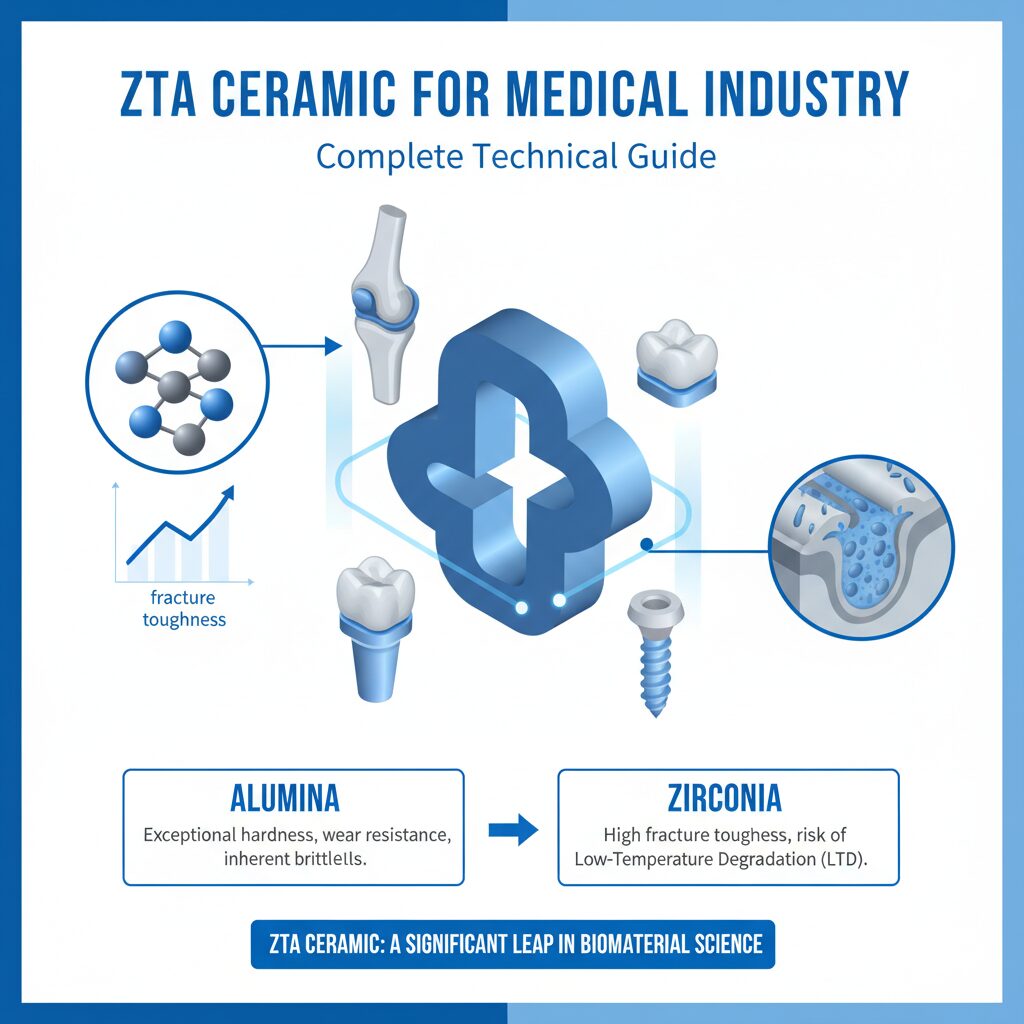
Because it is bio-inert, alumina does not react with human tissue or fluids. This makes it a standard material for hip replacement balls, dental implants. And surgical components. In pharmaceutical manufacturing, alumina plungers and valves provide a contamination-free environment for liquid filling and processing.
Chemical and Petrochemical
Alumina ceramic parts are used in pump seals, valve seats. And flow meters that handle aggressive chemicals. Unlike stainless steel, alumina will not corrode in the presence of sulfuric acid, hydrochloric acid, or high-temperature caustic solutions, significantly reducing maintenance downtime for chemical plants.
Wytwarzanie energii
In both traditional and renewable energy sectors, alumina acts as a high-voltage insulator. It is also used in coal-fired power plants as wear-resistant piping liners to protect against the abrasive nature of pulverized coal flow.
Advanced Surface Finishing Techniques
The performance of an alumina ceramic part is often determined by its surface finish. Depending on the application, parts may undergo several finishing stages:
- As-Fired Finish: The surface texture after the kiln. Usually around 0.8–1.6 µm Ra. Suitable for basic structural parts.
- Lapping: A process using loose abrasive to produce extremely flat surfaces (optical flatness) and a smooth finish (0.1 µm Ra). Essential for mechanical seals.
- Polishing: Using finer diamond pastes to achieve a mirror-like finish. Polishing reduces friction and improves the fatigue life of the ceramic.
- Glazing: Applying a glass coating to the ceramic surface to make it impermeable and easier to clean, often used in laboratory or sanitary applications.
Comparing Alumina to Other Technical Ceramics
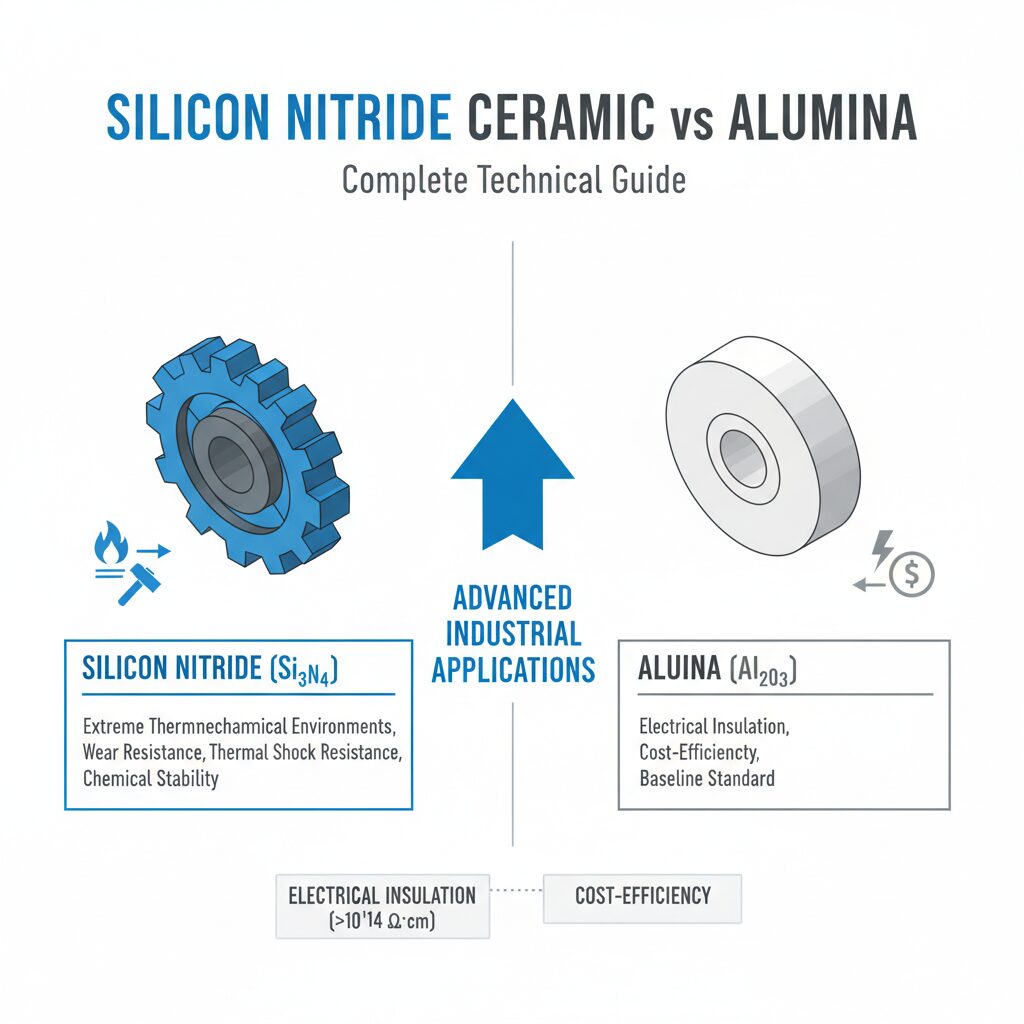
While alumina is the “workhorse” of the ceramic world, other materials like Zirconia or Silicon Carbide may be better suited for specific niches. Understanding the differences is vital for material selection.
Alumina vs. Zirconia (ZrO2)
Zirconia offers much higher fracture toughness than alumina, meaning it is less brittle and can withstand more impact. However, alumina has a higher maximum service temperature and better thermal conductivity than Zirconia. Use Zirconia for high-impact mechanical parts. use Alumina for high-heat or electrical insulation.
Alumina vs. Silicon Carbide (SiC)
Silicon Carbide is harder and has much higher thermal conductivity than Alumina. It is often used in high-performance heat exchangers. However, SiC is more expensive and difficult to machine. Alumina remains the preferred choice for general-purpose high-temperature and electrical applications due to its cost-to-performance ratio.
Quality Control and Testing of Alumina Parts
At Great Ceramic, we ensure that every alumina component meets rigorous quality standards. Technical ceramics require specialized inspection methods:
- CMM Inspection: Coordinate Measuring Machines verify dimensional accuracy to the micron level.
- Dye Penetrant Testing: Used to detect surface cracks or porosity that are invisible to the naked eye.
- SEM Analysis: Scanning Electron Microscopy is used for high-purity applications to verify grain size and material homogeneity.
- Testy ultradźwiękowe: To detect internal voids or structural inconsistencies within the ceramic body.
Często zadawane pytania (FAQ)
1. Is alumina ceramic brittle?
Yes, like most technical ceramics, alumina is brittle. It has high compressive strength but relatively low tensile strength and fracture toughness. This means it can support heavy loads but may crack if subjected to sudden impact or sharp bending forces. Design considerations like adding radii to corners can mitigate this.
2. Can I drill holes in alumina ceramic parts?
Holes can be drilled, but not with standard drill bits. Before sintering (in the green state), they can be drilled with carbide tools. After sintering, holes must be created using diamond-core drills or ultrasonic machining. It is always more cost-effective to design holes that can be formed during the initial molding or green machining stages.
3. How does temperature affect the dimensions of alumina?
Alumina has a relatively low coefficient of thermal expansion (approx. 7-8 x 10^-6/°C). While it is very stable, designers must still account for expansion in assemblies where alumina is joined to metals. This typically expand much faster. This difference in expansion can lead to stress at the joint interface.
4. What is the lead time for custom alumina ceramic parts?
Lead times vary depending on the complexity and whether green machining or post-sinter grinding is required. Generally, custom parts take between 4 to 8 weeks. This includes the time for tooling, forming, drying, sintering (which can take several days). And final precision grinding.
5. Is alumina ceramic safe for food contact?
Yes, high-purity alumina (99% and above) is non-toxic and chemically stable, making it safe for food processing and medical applications. It does not leach chemicals and can be easily sterilized at high temperatures.
6. Why is alumina used as an electrical insulator?
Alumina has a very high band gap, meaning electrons cannot easily flow through the material. It maintains high volume resistivity even at high temperatures, where many other insulators begin to fail. This makes it ideal for power tubes, vacuum feedthroughs. And heater supports.
7. What is the difference between “As-Fired” and “Ground” finishes?
“As-Fired” refers to the surface state directly out of the kiln. This is slightly rough and has a wider tolerance. “Ground” finish refers to surfaces that have been precision-machined with diamond wheels to achieve exact dimensions and a smooth finish. Ground surfaces are necessary for parts that must fit together precisely.
Conclusion: Choosing the Right Partner for Alumina Components
The manufacturing of alumina ceramic parts is a highly specialized field that requires a deep understanding of material science and precision engineering. Because ceramics do not behave like metals, the success of your project depends on selecting a manufacturer who understands the nuances of sintering, shrinkage. And diamond machining.
Alumina remains the premier choice for engineers seeking a material that offers high-temperature resistance, incredible hardness. And excellent electrical insulation. By following the design guidelines and choosing the appropriate purity grade, you can leverage the power of alumina to solve the most difficult engineering challenges in your industry.
Skontaktuj się z Great Ceramic, aby uzyskać obróbka ceramiki solutions tailored to your application. Our team of experts is ready to assist with material selection, design optimization. And high-precision manufacturing to ensure your project’s success.
alumina ceramic ceramic parts is widely used in advanced ceramic applications.
Dowiedz się więcej o Części ceramiczne z tlenku glinu i nasze usługi precyzyjnej obróbki ceramiki.