








Silicon Nitride Ceramic Ceramic Plate for Medical: Complete Technical Guide
The medical device industry demands materials that seamlessly bridge the gap between mechanical integrity and biological compatibility. When engineers and biomedical researchers require a Siliziumnitrid ceramic ceramic plate for medical applications, they are actively addressing the critical pain points of traditional implant materials—such as the poor osseointegration of polyetheretherketone (PEEK) and the long-term wear degradation of titanium alloys. Medical-grade silicon nitride (Si3N4) has emerged as a revolutionary biomaterial, offering an unparalleled combination of high fracture toughness (up to 8.0 MPa·m½), extreme wear resistance. And inherent antibacterial properties. Furthermore, its radiolucent nature ensures artifact-free imaging under MRI and CT scans, a vital requirement for postoperative diagnostics.
However, transitioning from raw powder to a clinical-grade implant requires exceptionally precise manufacturing. The extreme hardness of the material (1500–1800 HV) makes post-sintering fabrication incredibly challenging, often resulting in micro-cracking if not handled properly. Great Ceramic specializes in addressing these exact challenges. With our advanced Präzisionskeramikbearbeitung capabilities, we consistently deliver medical substrates and orthopedic components with rigid dimensional tolerances of ±0.005mm, ensuring perfect anatomical fit and long-term reliability. If your R&D team is scaling a new medical device, contact Great Ceramic today to discuss your precision machining requirements.
Materialeigenschaften
Understanding the thermomechanical and physical properties of a silicon nitride ceramic ceramic plate for medical use is crucial for orthopedic and diagnostic equipment engineering. The material exhibits a unique biphasic microstructure consisting of elongated beta-phase (β-Si3N4) grains embedded in an intergranular glassy phase. This interlocking fibrous structure is responsible for the material’s phenomenal mechanical reliability. With a density of strictly controlled 3.20 to 3.30 g/cm³, it closely mimics the mass-to-volume ratio of cortical bone (approximately 1.85 to 2.0 g/cm³), reducing the weight burden on the patient while providing load-bearing capabilities that far exceed human physiological requirements.
The flexural strength of medical-grade silicon nitride typically ranges between 800 and 1000 MPa, depending on the specific yttria (Y2O3) and Tonerde (Al2O3) sintering additives used. This extreme strength allows for the design of low-profile, thin-walled spinal cages and joint replacement plates that can withstand the dynamic, cyclical loading of human movement. A standard lumbar spine experiences compressive loads of up to 1,500 Newtons during normal activity. Si3N4 easily accommodates these forces without plastic deformation. Additionally, its high electrical resistivity (>10¹⁴ Ω·cm) makes it an excellent insulator for electrosurgical instrumentation, preventing stray currents from damaging surrounding healthy tissue during procedures operating at 300 to 500 kHz frequencies.
| Eigentum | Wert | Einheit |
|---|---|---|
| Dichte | 3.25 | g/cm³ |
| Härte | 1600 | HV |
| Biegefestigkeit | 900 | MPa |
| Bruchzähigkeit | 7.5 | MPa-m½ |
| Wärmeleitfähigkeit | 25 | W/m-K |
| Elektrischer spezifischer Widerstand | >10¹⁴ | Ω-cm |
| Maximale Betriebstemperatur | 1200 | °C |
Vergleich mit anderen Keramiken
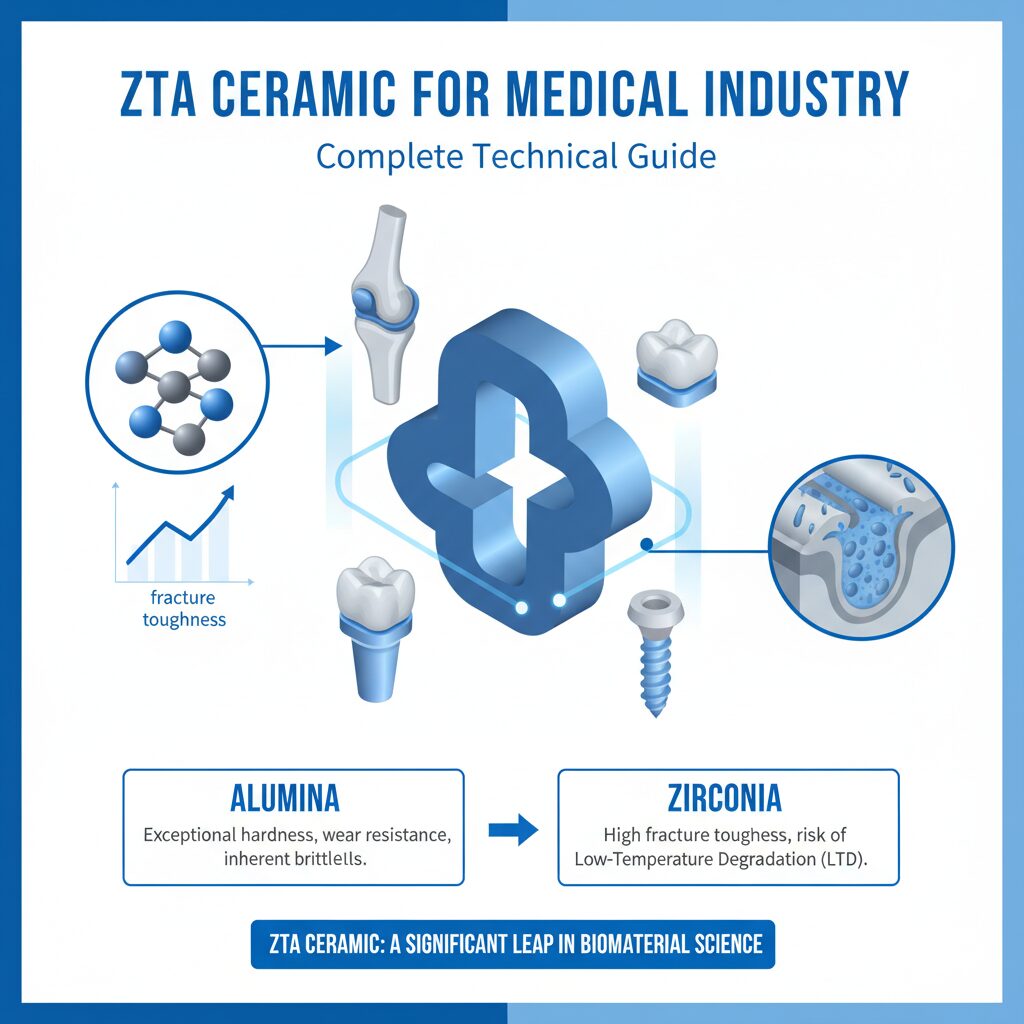
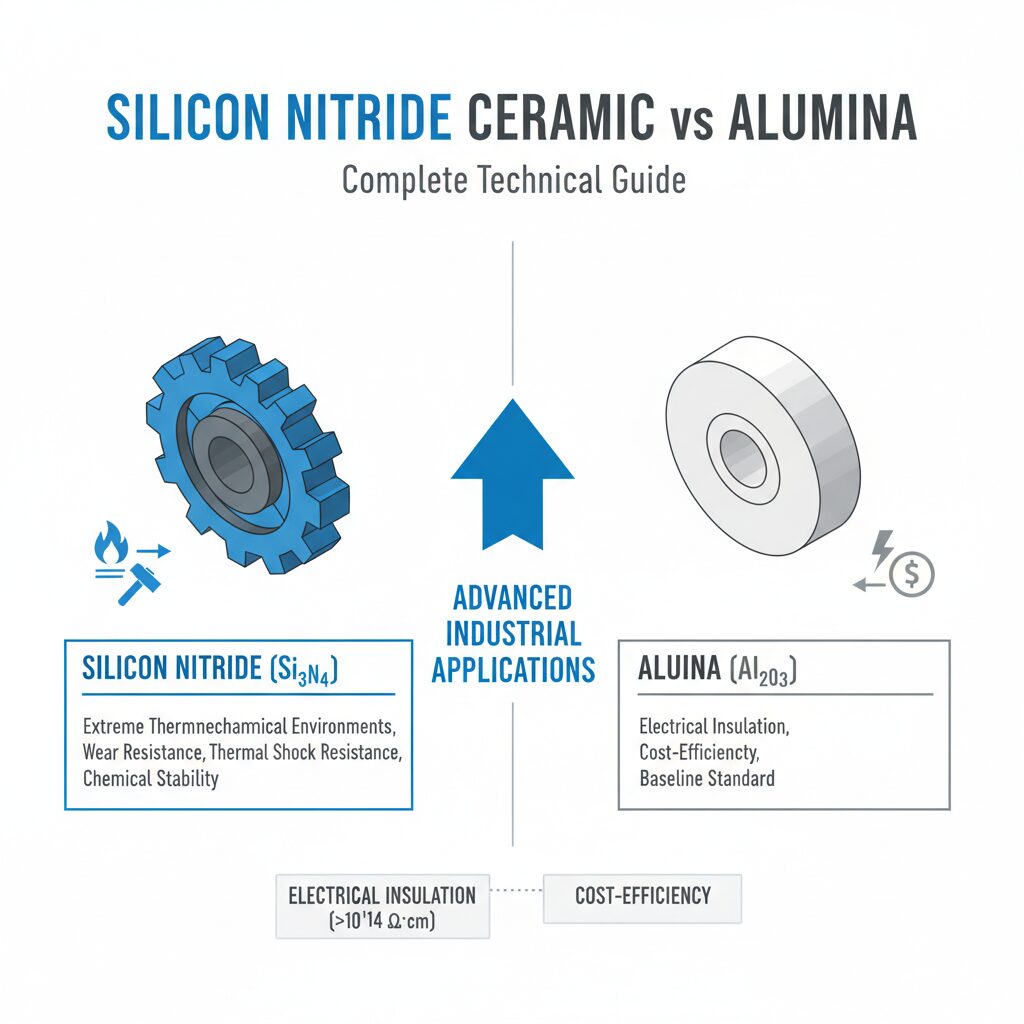
When selecting biomaterials, engineers frequently evaluate silicon nitride against other established bioceramics. Medical-grade alumina, while highly biocompatible and wear-resistant, suffers from inherently low fracture toughness (typically 3.0 to 4.0 MPa·m½). This makes pure Tonerde susceptible to catastrophic brittle failure under tensile or impact loads, limiting its use in specific load-bearing joint arthroplasties. Conversely, Zirkoniumdioxid—specifically Yttria-Stabilized Tetragonal Zirconia Polycrystal (Y-TZP)—boasts high initial strength (up to 1200 MPa) and fracture toughness (up to 9.0 MPa·m½). However, zirconia is prone to Low-Temperature Degradation (LTD) or hydrothermal aging in the moisture-rich, 37°C environment of the human body. This phase transformation from tetragonal to monoclinic leads to micro-cracking and a significant reduction in long-term mechanical strength.
A silicon nitride ceramic ceramic plate for medical use circumvents both of these critical failure modes. It offers the high-impact reliability of zirconia without the risk of hydrothermal aging. And it provides superior wear performance compared to alumina. Furthermore, when compared to standard industrial-grade Siliziumnitrid, the medical variant requires much stricter control over sintering additives and porosity (achieving >99.5% theoretical density) to meet ISO 10993 biocompatibility standards. The cost of medical-grade silicon nitride is correspondingly higher due to these stringent quality control measures, rigorous FDA/CE documentation traceability. And the complex ±0.005mm precision machining processes required to achieve the necessary surface finish (Ra < 0.1 µm) for optimal osteointegration.
| Eigentum | Silicon Nitride Ceramic Ceramic Plate for Medical | Tonerde | Zirkoniumdioxid | Siliziumnitrid |
|---|---|---|---|---|
| Wärmeleitfähigkeit | 25 W/m-K | 30 W/m·K | 2,5 W/m·K | 30 W/m·K |
| Härte | 1600 HV | 1800 HV | 1200 HV | 1500 HV |
| Bruchzähigkeit | 7.5 MPa·m½ | 3,5 MPa·m½ | 8.5 MPa·m½ | 6.5 MPa·m½ |
| Kosten | Premium | Niedrig | Mittel | Hoch |
Anwendungen
- Spinal Fusion Spacers and Cervical Cages: In interbody fusion procedures, materials must promote bone growth while bearing significant axial loads. A silicon nitride ceramic ceramic plate for medical use is chosen because its hydrophilic surface (with a water contact angle of just 10–15 degrees) actively promotes the adsorption of blood proteins and osteoblasts. Unlike hydrophobic PEEK. This often forms a fibrous tissue capsule, Si3N4 achieves direct appositional bone growth. Furthermore, its compressive strength of >3000 MPa prevents device subsidence into the vertebral endplates, a common complication in spinal surgeries.
- Orthopedic Joint Replacement Bearings: Hip and knee arthroplasty require materials with exceptionally low friction coefficients and high wear resistance to prevent the generation of particulate debris. This can lead to osteolysis and aseptic loosening. Silicon nitride provides a tribological advantage, demonstrating wear rates of less than 1.0 x 10⁻⁶ mm³/Nm when articulated against itself or cross-linked polyethylene. It is chosen over cobalt-chromium alloys because it completely eliminates the risk of heavy metal ion release (metallosis) into the patient’s bloodstream.
- Maxillofacial and Dental Implants: Dental restorations demand materials that not only withstand the extreme cyclical biting forces (up to 800 N in the molar region) but also resist bacterial colonization. Silicon nitride is specifically selected for this scenario because its surface chemistry naturally lyses bacteria. As the material’s surface reacts with the aqueous environment of the mouth, it forms microscopic amounts of peroxynitrite, a radical that breaks down the cell walls of harmful bacteria like *Porphyromonas gingivalis*, drastically reducing the risk of peri-implantitis without harming human tissue.
- Surgical Instruments and Cutting Tools: High-precision surgical procedures, particularly in neurosurgery and orthopedics, require cutting tools that maintain a razor-sharp edge without dulling mid-operation. A silicon nitride ceramic ceramic plate for medical applications is routinely machined into scalpel blades and bone drills. It is chosen because its 1600 HV hardness allows for sub-micron edge radii. And unlike stainless steel, it is entirely non-magnetic, making it safe for use in robotic surgeries guided by real-time Intraoperative MRI (iMRI) fields measuring 1.5 to 3.0 Tesla.
- Medical Diagnostic Equipment Substrates: Advanced diagnostic machines, such as high-frequency ultrasound transducers and portable blood analyzers, require internal substrates that offer thermal management and electrical insulation. While Aluminiumnitrid is often used for extreme thermal dissipation, silicon nitride is chosen when structural rigidity must be combined with a steady thermal conductivity of 25 W/m·K. These plates serve as durable, high-strength mounting platforms for delicate micro-electronic mechanical systems (MEMS) in diagnostic tools, protecting them from mechanical shock during transport and use.
Herstellungsprozess
The transformation of elemental raw materials into a clinical-grade silicon nitride ceramic ceramic plate for medical applications is a highly controlled, multi-stage metallurgical process. It begins with the synthesis of ultra-pure alpha-phase silicon nitride (α-Si3N4) powder, characterized by a fine particle size distribution (typically D50 < 0.8 µm). Because covalent bonds in silicon nitride are exceptionally strong, the powder cannot be sintered in a pure state. Biocompatible sintering additives, strictly limited to compounds like yttrium oxide (Y2O3) and aluminum oxide (Al2O3), are uniformly milled into the powder matrix at weight percentages ranging from 4% to 8%. This mixture undergoes extensive spray drying to create flowable, spherical granules, ensuring uniform density during the subsequent forming stages and preventing internal stress concentrations.
Formgebungsmethoden
- Kaltisostatisches Pressen (CIP): The granulated powder is sealed in a flexible elastomeric mold and subjected to omnidirectional hydraulic pressure, typically ranging from 200 to 300 MPa. This method is critical for producing large, homogeneous blanks without the density gradients commonly seen in uniaxial pressing. For medical plates, CIP ensures that the shrinkage during firing remains isotropic, allowing for predictable dimensional control prior to precision machining.
- Bandgießen: For the production of ultra-thin silicon nitride medical substrates (thicknesses ranging from 0.2mm to 1.5mm), tape casting is utilized. The ceramic powder is mixed with organic binders, plasticizers. And solvents to create a viscous slurry. This slurry is precisely cast onto a moving carrier film using a doctor blade assembly. After solvent evaporation, the resulting “green tape” can be laser-cut into complex geometries before firing, ideal for diagnostic equipment components.
Sintern
The densification of a silicon nitride ceramic ceramic plate for medical use is primarily achieved through Gas Pressure Sintering (GPS) or Hot Isostatic Pressing (HIP). During GPS, the green bodies are placed in a graphite or tungsten-heated furnace and heated to extreme temperatures between 1750°C and 1850°C. To prevent the dissociation of silicon nitride into silicon and nitrogen gas at these temperatures, the furnace is pressurized with ultra-pure nitrogen gas at 10 to 100 MPa. This thermal energy causes the α-phase powder to dissolve into the liquid phase formed by the additives, subsequently precipitating as interlocking, elongated β-phase grains. This phase transformation is the precise mechanism that endows the material with its exceptional 7.5 MPa·m½ fracture toughness. Medical grades require a final density of ≥99.5% to ensure zero interconnected porosity. This is vital for preventing biological fluid ingress.
Endbearbeitung
The sintered blanks undergo rigorous final machining to meet the exact specifications of medical device blueprints. Due to the material’s immense hardness, conventional steel or carbide cutting tools are completely ineffective. The process relies exclusively on multi-axis CNC grinding centers equipped with resin-bonded and metal-bonded diamond abrasives. Roughing operations utilize coarse diamond grits (e.g., D126 to D64) to remove bulk material, while finishing passes use micron-sized abrasives (D15 to D4) to achieve the final dimensions. Coolant delivery must be precisely targeted at high pressures (up to 70 bar) to flush away ceramic swarf and prevent thermal damage to the workpiece. Great Ceramic’s expertise in this phase ensures that dimensional tolerances of ±0.005mm are consistently met without introducing micro-fractures into the implant’s surface.
Vorteile und Beschränkungen
Vorteile
- Exceptional Osseointegration: Unlike many biologically inert polymers and metals, a silicon nitride ceramic ceramic plate for medical use possesses a bioactive surface. When exposed to physiological fluids, a microscopic silicic acid layer forms, accelerating the proliferation and differentiation of osteoblast cells, leading to rapid and robust bone fusion.
- Inherent Antibacterial Properties: The unique surface chemistry of Si3N4 negatively impacts bacterial metabolism. By altering the local pH and releasing minute amounts of nitrogen radicals, it inhibits the biofilm formation of virulent pathogens like *Staphylococcus aureus* and *Escherichia coli*, drastically reducing postoperative infection rates.
- Unmatched Imaging Compatibility: Implants made from silicon nitride are completely non-magnetic and radiolucent. They have a density and attenuation coefficient similar to human bone. Consequently, they do not produce the massive white-out scattering artifacts on X-rays and CT scans typical of titanium, nor do they cause localized heating or distortion in MRI fields, allowing surgeons a clear view of the healing anatomy.
- Superior Mechanical Reliability: With a fracture toughness double that of standard alumina and absolute resistance to the hydrothermal degradation that plagues zirconia, silicon nitride offers a lifetime of structural integrity. It easily absorbs the high-impact shocks of joint articulation without the risk of catastrophic brittle shattering.
Beschränkungen
- High Manufacturing Costs: The requirement for ultra-pure raw materials, combined with the extreme energy consumption of 1800°C gas pressure sintering and complex diamond machining, results in a higher initial component cost compared to stainless steel or PEEK alternatives.
- Complex Machinability: The very properties that make it durable in the human body make it exceptionally difficult to fabricate. Any error in feed rates or spindle speeds during the grinding process can induce sub-surface micro-cracks, necessitating strict quality control, dye penetrant inspections. And expertise from specialized facilities like Great Ceramic.
Überlegungen zur Bearbeitung
The fabrication of a silicon nitride ceramic ceramic plate for medical devices presents severe tribological and kinematic challenges during the manufacturing phase. Once sintered, the material achieves a hardness of up to 1800 HV, rendering traditional subtractive manufacturing impossible. The primary machining challenge lies in material removal rate (MRR) versus surface integrity. Aggressive grinding with heavy depths of cut (greater than 0.05 mm per pass) generates intense localized heat and severe cutting forces. If these forces exceed the material’s localized yield threshold, sub-surface damage—microscopic cracks extending 10 to 50 micrometers beneath the visible surface—will occur. In a medical implant, these latent defects act as stress concentrators that could lead to catastrophic fatigue failure in vivo.
To mitigate these risks and achieve tight-tolerance requirements, Great Ceramic employs highly specialized CNC grinding protocols. We utilize ultra-stiff machine tools to prevent vibration and chatter, paired with dynamic spindle balancing at speeds frequently exceeding 30,000 RPM. This allows for very shallow depths of cut (often less than 0.002 mm per pass) combined with high feed rates, operating in a “ductile grinding regime.” In this state, the ceramic is removed through plastic deformation rather than brittle fracture, resulting in pristine, crack-free surfaces with roughness averages (Ra) easily falling below 0.1 µm. Furthermore, achieving complex anatomical contours, such as the lordotic angles of a spinal cage, requires simultaneous 5-axis interpolation with custom-dressed diamond wheels. From simple substrates to highly complex articulating joints, Great Ceramic guarantees zero-defect manufacturing, consistently holding critical dimensional tolerances of ±0.005mm. If you are struggling with the manufacturability of your ceramic medical device, contact our engineering team for immediate DFM support.
FAQ
What is a silicon nitride ceramic ceramic plate for medical?
A silicon nitride ceramic ceramic plate for medical applications is an advanced biomaterial component engineered from pure α-Si3N4 powder and biocompatible additives. Sintered under immense pressure and heat, it forms a robust, biphasic microstructure characterized by extreme strength, fracture toughness (up to 8.0 MPa·m½). And a hardness of around 1600 HV. In the medical sector, these plates are precision-machined into orthopedic implants, spinal fusion cages, joint bearings. And substrates for diagnostic equipment. The material is highly valued in biomedicine due to its unique combination of osseointegration capabilities, inherent antibacterial resistance. And complete radiolucency, allowing for clear postoperative imaging without the scattering artifacts caused by metallic implants.
What are the main applications of a silicon nitride ceramic ceramic plate for medical?
The main applications heavily revolve around load-bearing orthopedics and high-precision surgical tools. Specifically, they are used as cervical and lumbar spinal fusion cages, where their compressive strength (>3000 MPa) prevents subsidence. And their hydrophilic surface promotes rapid bone-on-bone fusion. They are also heavily utilized in total hip and knee arthroplasties as wear-resistant, low-friction articulation bearings, eliminating the risk of metallosis. Beyond orthopedics, these plates are machined into dental implants that resist biofilm formation, non-magnetic scalpel blades for MRI-guided neurosurgery. And rigid, thermally stable substrates for sensitive medical diagnostic instruments like ultrasound arrays and blood gas analyzers.
How does a silicon nitride ceramic ceramic plate for medical compare to other ceramics?
Medical-grade silicon nitride bridges the critical performance gaps left by other bioceramics. When compared to medical alumina, silicon nitride boasts more than double the fracture toughness (7.5 MPa·m½ vs. 3.5 MPa·m½), making it significantly more resistant to impact shocks and catastrophic brittle failure. When compared to yttria-stabilized zirconia (Y-TZP), silicon nitride is entirely immune to Low-Temperature Degradation (LTD)—a critical flaw where zirconia loses mechanical strength over time when exposed to the warm, aqueous environment of the human body. Additionally, unlike Siliziumkarbid. This is primarily used for industrial seal faces, medical silicon nitride has undergone extensive in vivo testing and holds comprehensive FDA master files proving its superior biocompatibility, osteoconductivity. And cellular non-toxicity.
What are the advantages of a silicon nitride ceramic ceramic plate for medical?
The advantages are multi-faceted, combining mechanical, biological. And radiological benefits. Biologically, its surface chemistry releases trace amounts of nitrogen species that actively lyse bacterial cell walls, offering a built-in defense against hospital-acquired surgical site infections. Simultaneously, it is osteoconductive, meaning human bone cells readily attach and proliferate on its surface. Mechanically, its interlocking fibrous grain structure stops microscopic cracks from propagating, granting it a virtually limitless fatigue life under human physiological loads. Radiologically, it perfectly matches the density of cortical bone, making it radiolucent. This means surgeons can easily monitor bone healing through the implant using standard X-rays, CTs. And MRIs, a task that is impossible with opaque titanium or cobalt-chrome devices.
How is a silicon nitride ceramic ceramic plate for medical machined?
Machining this material is an incredibly demanding process that requires state-of-the-art subtractive technologies. Because its hardness significantly exceeds that of standard cutting tools, it cannot be milled or turned using traditional methods. Instead, it requires precision grinding using custom diamond abrasives. The process involves high-speed spindles, ultra-rigid CNC frameworks. And copious amounts of high-pressure coolant to manage the extreme friction generated. To prevent sub-surface micro-cracking, engineers must strictly control feed rates, depths of cut. And the diamond grit size, operating in a ductile material removal regime. Great Ceramic specializes in this exact process. Utilizing advanced multi-axis grinding centers, Great Ceramic provides unparalleled Präzisionskeramikbearbeitung, routinely achieving strict medical tolerances of ±0.005mm and pristine surface finishes tailored for specific biomedical integrations.
Need custom silicon nitride ceramic ceramic plate for medical parts? Kontakt zu Great Ceramic für Präzisionsbearbeitungsleistungen mit engen Toleranzen oder per E-Mail [email protected].
silicon nitride ceramic ceramic plate for medical is widely used in advanced ceramic applications.
Erfahren Sie mehr über Silicon Nitride Ceramic Ceramic Plate For Medical und unsere Dienstleistungen im Bereich der keramischen Präzisionsbearbeitung.