








Alumina Ceramic Ball for Semiconductor: Complete Technical Guide
The modern semiconductor manufacturing environment operates at the absolute limits of physical and chemical tolerances, requiring materials that can withstand aggressive plasmas, corrosive wet chemicals. And ultra-high vacuum conditions without generating particulate contamination. An Tonerde ceramic ball for semiconductor equipment serves as a highly specialized, mission-critical mechanical component designed specifically for these harsh environments. Where standard metallic bearings and valves catastrophically fail due to chemical degradation or generate unacceptable levels of metallic ion contamination, high-purity alumina (typically 99.8% to 99.9% Al2O3) provides exceptional dielectric strength, extreme hardness. And broad-spectrum chemical inertness. For engineers designing wafer fabrication equipment, sourcing dimensionally perfect ceramic spheres is a primary engineering challenge. By leveraging Präzisionskeramikbearbeitung, Great Ceramic engineers and manufactures these components to strictly controlled diametric tolerances of ±0.005mm, ensuring zero-defect integration into chemical mechanical planarization (CMP) tools, plasma etching chambers. And high-vacuum lithography stages. If your fab equipment requires components that eliminate heavy metal contamination while surviving continuous exposure to halogenated chemistries, this engineering guide details the technical specifications, performance metrics. And manufacturing methodologies defining advanced semiconductor-grade alumina balls.
Materialeigenschaften
The performance of an alumina ceramic ball for semiconductor applications is fundamentally dictated by its microstructural purity and density. Semiconductor fabrication strictly prohibits heavy metal contamination (such as Fe, Cu, Ni). This can rapidly diffuse into silicon substrates and destroy minority carrier lifetimes, leading to total device failure. Therefore, semiconductor-grade alumina relies on refined sub-micron powders to achieve near-theoretical density (exceeding 3.95 g/cm³) with nearly zero residual porosity. The absence of interconnected pores is vital for preventing the entrapment of volatile gases in ultra-high vacuum (UHV) applications, outgassing levels are kept below 10^-9 Torr·L/s. Furthermore, the exceptional electrical resistivity (>10^14 Ω·cm) acts as a critical insulator, preventing electrostatic discharge (ESD) events during the high-speed transfer of charged silicon wafers. Below are the standard mechanical and thermal specifications for our semiconductor-grade 99.8% purity alumina.
| Eigentum | Wert | Einheit |
|---|---|---|
| Dichte | 3.95 | g/cm³ |
| Härte | 1650 | HV |
| Biegefestigkeit | 380 | MPa |
| Bruchzähigkeit | 4.5 | MPa-m½ |
| Wärmeleitfähigkeit | 30 | W/m-K |
| Elektrischer spezifischer Widerstand | >10^14 | Ω-cm |
| Maximale Betriebstemperatur | 1650 | °C |
When analyzing these values, mechanical design engineers must carefully consider the modulus of elasticity (typically 370 GPa for high-purity alumina). This high stiffness prevents microscopic deformation under load, maintaining precise kinematic positioning in wafer handling robots. However, this same stiffness requires exacting tolerance control during bearing assembly to prevent destructive point-loading. The maximum working temperature of 1650 °C ensures dimensional stability even in rapid thermal processing (RTP) and epitaxial growth environments, where ambient temperatures frequently exceed 1100 °C.
Vergleich mit anderen Keramiken
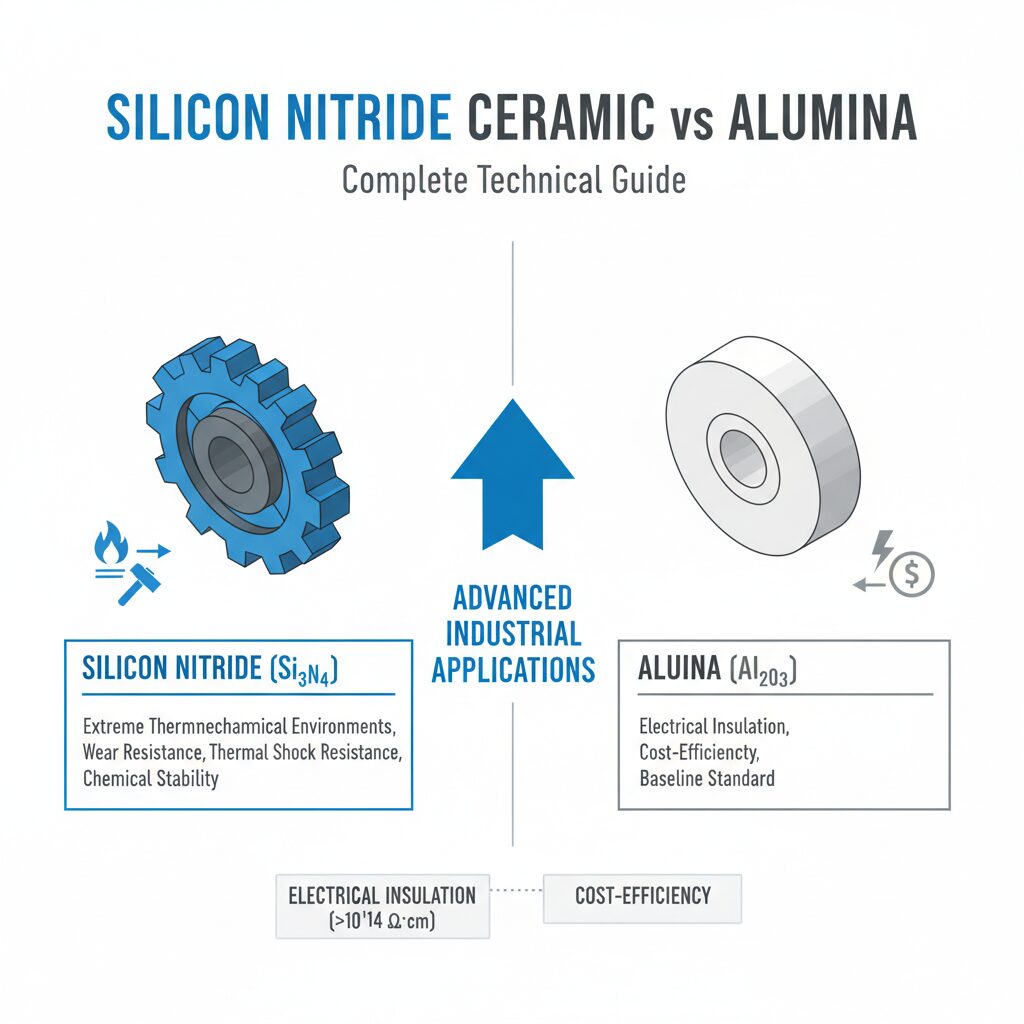
Selecting the correct technical ceramic for a specific semiconductor tool requires balancing tribological performance, chemical compatibility. And procurement costs. While Tonerde is the industry standard for broad-spectrum chemical and electrical applications, engineers frequently evaluate it against other advanced technical ceramics to optimize subsystem performance.
| Eigentum | Alumina Ceramic Ball for Semiconductor | Standard Industrial Alumina | Zirkoniumdioxid | Siliziumnitrid |
|---|---|---|---|---|
| Wärmeleitfähigkeit | 30 | 20 | 2.5 | 30 |
| Härte | 1650 | 1300 | 1200 | 1500 |
| Bruchzähigkeit | 4.5 | 3.5 | 9.0 | 6.5 |
| Kosten | Hoch | Niedrig | Mittel | Sehr hoch |
The distinction between an alumina ceramic ball for semiconductor processing and a standard industrial alumina ball lies primarily in the purity level and surface integrity. Standard alumina (typically 95% purity) contains silicate binders and glassy grain boundary phases that easily degrade in semiconductor etching environments, releasing particulate matter into the cleanroom. In contrast, semiconductor-grade alumina (99.8%+) utilizes a homogenous microstructure that resists chemical attack. When high impact resistance and superior fracture toughness are required—such as in certain heavy-load vibration environments—engineers may look toward Zirkoniumdioxid. Zirconia offers a remarkable fracture toughness of 9.0 MPa·m½ due to transformation toughening, though it suffers from poor thermal conductivity (2.5 W/m·K). This can cause localized heat accumulation in high-rpm bearing configurations. Conversely, Siliziumnitrid provides the ultimate tribological performance for rolling contact fatigue and is the premier material for extreme-speed ceramic bearings. However, silicon nitride commands a highly restrictive cost and is susceptible to etching in certain high-density fluorine plasmas where alumina effortlessly survives by forming a stable, non-volatile aluminum fluoride (AlF3) passivation layer. For thermal management applications specifically requiring massive heat dissipation away from heat-generating semiconductor packages, materials like Aluminiumnitrid (exceeding 170 W/m·K) are utilized in chucks, though they are rarely formed into ball bearings due to processing constraints.
Anwendungen
- Chemical Mechanical Planarization (CMP) Slurry Valves: In CMP processes, silicon wafers are polished using highly abrasive, chemically active slurries containing nanometer-scale silica or ceria particles suspended in highly basic (pH 11) or highly acidic (pH 2) solutions. An alumina ceramic ball for semiconductor CMP check valves is chosen because it resists both the corrosive chemical attack of the fluid and the severe erosive wear of the abrasive particles. Metallic valves degrade within days under these conditions, whereas high-density alumina maintains a leak-proof seal with a sphericity tolerance of less than 0.13 µm over millions of actuation cycles.
- High-Vacuum Wafer Transport Bearings: Wafer handling robots operate inside Class 1 (ISO Class 3) cleanrooms and ultra-high vacuum environments (down to 10^-8 Torr). Traditional steel bearings require liquid lubricants that instantly outgas and contaminate the vacuum chamber. Alumina ceramic balls run completely dry (unlubricated), generating zero outgassing. Their high hardness (1650 HV) ensures that microscopic wear debris—a primary source of wafer-killing defects—is virtually eliminated during robotic articulation.
- Plasma Etching Chamber Fluid Delivery Systems: Etch chambers utilize aggressive halogen gases, such as CF4, NF3. And Cl2, ionized into high-energy plasmas. When these chemistries interact with Siliziumkarbid or quartz, they can cause varied etching rates. However, high-purity alumina forms an incredibly stable passivation layer of AlF3 when exposed to fluorine plasmas. Alumina balls used in mass flow controllers and fluid delivery check valves adjacent to the plasma zone remain dimensionally stable, preventing pressure drift in the fluid lines.
- Lithography Machine Non-Magnetic Positioning Stages: Extreme Ultraviolet (EUV) lithography equipment relies on powerful electromagnetic linear motors to accelerate reticle and wafer stages at forces exceeding 5G. Any ferrous material within the bearing tracks will cause severe magnetic interference, distorting the nanometer-level positioning loops. Alumina is 100% diamagnetic and provides an electrical resistivity of >10^14 Ω·cm, ensuring complete magnetic transparency and zero eddy-current generation, making it ideal for linear guide bearings in these critical photolithography stages.
- Wet Cleaning Bench Flow Regulators: During RCA cleaning protocols, wafers are submerged in aggressive mixtures of sulfuric acid and hydrogen peroxide (SPM), or dilute hydrofluoric acid (DHF). Alumina balls act as the primary sealing mechanism in pneumatic diaphragm valves controlling these chemistries. Because 99.8% purity alumina lacks the vulnerable glassy silicate boundaries found in lower-grade ceramics, it offers exceptional resistance to chemical leaching, ensuring that not a single parts-per-billion (ppb) of alkali metal ions is introduced into the ultra-pure water (UPW) chemical lines.
Herstellungsprozess
Producing an alumina ceramic ball for semiconductor standards is an extraordinarily precise metallurgical and mechanical endeavor. The process must eliminate microscopic voids and achieve near-perfect isotropic grain structures to allow for subsequent ultra-precision machining. The journey from raw powder to a ±0.005mm tolerance sphere requires strict environmental controls to prevent cross-contamination.
Formgebungsmethoden
- Kaltisostatisches Pressen (CIP): To ensure uniform density without directional stress gradients, highly refined spray-dried alumina powder (average particle size under 0.5 µm) is sealed in elastomeric molds and subjected to multi-directional hydraulic pressure ranging from 200 to 300 MPa. This method ensures the pre-sintered “green” ball has a homogenous internal structure, drastically reducing asymmetrical shrinkage during the firing process.
- High-Pressure Injection Molding (CIM): For micro-balls with diameters ranging from 0.5mm to 3.0mm, ceramic injection molding is utilized. The ultra-pure alumina powder is compounded with organic thermoplastic binders. The mixture is injected into precision tooling under high shear rates, allowing for high-volume production of near-net-shape spheres before the critical debinding phase removes the organic matrix.
Sintern
The green alumina spheres undergo a highly controlled thermal profile in electric kilns. Initial ramp rates are kept strictly below 1 °C per minute up to 600 °C to safely outgas organic binders without fracturing the ceramic lattice. The solid-state sintering phase occurs between 1600 °C and 1650 °C. The hold time is carefully calibrated to achieve >99% theoretical density while suppressing excessive grain growth. For semiconductor applications, maintaining a fine, equiaxed grain size of 2-3 µm is mandatory, as oversized grains will cause micro-pullouts during the final lapping process, resulting in unacceptably high surface roughness (Ra) that traps particulate contamination.
Endbearbeitung
The sintered alumina balls are initially oversized and exhibit a rough, opaque surface. The final machining relies entirely on advanced super-abrasive kinematics. The balls are placed between massive cast-iron or hardened steel grooved plates flooded with progressively finer diamond slurries. The dual-plate lapping machines rotate counter-directionally, forcing the ceramic balls into a randomized multidirectional rolling path. This complex kinematic motion slowly abrades the high spots on the sphere. To achieve semiconductor-grade specifications (Grade 5 or Grade 10), the process steps down from 15 µm diamond paste to ultra-fine 0.25 µm polycrystalline diamond slurries. The final stage produces a mirror-like surface finish (Ra < 0.02 µm) and achieves diametric tolerances tighter than ±0.005mm, ensuring perfect load distribution in precision bearing races.
Vorteile und Beschränkungen
Vorteile
- Extreme Chemical Inertness in Halogen Environments: Unlike metals or inferior ceramic grades, high-purity alumina does not generate volatile byproducts when exposed to high-density fluorine or chlorine plasmas. The resulting stability prevents chamber particle generation, directly contributing to higher semiconductor wafer yields.
- Superior Dielectric Properties: With an electrical breakdown strength surpassing 15 kV/mm and a volume resistivity exceeding 10^14 Ω·cm at room temperature, alumina completely isolates critical internal tool mechanisms from high-voltage RF plasma fields and prevents destructive electrostatic discharge (ESD).
- Zero Metallic Ion Contamination: Formulated without heavy metal sintering aids, semiconductor-grade alumina strictly prevents the leaching of sodium, potassium, iron, or copper ions into process fluids. This maintains the integrity of ultra-pure water (UPW) systems and wet chemical baths required for modern 3nm and 2nm node manufacturing.
- Exceptional Wear Resistance at High Temperatures: Registering 1650 HV on the Vickers scale, alumina maintains its tribological integrity and dimensional stability at continuous operating temperatures up to 1650 °C, ensuring zero mechanical creep or deformation during rapid thermal annealing (RTA) cycles.
Beschränkungen
- Mäßige Bruchzähigkeit: With a fracture toughness of 4.5 MPa·m½, alumina is significantly more brittle than bearing steel or specialized toughened ceramics like zirconia. It is susceptible to catastrophic brittle failure if subjected to sudden, high-velocity point-impact shocks or severe installation misalignment.
- Extensive Machining Time and Cost: Because alumina can only be machined using diamond abrasives, the lapping process to achieve Grade 5 sphericity is highly time-consuming and energy-intensive, making these components significantly more expensive than standard industrial bearings.
Überlegungen zur Bearbeitung
The machining of an alumina ceramic ball for semiconductor applications presents a set of formidable engineering challenges that separate standard industrial manufacturers from advanced ceramic specialists. Alumina’s extreme hardness (9 on the Mohs scale, second only to diamond and cubic Bornitrid among standard abrasives) dictates that all material removal must be executed via diamond lapping. The primary difficulty lies in achieving the strict geometric tolerance of ±0.005mm (5 microns) for the outer diameter, while simultaneously maintaining a sphericity deviation (roundness) of less than 0.13 microns.
When operating at these sub-micron levels, thermal expansion during the lapping process becomes a critical variable. Heat generated by abrasive friction can cause the alumina to temporarily expand. if the lapping plates are not actively chilled with temperature-controlled coolants, the balls will shrink out of tolerance upon returning to room temperature. Furthermore, the risk of “micro-pullout” during rough grinding is high. If the diamond slurry is too aggressive, it can rip entire microscopic grains from the ceramic matrix, leaving behind surface craters. These craters are unacceptable in semiconductor cleanrooms because they trap chemical slurry or act as nucleation sites for particulate generation. Great Ceramic overcomes these challenges utilizing proprietary multi-axis lapping kinematics and dynamically graded polycrystalline diamond suspensions. By precisely controlling the abrasive downforce and slurry viscosity, we yield a flawless, mirror-polished surface finish (Ra 0.01 – 0.02 µm) entirely free of sub-surface micro-cracking. Our metrology department subsequently verifies each batch using advanced laser interferometry and ultra-precision roundness testers to guarantee every sphere meets strict Class 1 cleanroom specifications.
If your semiconductor fabrication equipment requires high-purity, tightly toleranced ceramic components, we possess the engineering expertise to meet your most demanding prints. Explore our Präzisionskeramikbearbeitung capabilities to discover how we can optimize your supply chain.
FAQ
What is an alumina ceramic ball for semiconductor?
An alumina ceramic ball for semiconductor applications is an ultra-high purity (typically 99.8% or greater) spherical mechanical component engineered from aluminum oxide (Al2O3). Unlike standard industrial ceramic balls, the semiconductor-grade variant is manufactured under strict cleanroom protocols without the use of heavy-metal sintering aids (like iron or sodium) to prevent ionic contamination of silicon wafers. It is primarily utilized in wafer processing equipment as a precision bearing, check valve sealing element, or kinematic mount component. The component is defined by its extreme hardness (1650 HV), exceptional electrical resistivity (>10^14 Ω·cm). And diametric tolerances machined down to ±0.005mm or better.
What are the main applications of an alumina ceramic ball for semiconductor?
The main applications involve critical fluid handling and mechanical positioning in aggressive fab environments. In Chemical Mechanical Planarization (CMP) tools, they are used as check valves to regulate highly abrasive and corrosive slurries without wearing out. In wet bench cleaning stations, they function within diaphragm valves handling aggressive acids like hydrofluoric acid (HF) and sulfuric acid (H2SO4) without leaching metallic ions. Additionally, they are heavily deployed as non-magnetic, non-lubricated ball bearings in ultra-high vacuum (UHV) robotic wafer handling systems. And as highly stable kinematic positioning spheres in the linear stages of advanced Extreme Ultraviolet (EUV) lithography systems.
How does an alumina ceramic ball for semiconductor compare to other ceramics?
Compared to other technical ceramics, high-purity alumina offers the best balance of broad-spectrum chemical inertness, electrical insulation. And cost-efficiency. When compared to silicon nitride, an alumina ceramic ball for semiconductor processing is more cost-effective and notably superior in maintaining passivity within high-density fluorine plasma chambers (forming stable AlF3 rather than etching away). However, silicon nitride does outperform alumina in pure high-speed bearing applications due to its higher fracture toughness and rolling contact fatigue life. Compared to zirconia, alumina has superior thermal conductivity (30 W/m·K vs 2.5 W/m·K) and higher operating temperature limits, though it lacks zirconia’s extreme impact resistance.
What are the advantages of an alumina ceramic ball for semiconductor?
The primary advantages are zero outgassing in high vacuum, complete magnetic transparency. And extreme chemical stability. Because the alumina is 99.8%+ pure, it will not shed harmful metallic ions (like Cu, Ni, Fe) that destroy semiconductor minority carrier lifetimes. Its electrical breakdown strength (15 kV/mm) completely insulates sensitive wafer stages from high-voltage plasma RF interference. Furthermore, its extreme hardness virtually eliminates the generation of friction-induced particulate matter in cleanrooms, dramatically extending the mean time between failures (MTBF) for semiconductor processing tools compared to stainless steel or engineered polymer alternatives.
How is an alumina ceramic ball for semiconductor machined?
The machining process is a highly specialized, multi-stage abrasive lapping operation. Because alumina boasts a hardness of 9 on the Mohs scale, conventional cutting tools cannot scratch it. Instead, oversized sintered ceramic blanks are placed between heavy, counter-rotating iron plates flooded with a liquid suspension of microscopic diamond particles. Over several days, the pressure and complex multidirectional kinematics gradually abrade the surface down to the final dimension. To achieve the ±0.005mm tolerance and Ra 0.02 µm surface finish required by the semiconductor industry, Great Ceramic gradually steps down the diamond slurry from a coarse 15 µm grit to a sub-micron 0.25 µm polishing paste. This stringent process ensures mathematically perfect sphericity without inducing subsurface micro-cracks.
Need custom alumina ceramic balls for semiconductor parts? Kontakt zu Great Ceramic für Präzisionsbearbeitungsleistungen mit engen Toleranzen oder per E-Mail [email protected].
alumina ceramic ball for semiconductor is widely used in advanced ceramic applications.
Erfahren Sie mehr über Aluminiumoxid-Keramikkugel für die Halbleiterindustrie und unsere Dienstleistungen im Bereich der keramischen Präzisionsbearbeitung.