








ZTA ceramic ceramic block for vacuum: Complete Technical Guide
Designing critical components for ultra-high vacuum (UHV) environments presents structural and materials engineers with a complex matrix of operational challenges. At profound vacuum pressure regimes operating below 1.0 × 10⁻⁹ Torr, conventional metallic alloys and standard single-phase technical ceramics frequently fail to meet the uncompromising requirements for near-zero outgassing, absolute dimensional stability. And high-voltage electrical isolation. Pure monolithic ceramics traditionally suffer from catastrophic brittle failure under dynamic mechanical stress, while metallic alternatives introduce unacceptable risks of particulate generation, electromagnetic interference. And thermal expansion distortion. The optimal engineering solution for these extreme operational conditions is a precision-machined ZTA ceramic ceramic block for vacuum applications. Zirconia Toughened Alumina (ZTA) systematically engineers out the inherent limitations of standard ceramics by leveraging a highly precise stress-induced phase transformation mechanism. This engineered composite microstructure yields remarkable fracture toughness values reaching up to 7.0 MPa·m½, all while maintaining an exceptionally dense, non-porous matrix that definitively eliminates trapped atmospheric gases. In this comprehensive technical guide, we will analyze the precise thermomechanical properties, intricate manufacturing methodologies. And rigorous precision machining protocols required to produce vacuum-ready ZTA components with ±0.005mm tolerances. If your engineering team is actively working to mitigate thermal shock, mechanical wear, or dielectric breakdown within high-vacuum chambers, contact Great Ceramic to optimize your component manufacturing strategy.
Materialeigenschaften
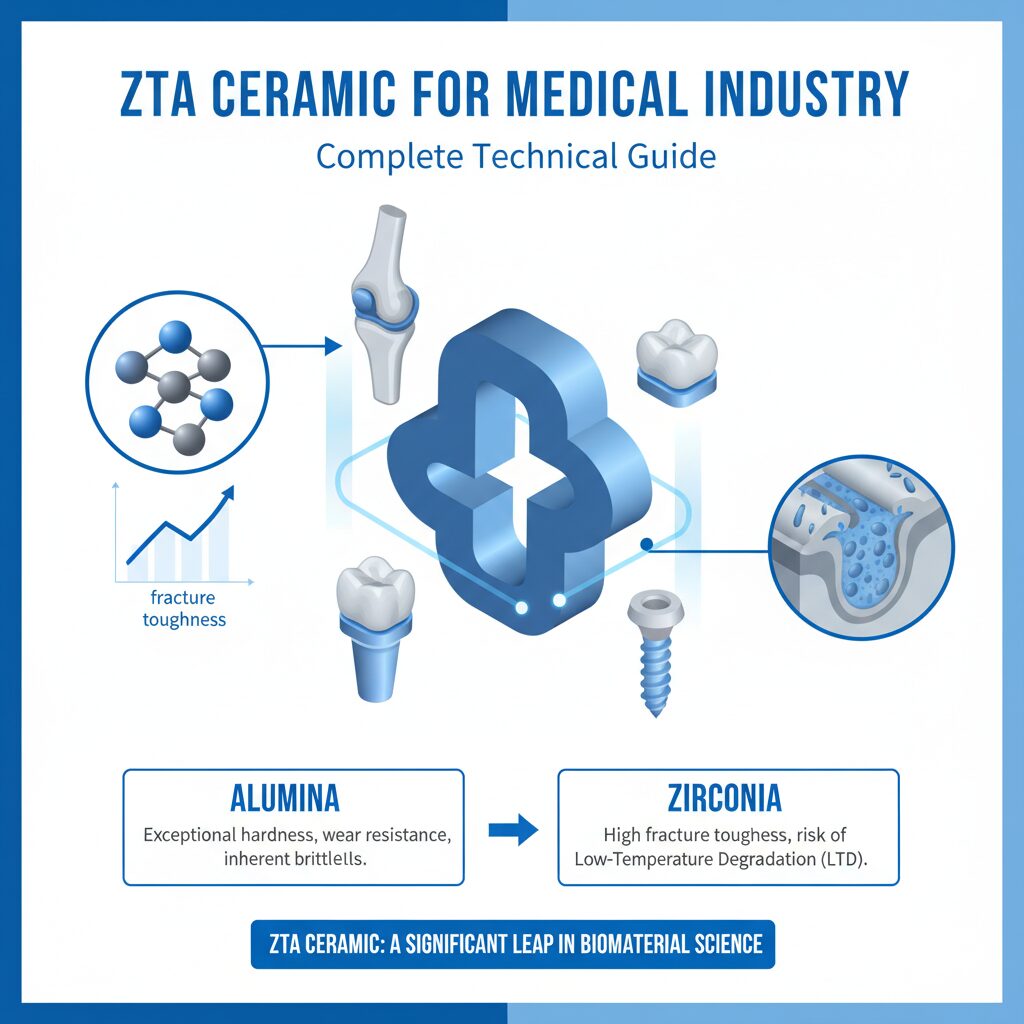
Understanding the thermomechanical and dielectric behavior of a ZTA ceramic ceramic block for vacuum requires a rigorous analysis of its fundamental composite properties. ZTA typically consists of an aluminum oxide matrix (70% to 90% by volume) with uniformly dispersed zirconium oxide particles (10% to 30% by volume). This specific microstructural engineering results in a material that vastly outperforms standard pure ceramics in structurally demanding vacuum applications. The critical mechanism at play is transformation toughening: when a micro-crack begins to propagate through the material matrix, the stress field at the advancing crack tip triggers the metastable tetragonal zirconia particles to undergo a martensitic phase transformation into a monoclinic crystal structure. This highly localized transformation is accompanied by a volumetric expansion of approximately 3% to 5%. This volumetric expansion actively induces compressive stresses at the leading edge of the crack, effectively pinching the crack shut and requiring significantly higher energy inputs for further propagation. In vacuum environments, where component replacement requires costly system venting and multi-day bake-out procedures, this enhanced reliability is a mandatory engineering requirement. Furthermore, the material exhibits an exceptional outgassing rate of less than 1.0 × 10⁻¹⁰ mbar·L/s·cm² after standard vacuum bake-out protocols at 250 °C, ensuring UHV baseline pressures remain completely uncompromised.
| Eigentum | Wert | Einheit |
|---|---|---|
| Dichte | 4.10 – 4.30 | g/cm³ |
| Härte | 1600 – 1800 | HV |
| Biegefestigkeit | 600 - 800 | MPa |
| Bruchzähigkeit | 5.0 – 7.0 | MPa-m½ |
| Wärmeleitfähigkeit | 20 - 24 | W/m-K |
| Elektrischer spezifischer Widerstand | > 1.0 × 10¹⁴ | Ω-cm |
| Maximale Betriebstemperatur | 1400 – 1500 | °C |
From an electrical engineering standpoint, the resistivity exceeding 1.0 × 10¹⁴ Ω·cm at 20 °C makes this material an exceptional dielectric insulator for high-voltage vacuum feedthroughs, easily isolating potentials of up to 15 kV/mm. The thermal conductivity of 20 to 24 W/m·K is sufficient for moderate heat dissipation in enclosed high-vacuum systems, while the coefficient of thermal expansion (CTE) rests predictably between 7.5 and 8.2 × 10⁻⁶ /°C (from 20 °C to 1000 °C), allowing engineers to design highly reliable hermetic seals with matching Kovar or titanium transition flanges.
Vergleich mit anderen Keramiken
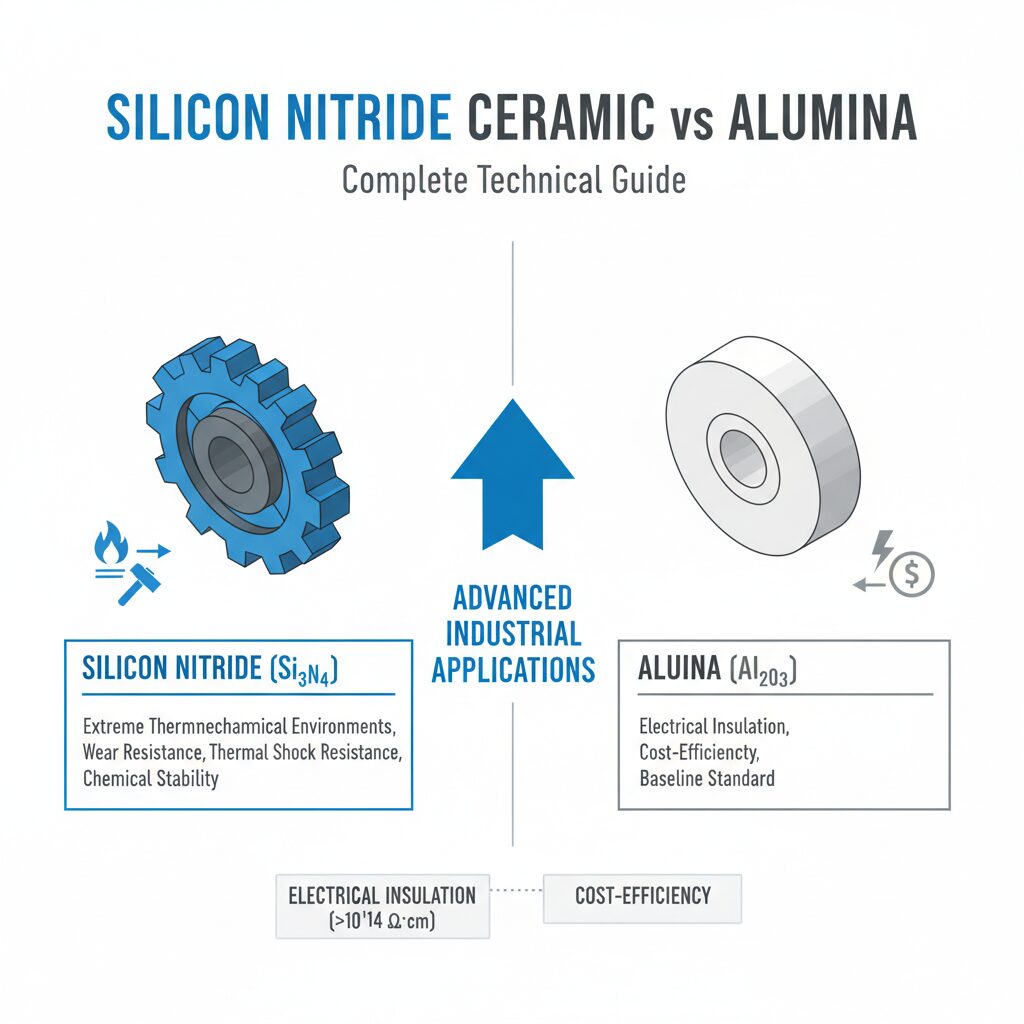
When selecting a ceramic block for critical vacuum applications, engineers must execute a careful comparative analysis to balance toughness, thermal management, outgassing characteristics. And overall system cost. The choice often rests between ZTA and standard baseline ceramics such as Tonerde/”>Tonerde, high-toughness pure Zirkoniumdioxid, or highly thermal-shock resistant materials like Siliziumnitrid.
| Eigentum | ZTA ceramic ceramic block for vacuum | Tonerde (99,5%) | Zirkoniumdioxid (Y-TZP) | Siliziumnitrid (Si3N4) |
|---|---|---|---|---|
| Wärmeleitfähigkeit (W/m-K) | 20 - 24 | 30 – 35 | 2.5 – 3.0 | 25 – 30 |
| Härte (HV) | 1600 – 1800 | 1500 – 1650 | 1200 – 1300 | 1400 – 1600 |
| Bruchzähigkeit (MPa-m½) | 5.0 – 7.0 | 3.5 - 4.5 | 8.0 - 10.0 | 6,0 – 8,0 |
| Kosten | Mäßig | Niedrig | Hoch | Sehr hoch |
Alumina (Aluminum Oxide) remains the legacy standard for vacuum insulators due to its low cost and acceptable baseline properties. However, with a fracture toughness limited to 3.5 – 4.5 MPa·m½, pure alumina is highly susceptible to chipping during assembly, overtightening of bolted joints. And sudden mechanical shock within moving vacuum stages. Conversely, Yttria-Tetragonal Zirconia Polycrystal (Y-TZP) offers exceptional fracture toughness (up to 10.0 MPa·m½), but suffers from extremely poor thermal conductivity (under 3.0 W/m·K) and a relatively low hardness that reduces wear resistance in dynamic sliding applications. Silicon nitride provides an exceptional balance of low density (3.2 g/cm³), excellent thermal shock resistance. And high toughness, but it presents significant raw material and machining costs that can make large-scale monolithic components economically unviable for certain budgets.
ZTA systematically bridges these engineering gaps. By combining the high hardness (up to 1800 HV) and superior elastic modulus of the alumina matrix with the transformation-toughening mechanism of the dispersed zirconia particles, ZTA delivers a composite material that costs significantly less than silicon nitride, dissipates heat eight times more effectively than pure zirconia. And provides nearly double the crack-propagation resistance of pure 99.5% alumina. This optimized matrix is why a precision-machined ZTA ceramic ceramic block for vacuum is increasingly specified for semiconductor fabrication equipment and advanced analytical instrumentation.
Anwendungen
The unique thermomechanical stability and zero-porosity microstructure of ZTA make it the material of choice for highly critical applications operating under rigorous vacuum conditions. In these precise environments, component failure is not merely an inconvenience. it represents hundreds of thousands of dollars in lost yield and system downtime.
- Semiconductor Wafer Handling End Effectors: Operating inside ultra-high vacuum transfer chambers at pressures of 1.0 × 10⁻⁸ Torr, robotic end effectors must transport 300mm silicon wafers at high accelerations (up to 2G) without inducing damaging vibration or particulate generation. ZTA’s high specific stiffness (Young’s Modulus exceeding 350 GPa) prevents harmful deflection, while its extreme hardness prevents abrasive wear against the wafer edge, thereby maintaining a Class 1 cleanroom rating and preventing catastrophic wafer drops.
- Electron Microscopy Stage Components: In Scanning Electron Microscopes (SEM) and Transmission Electron Microscopes (TEM), the sample manipulation stages operate in vacuum levels reaching 1.0 × 10⁻¹⁰ Torr to prevent critical electron beam scattering. ZTA ceramic blocks are utilized to machine highly precise, non-magnetic. And dimensionally stable stage components. The material’s thermal stability ensures that sub-nanometer imaging resolution is not compromised by thermal drift resulting from microscopic fluctuations in chamber temperature.
- High-Voltage Vacuum Feedthrough Insulators: Analytical systems such as mass spectrometers require the introduction of multi-kilovolt power lines directly into high-vacuum environments. ZTA components serve as primary structural insulators, separating live high-voltage conductors from grounded stainless-steel vacuum chamber walls. The material’s exceptional dielectric strength (>15 kV/mm) definitively prevents electrical arcing, while its ultra-low outgassing ensures that background noise spectra in the analytical equipment remain absolutely undisturbed.
- Mass Spectrometry Ion Optics Mounts: The alignment of ion lenses within a mass spectrometer must remain accurate to within ±0.005mm over thousands of hours of operation. Metallic mounts undergo unacceptable thermal expansion and risk electromagnetic interference with the ion beam trajectory. ZTA provides the requisite non-magnetic mounting platform, ensuring rigorous optical alignment while entirely eliminating the risk of outgassed hydrocarbons depositing onto and degrading sensitive quadrupole rods.
- Vacuum Chucks and Susceptors: In advanced physical vapor deposition (PVD) and etching processes, the substrate must be clamped securely while simultaneously undergoing rapid thermal cycling (ranging from 20 °C to over 400 °C in minutes). ZTA’s superior fracture toughness (up to 7.0 MPa·m½) completely prevents the catastrophic thermal-shock cracking that regularly plagues pure alumina chucks, while its highly refined surface finish (machinable down to Ra 0.1 µm) ensures uniform thermal contact and eliminates localized micro-leaks in the vacuum hold-down system.
Herstellungsprozess
Producing a defect-free ZTA ceramic ceramic block for vacuum applications requires an exhaustively controlled manufacturing protocol. Even microscopic internal pores or density gradients can result in virtual leaks—where trapped gases slowly escape through microscopic pathways over hundreds of hours, permanently preventing a vacuum system from reaching its target base pressure. Great Ceramic implements stringent quality control at every phase of the manufacturing cycle, ensuring absolute density and microstructural uniformity.
Formgebungsmethoden
- Kaltisostatisches Pressen (CIP): To ensure perfectly uniform density throughout large, monolithic ceramic blocks, highly refined sub-micron alumina and zirconia powders are blended with proprietary organic binders and sealed within a flexible elastomeric mold. The mold is then submerged in a high-pressure hydraulic fluid vessel and subjected to omnidirectional pressures ranging from 200 MPa to 300 MPa. This uniform multi-axial pressure eliminates standard die-wall friction, preventing the formation of density gradients and internal voids that could act as virtual leak sources in UHV environments.
- Trockenes Pressen: For smaller, high-volume near-net-shape components that will later be machined from a standard block, precision automated mechanical dry pressing is utilized. The raw powder is compacted in highly polished rigid tungsten carbide dies under uniaxial pressures of 50 to 100 MPa. This method is highly efficient but requires precise binder control to ensure the resulting “green” part maintains sufficient structural integrity for pre-sintering handling.
Sintern
The sintering profile is the most metallurgically critical step in forming a vacuum-compatible ZTA structure. The green ceramic block undergoes a precise, multi-stage thermal profile in a high-temperature atmospheric furnace. The initial stage involves a controlled ramp-up (typically 1 to 2 °C per minute) to between 300 °C and 600 °C to facilitate complete and absolute binder burnout. Any residual carbon left in the matrix at this stage will cause severe outgassing problems during final vacuum application. Following the burnout phase, the furnace ramps to absolute sintering temperatures ranging from 1500 °C to 1600 °C. At this elevated temperature, solid-state diffusion occurs, consolidating the powder particles and eliminating virtually all microscopic porosity. The cooling rate is strictly controlled to manage the tetragonal-to-monoclinic phase transformation of the zirconia particles, actively locking in the internal compressive stresses that provide ZTA with its signature fracture toughness. The resulting fired block achieves greater than 99.5% theoretical density.
Endbearbeitung
Because the sintered ZTA ceramic ceramic block for vacuum achieves a hardness of up to 1800 HV, it cannot be machined utilizing conventional high-speed steel or standard carbide tooling. Final machining requires rigorous, specialized techniques known as hard or Präzisionskeramikbearbeitung. This involves utilizing custom-profiled, resin-bonded and metal-bonded diamond grinding wheels, operating on ultra-rigid multi-axis CNC machining centers. Because components intended for UHV seals frequently require stringent geometric tolerances (flatness to within 0.002mm and surface roughness of Ra 0.1 µm), extensive diamond lapping, ultra-precision grinding. And optical polishing are employed as the final steps to guarantee absolute hermetic sealing capability.
Vorteile und Beschränkungen
Vorteile
- Exceptional Microstructural Density: The meticulously controlled sintering process yields a porosity approaching 0.0%, effectively eliminating the trapped atmospheric gases that cause crippling virtual leaks in systems operating below 1.0 × 10⁻⁸ Torr.
- Superior Mechanical Toughness: With a fracture toughness reaching 7.0 MPa·m½, ZTA substantially mitigates the risk of catastrophic brittle failure, edge chipping. And crack propagation caused by over-torqued mechanical fasteners or automated robotic handling impacts.
- High Dielectric Breakdown Strength: Exhibiting an electrical resistivity greater than 1.0 × 10¹⁴ Ω·cm and a dielectric strength exceeding 15 kV/mm, ZTA is a peerless material for isolating highly sensitive high-voltage instrumentation arrays without generating electrical noise.
- Optimal Cost-to-Performance Ratio: ZTA effectively engineers the critical gap between cost-effective but brittle pure alumina. And highly tough but economically restrictive silicon nitride, making it structurally ideal for large-format vacuum chamber components.
Beschränkungen
- Density and Weight Metrics: With a density of 4.10 to 4.30 g/cm³, ZTA is heavier than both standard pure alumina (3.9 g/cm³) and silicon nitride (3.2 g/cm³). This requires engineers to account for increased inertial mass in highly dynamic, rapidly moving vacuum stages.
- Thermal Shock Ceilings: While dramatically superior to standard pure alumina, ZTA cannot match the extreme thermal shock resilience of specific engineered materials like silicon nitride, limiting its application in environments experiencing instantaneous temperature deltas exceeding 300 °C per second.
Überlegungen zur Bearbeitung
Producing precision components from a fully dense ZTA ceramic ceramic block for vacuum environments requires overcoming formidable manufacturing physics. Due to its extreme hardness (1600 – 1800 HV) and optimized fracture toughness, ZTA exerts severe abrasive wear on cutting tools and demands exceptional rigidity from the machine tool architecture to prevent chatter. This leads to subsurface micro-cracking. To achieve the rigorous ±0.005mm tolerances mandated by UHV engineering standards, specialized Präzisionskeramikbearbeitung protocols must be strictly followed. This involves the exclusive use of high-concentration diamond tooling (typically utilizing grit sizes from D46 for aggressive roughing down to D126 or finer for delicate finishing passes). Spindle kinematics must be tightly controlled, frequently operating between 10,000 and 30,000 RPM, coupled with extremely shallow depths of cut (often less than 0.01mm per pass) to maintain critical thermal equilibrium at the cutting zone.
Coolant management is equally vital. high-pressure, specifically formulated aqueous coolants must be continuously flooded directly into the cutting zone to flush away abrasive ceramic swarf and dissipate severe frictional heat. Failure to control thermal gradients during the grinding process can inadvertently trigger the zirconia phase transformation prematurely at the component’s surface layer, compromising the designed structural integrity. Additionally, for components demanding absolute vacuum sealing surfaces, multi-stage diamond lapping and chemo-mechanical polishing are utilized to achieve optical-grade surface finishes of Ra 0.1 µm or better, completely eliminating microscopic asperities that would otherwise compromise a metallic O-ring seal. If your application demands alternative extreme-environment materials, Great Ceramic also provides expert machining for advanced substrates like Siliziumkarbid to meet your specific thermomechanical requirements.
FAQ
What is a ZTA ceramic ceramic block for vacuum?
A ZTA (Zirconia Toughened Alumina) ceramic block for vacuum is a highly advanced composite engineering material consisting of a rigid aluminum oxide matrix reinforced with 10% to 30% uniformly dispersed zirconium oxide particles. It is specifically manufactured and sintered to achieve near-zero porosity, ensuring it exhibits exceptional mechanical toughness (up to 7.0 MPa·m½) and an ultra-low outgassing rate (under 1.0 × 10⁻¹⁰ mbar·L/s·cm²). These fully dense blocks are subsequently utilized as bulk raw materials to precision-machine highly complex, structurally demanding components for ultra-high vacuum (UHV) systems where standard metals or pure ceramics would fail.
What are the main applications of ZTA in vacuum environments?
ZTA components are predominantly utilized in ultra-high vacuum environments where particulate generation, outgassing. And electrical arcing must be completely eliminated. Primary applications include robotic wafer handling end effectors in semiconductor manufacturing equipment, high-voltage structural insulators and feedthroughs in complex mass spectrometry systems, precisely aligned mounting stages in electron microscopy (SEM/TEM). And robust vacuum chucks used in physical vapor deposition (PVD) chambers operating at high temperatures.
How does ZTA compare to other advanced technical ceramics?
ZTA is engineered to bridge the fundamental performance gaps between pure alumina and advanced pure zirconia. It provides approximately double the fracture toughness of standard 99.5% alumina, making it vastly more resistant to chipping and impact damage, while avoiding the extremely poor thermal conductivity and structural flexibility that limits pure zirconia. Furthermore, while it does not match the extreme thermal shock resistance of silicon nitride, ZTA provides a highly cost-effective and highly machinable alternative for complex monolithic components operating in deep vacuum environments.
What are the critical mechanical advantages of ZTA?
The primary mechanical advantage of ZTA is its unique stress-induced transformation toughening mechanism. When an internal micro-crack encounters a zirconia particle, the particle rapidly transforms from a tetragonal to a monoclinic crystal structure, volumetrically expanding by 3% to 5%. This specific expansion places the advancing crack tip under immense compressive stress, effectively halting crack propagation. This results in an engineered material that maintains the extreme hardness (up to 1800 HV) and stiffness of alumina, while decisively eliminating the catastrophic brittle failure associated with pure monolithic technical ceramics.
How is a ZTA ceramic block machined to strict vacuum tolerances?
Machining fully sintered ZTA to meet UHV tolerances (such as ±0.005mm dimensional accuracy and Ra 0.1 µm surface finishes) requires specialized precision hard grinding. Because the material is exceptionally hard, standard carbide tooling is ineffective. Machining centers must utilize high-speed spindles equipped with custom resin-bonded or metal-bonded diamond grinding wheels. The process requires ultra-rigid CNC machine architecture, minimal depths of cut to prevent subsurface micro-cracking. And high-pressure flood coolant to eliminate frictional heat. Great Ceramic specializes in these complex ultra-precision methodologies to deliver perfect vacuum-ready components directly to your assembly line.
Need custom ZTA ceramic ceramic block for vacuum parts? Kontakt zu Great Ceramic für Präzisionsbearbeitungsleistungen mit engen Toleranzen oder per E-Mail [email protected].
ZTA ceramic ceramic block for vacuum is widely used in advanced ceramic applications.
Erfahren Sie mehr über Zta Ceramic Ceramic Block For Vacuum und unsere Dienstleistungen im Bereich der keramischen Präzisionsbearbeitung.