






Zirkoniumdioxid ceramic young modulus: Complete Technical Guide
Engineers and material scientists designing high-stress mechanical assemblies frequently encounter premature component failure when utilizing standard advanced ceramics due to catastrophic brittle fracture. Understanding the zirconia ceramic young modulus is the critical solution to bridging the gap between mechanical elasticity and extreme wear resistance. Zirconia (ZrO₂), specifically Yttria-Stabilized Tetragonal Zirconia Polycrystal (Y-TZP), exhibits a unique elastic modulus of approximately 200 to 210 GPa. This specific modulus closely mirrors that of standard steel alloys (200 GPa), allowing engineers to seamlessly integrate ceramic components into metal assemblies—such as press fits and dynamic bearing housings—without generating severe mismatch stresses under heavy mechanical loads. Combined with a fracture toughness of up to 10 MPa·m½, zirconia offers unparalleled damage tolerance. However, achieving precise geometric control in such a tough material requires elite manufacturing capabilities. Great Ceramic specializes in the tight-tolerance machining of these advanced components, delivering geometric accuracies of ±0.005mm. This comprehensive guide explores the thermomechanical properties, phase transformation toughening mechanics. And optimized machining strategies for zirconia ceramics, enabling R&D and procurement teams to confidently accelerate their RFQ processes for mission-critical parts.
Materialeigenschaften
The macroscopic mechanical behavior of zirconia is dictated by its crystallographic microstructure and the precise doping of stabilizing oxides, typically 3 mol% yttria (Y₂O₃) for Y-TZP. At room temperature, pure zirconia naturally attempts to revert to a monoclinic phase, but the yttria stabilizer locks the matrix into a metastable tetragonal phase. The zirconia ceramic young modulus of 200-210 GPa dictates the material’s stiffness and elastic deformation under uniaxial stress. Hooke’s Law (σ = E·ε) applies linearly up to the material’s yield point. This, in high-performance zirconia, aligns closely with its ultimate flexural strength of 1000 to 1200 MPa. Because of its relatively lower modulus compared to other structural ceramics, zirconia is capable of slight elastic deflection before fracture, absorbing mechanical shock energy effectively. When coupled with a Poisson’s ratio of 0.31, this material exhibits exceptional triaxial stress distribution properties.
| Eigentum | Wert | Einheit |
|---|---|---|
| Elastizitätsmodul | 200 – 210 | GPa |
| Dichte | 6.05 | g/cm³ |
| Härte | 1250 | HV |
| Biegefestigkeit | 1200 | MPa |
| Bruchzähigkeit | 8.0 - 10.0 | MPa-m½ |
| Wärmeleitfähigkeit | 2.2 | W/m-K |
| Elektrischer spezifischer Widerstand | > 10¹⁰ | Ω-cm |
| Maximale Betriebstemperatur | 1000 | °C |
Vergleich mit anderen Keramiken
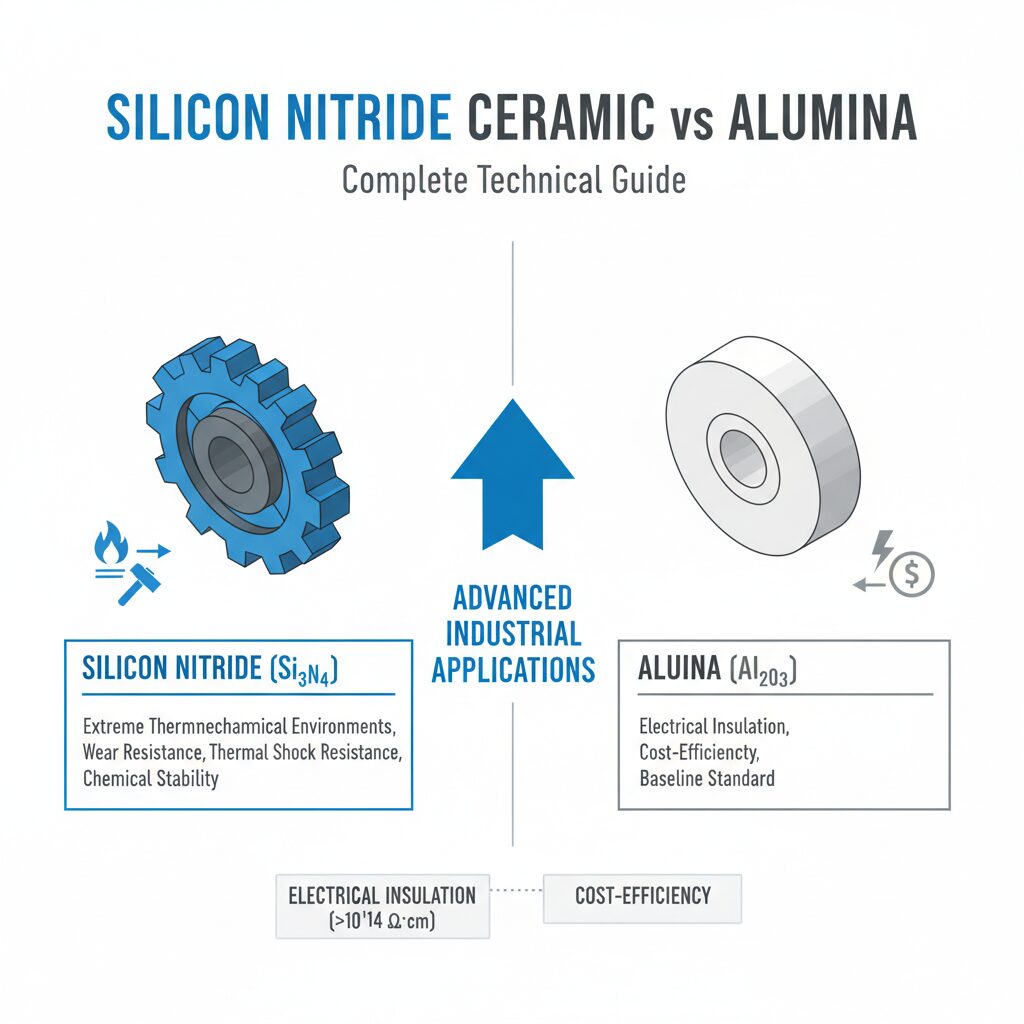
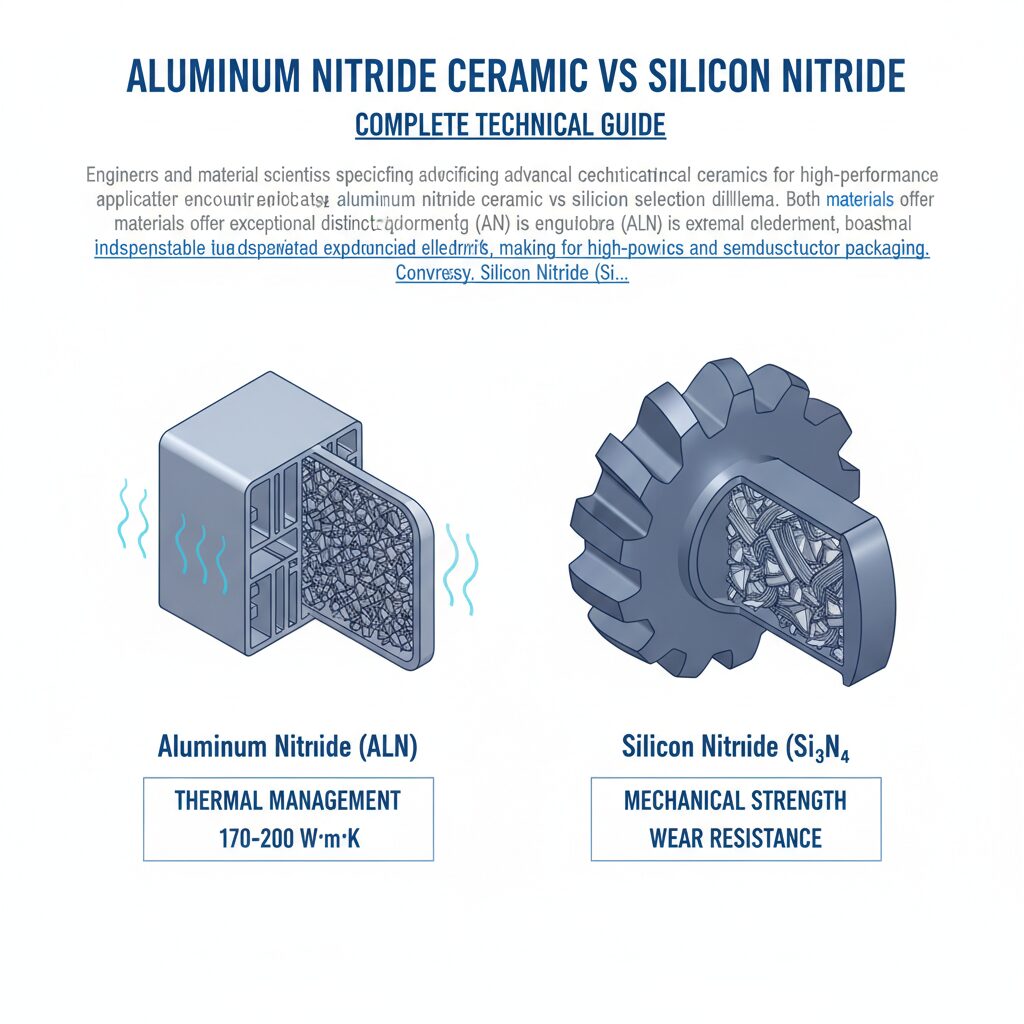
To properly specify materials for demanding industrial applications, engineers must analyze how the zirconia ceramic young modulus compares against alternative advanced ceramics. For instance, the high stiffness of Tonerde/”>Tonerde (380 GPa) makes it highly rigid, but vastly more susceptible to impact shattering because it cannot elastically deform to absorb kinetic energy. In stark contrast, zirconia’s lower modulus (205 GPa) allows for dynamic load sharing when mated with metallic components. Furthermore, when compared to Siliziumnitrid (310 GPa), zirconia offers superior fracture toughness through a mechanism known as transformation toughening. When a micro-crack begins to propagate through the Y-TZP matrix, the localized stress field induces a phase transformation from the metastable tetragonal phase to the monoclinic phase. This transformation is accompanied by a localized volume expansion of approximately 3% to 5%. This actively compresses the propagating crack tip, effectively arresting the fracture. Understanding these comparative metrics is essential for optimizing the mean time between failures (MTBF) in mechanical systems.
| Eigentum | zirconia ceramic young modulus | Aluminiumoxid | Zirkonoxid | Siliziumnitrid |
|---|---|---|---|---|
| Elastizitätsmodul (GPa) | 205 | 380 | 205 | 310 |
| Wärmeleitfähigkeit (W/m-K) | 2.2 | 30.0 | 2.2 | 25.0 |
| Härte (HV) | 1250 | 1500 | 1250 | 1600 |
| Bruchzähigkeit (MPa-m½) | 9.5 | 4.0 | 9.5 | 7.0 |
| Kosten | Mittel-Hoch | Niedrig | Mittel-Hoch | Hoch |
Anwendungen
- High-Pressure Pump Plungers: Operating in fluid handling systems at pressures exceeding 15,000 PSI, plungers require a material that resists abrasive fluid wear while safely deflecting under asymmetric loads. The 205 GPa modulus allows the ceramic plunger to bend elastically within steel housings without snapping, while maintaining a Ra 0.1 µm surface finish for seal longevity.
- Metal Forming & Wire Drawing Dies: During the extrusion or drawing of metallic wires at speeds up to 30 m/s, friction induces severe tribological stress. Zirkonoxid is selected because its exceptional fracture toughness (up to 10 MPa·m½) prevents edge chipping. And its low coefficient of friction minimizes galling with drawn metals like copper and aluminum.
- Deep Hole Drilling Guide Pads: In BTA (Boring and Trepanning Association) drilling operations, guide pads are subjected to intense radial vibrations. Zirconia’s lower elastic modulus compared to carbide allows the pads to dampen high-frequency harmonic vibrations without fracturing, extending the life of the drill string and improving bore straightness.
- Medical and Dental Implants: Orthopedic joints and dental abutments require materials that are perfectly biocompatible and mechanically matched to human bone mechanics. Zirconia provides the necessary 1200 MPa flexural strength for mastication or joint loading, while avoiding the dark aesthetic and galvanostatic corrosion risks associated with titanium.
- Precision Check Valve Balls and Seats: In the petrochemical and hydraulic industries, check valves must repeatedly impact a hard seat millions of times to halt backflow. Zirconia is chosen here because transformation toughening absorbs the kinetic impact energy. And its high density (6.05 g/cm³) ensures rapid valve closure dynamics in viscous fluids.
Herstellungsprozess
Producing industrial-grade components that leverage the optimal zirconia ceramic young modulus requires an intensely controlled manufacturing ecosystem. Variations in powder purity, binder distribution, or thermal profiling can cause phase destabilization, radically degrading the material’s mechanical elasticity and toughness. Great Ceramic strictly controls every phase of the manufacturing lifecycle—from the sub-micron powder preparation (D50 < 0.5 µm) to the final ultra-precision grinding—ensuring that every part conforms to exact isotropic specifications and absolute geometric tolerances.
Formgebungsmethoden
- Kaltisostatisches Pressen (CIP): For complex or thick-walled geometries, raw zirconia powder mixed with polymeric binders is placed into elastomeric molds and subjected to multi-directional hydrostatic pressure ranging from 200 to 300 MPa. This yields a highly uniform “green” density (typically 50-55% of theoretical density). This is crucial for preventing differential shrinkage during the subsequent firing phase.
- Trockenes Pressen: For high-volume, flat, or rotationally symmetrical parts, uniaxial dry pressing is employed. Granulated Y-TZP powder is compressed in hardened steel or tungsten carbide dies under pressures of 100 to 150 MPa. This process offers rapid cycle times and excellent repeatability for mass production of bearing rollers or seal faces.
Sintern
The sintering profile is the most critical metallurgical step in dictating the final properties of the ceramic. The compacted green bodies are carefully transferred to high-temperature atmospheric furnaces. The process begins with a meticulous binder burnout phase, raising the temperature at a rate of 1-2°C/minute to 400-600°C to volatilize organics without inducing internal vapor pressure cracking. The temperature is then ramped to the peak sintering plateau, typically between 1400°C and 1500°C. And held for 2 to 4 hours. During this solid-state diffusion process, the material undergoes a volumetric shrinkage of 20% to 25%. Stringent thermal control ensures that the resulting grain size remains strictly sub-micron (0.3 – 0.6 µm). oversized grains can prematurely trigger the tetragonal-to-monoclinic transformation, thereby degrading the strength and the targeted 200 GPa modulus.
Endbearbeitung
Because fully sintered zirconia possesses a hardness of 1250 HV, conventional metallic cutting tools cannot be utilized. Final shaping is achieved through advanced Präzisionskeramikbearbeitung utilizing multi-axis CNC grinding centers equipped with diamond abrasives. To achieve Great Ceramic’s standard ±0.005mm tolerances, rough grinding is first performed with 100-150 grit metal-bonded diamond wheels to remove bulk material. This is followed by precision finish grinding using resin-bonded diamond wheels in the 400-800 grit range. Throughout the process, pressurized flood coolant is essential to evacuate swarf and, more importantly, to dissipate heat. If grinding zone temperatures exceed 300°C, localized hydrothermal degradation can occur on the component’s surface layer, compromising structural integrity.
Vorteile und Beschränkungen
Vorteile
- Transformation Toughening Mechanics: Zirconia is the only advanced ceramic capable of phase-transformation toughening. When subjected to stress, the phase shift from tetragonal to monoclinic effectively squeezes micro-cracks shut, yielding an unmatched fracture toughness of up to 10 MPa·m½.
- Thermomechanical Steel Matching: With a coefficient of thermal expansion (CTE) of approximately 10.5 × 10⁻⁶ /°C and a Young’s Modulus of 205 GPa, zirconia intimately matches the physical properties of carbon and stainless steels. This allows engineers to design robust interference shrink-fits without fear of temperature-induced shattering.
- Extreme Thermal Insulation: Unlike Siliziumkarbid or alumina, zirconia boasts an incredibly low thermal conductivity (2.2 W/m·K). This makes it an ideal thermal barrier material in high-temperature engine components and welding fixtures, preventing heat transfer into sensitive metallic structures.
- Superior Surface Finish Capabilities: Due to its ultra-fine, sub-micron grain structure, sintered Y-TZP can be lapped and polished to an optical-grade surface finish of Ra 0.02 µm. This is essential for minimizing tribological friction in medical joint replacements and high-speed rotary pump seals.
Beschränkungen
- Low-Temperature Degradation (LTD): Y-TZP is susceptible to aging or hydrothermal degradation when exposed to humid environments or superheated steam at temperatures ranging from 200°C to 300°C. In these conditions, surface grains spontaneously revert to the monoclinic phase, leading to micro-cracking and loss of strength over time.
- High-Temperature Creep: While its melting point is exceedingly high, the mechanical strength and elasticity of Y-TZP drastically fall off when operating temperatures continuously exceed 800°C to 1000°C. For applications exceeding these limits, engineers must pivot to alternate materials like silicon nitride.
Überlegungen zur Bearbeitung
Machining fully dense zirconia presents formidable engineering challenges. Unlike metals. This undergo plastic deformation under shear stress, ceramics fail via brittle fracture mechanisms. The primary machining difficulty lies in maintaining the delicate balance between material removal rates (MRR) and sub-surface damage (SSD). While zirconia’s high fracture toughness makes it less prone to catastrophic edge chipping compared to rigid alumina, its low thermal conductivity (2.2 W/m·K) becomes a severe liability during grinding. Because the ceramic cannot conduct the heat generated by abrasive friction away from the cut zone, nearly 90% of the thermal energy is directed into the diamond grinding wheel and the workpiece surface.
If not aggressively managed through high-pressure, specifically formulated lubricity coolants, this thermal bottleneck causes rapid diamond tool degradation and induces high residual tensile stresses within the machined surface of the ceramic. Great Ceramic mitigates these challenges through state-of-the-art kinematic programming. By maintaining high spindle velocities (20,000 to 40,000 RPM) combined with ultra-low feed rates (often down to 0.001 mm/rev), we ensure the chip load per diamond grit remains safely below the critical depth of cut (ductile regime grinding). This precise control enables us to guarantee a geometric tolerance of ±0.005mm and pristine surface integrity.
| Bearbeitungsparameter | Grobschleifen | Precision Finish Grinding |
|---|---|---|
| Diamond Grit Size (Mesh) | 100 – 150 | 400 – 800 |
| Spindeldrehzahl (U/min) | 15.000 – 20.000 | 30,000 – 40,000 |
| Schnitttiefe (mm) | 0.050 – 0.100 | 0.002 - 0.005 |
| Feed Rate (mm/min) | 100 – 150 | 10 – 25 |
| Coolant Pressure (Bar) | 20 | 50 |
FAQ
What is zirconia ceramic young modulus?
Die zirconia ceramic young modulus is the measure of the material’s solid stiffness and its ability to elastically deform under uniaxial tensile or compressive stress. For standard structural Yttria-Stabilized Zirconia (Y-TZP), this value typically ranges from 200 GPa to 210 GPa. This specific modulus is incredibly significant for industrial engineers because it closely aligns with the elastic modulus of standard steel alloys. This mechanical synergy allows zirconia components to be pressed, fitted. And dynamically loaded alongside steel parts with vastly reduced risks of mismatch-induced stress fractures.
What are the main applications of zirconia ceramic?
Due to its exceptional fracture toughness (up to 10 MPa·m½) and wear resistance, zirconia is heavily utilized in high-stress, high-wear industrial environments. Major applications include high-pressure pump plungers, wire drawing dies, deep hole drilling guide pads. And precision check valves in the oil and gas industry. Additionally, because the material is bio-inert and features extreme flexural strength (1200 MPa), it is considered the gold standard for medical and dental implants, such as hip joint balls and dental crowns.
How does zirconia ceramic compare to other ceramics?
Zirconia is unique among advanced structural ceramics due to its phase-transformation toughening ability. This grants it the highest fracture toughness of any monolithic ceramic. While Tonerde is harder and more rigid (380 GPa modulus) and Siliziumkarbid offers superior thermal conductivity (120 W/m·K) and extreme temperature resistance, zirconia acts more like a “ceramic steel.” It absorbs impact energy by locally expanding at the tip of propagating micro-cracks. However, zirconia’s low thermal conductivity (2.2 W/m·K) means it acts as an extreme thermal insulator compared to its peers.
What are the advantages of zirconia ceramic?
The primary advantages of zirconia include unmatched fracture toughness, high flexural strength (frequently exceeding 1000 MPa). And an elastic modulus and coefficient of thermal expansion that closely mimic steel. This allows for straightforward integration into hybrid metal/ceramic mechanical assemblies. Furthermore, its ultra-fine grain structure permits sub-micron surface finishes (Ra 0.02 µm), yielding ultra-low friction coefficients in tribological wear applications. It is also highly resistant to chemical corrosion and acts as an exceptional electrical and thermal insulator.
How is zirconia ceramic machined?
Because sintered zirconia boasts a hardness of 1250 HV, it cannot be machined using conventional high-speed steel or carbide tooling. Shaping the fully dense material requires ultra-precision grinding utilizing multi-axis CNC machines equipped with diamond-impregnated tooling. The machining process must be heavily flooded with coolant to overcome zirconia’s poor thermal conductivity, preventing localized heat build-up that could cause phase destabilization and surface micro-cracking. Through advanced Präzisionskeramikbearbeitung, Great Ceramic expertly navigates these thermal and kinetic challenges, consistently delivering complex zirconia components with absolute dimensional accuracies of ±0.005mm.
Need custom zirconia ceramic parts? Kontakt zu Great Ceramic für Präzisionsbearbeitungsleistungen mit engen Toleranzen oder per E-Mail [email protected].
zirconia ceramic young modulus is widely used in advanced ceramic applications.
Erfahren Sie mehr über Elastizitätsmodul von Zirkonoxidkeramik und unsere Dienstleistungen im Bereich der keramischen Präzisionsbearbeitung.