







Zirkoniumdioxid ceramic substrate for energy: Complete Technical Guide
The transition toward high-efficiency power generation and advanced energy storage has fundamentally escalated the material requirements for core system components, bringing the zirconia ceramic substrate for energy applications to the forefront of materials science. In sectors ranging from Solid Oxide Fuel Cells (SOFCs) to solid-state lithium batteries, engineers face chronic pain points: extreme operating temperatures (often exceeding 800°C), the need for high ionic conductivity coupled with strict electrical insulation. And the mechanical failure of traditional substrates under severe thermal cycling. Standard materials rapidly degrade, oxidize, or fracture under these aggressive thermodynamic loads. Yttria-stabilized Zirkoniumdioxid provides a highly engineered solution to these challenges, offering a unique matrix of high fracture toughness (up to 10 MPa·m½), matched coefficient of thermal expansion to structural metals. And exceptional phase stability. However, integrating this ultra-hard material into precise energy architectures requires uncompromising manufacturing precision. Leveraging advanced deterministic micro-grinding and diamond-tooling kinematics, Great Ceramic resolves these integration challenges by delivering defect-free zirconia substrates with critical dimensional tolerances held strictly to ±0.005mm, enabling engineers to push the boundaries of next-generation energy conversion systems.
Materialeigenschaften
The mechanical and thermodynamic properties of a zirconia ceramic substrate for energy applications dictate its operational viability in high-stress environments. Unlike standard technical ceramics, zirconia utilized in the energy sector is typically stabilized with dopants—most commonly yttria (Y₂O₃) or scandia (Sc₂O₃)—to maintain its highly desirable tetragonal or cubic crystal phases at room temperature. For structural energy substrates, 3 mol% yttria-stabilized tetragonal zirconia polycrystal (3Y-TZP) is favored for its extraordinary mechanical resilience, whereas 8 mol% yttria-stabilized zirconia (8YSZ) is predominantly selected when ionic conductivity is the paramount requirement, such as in solid electrolyte systems. The phase transformation toughening mechanism inherent to 3Y-TZP allows the material to actively resist crack propagation. When a localized micro-crack occurs, the stress field induces a volumetric expansion of approximately 4% as the crystal structure transitions from tetragonal to monoclinic. This expansion generates a massive compressive stress zone that pinches the crack closed, preventing catastrophic failure. Below are the definitive engineering values for energy-grade stabilized zirconia substrates.
| Eigentum | Wert | Einheit |
|---|---|---|
| Dichte | 6.02 – 6.05 | g/cm³ |
| Härte | 1200 – 1300 | HV |
| Biegefestigkeit | 900 - 1200 | MPa |
| Bruchzähigkeit | 8.0 - 10.0 | MPa-m½ |
| Wärmeleitfähigkeit | 2.0 – 2.5 | W/m-K |
| Elektrischer spezifischer Widerstand | > 10¹⁰ (at 20°C) | Ω-cm |
| Maximale Betriebstemperatur | 1000 – 1500 (phase dependent) | °C |
Vergleich mit anderen Keramiken
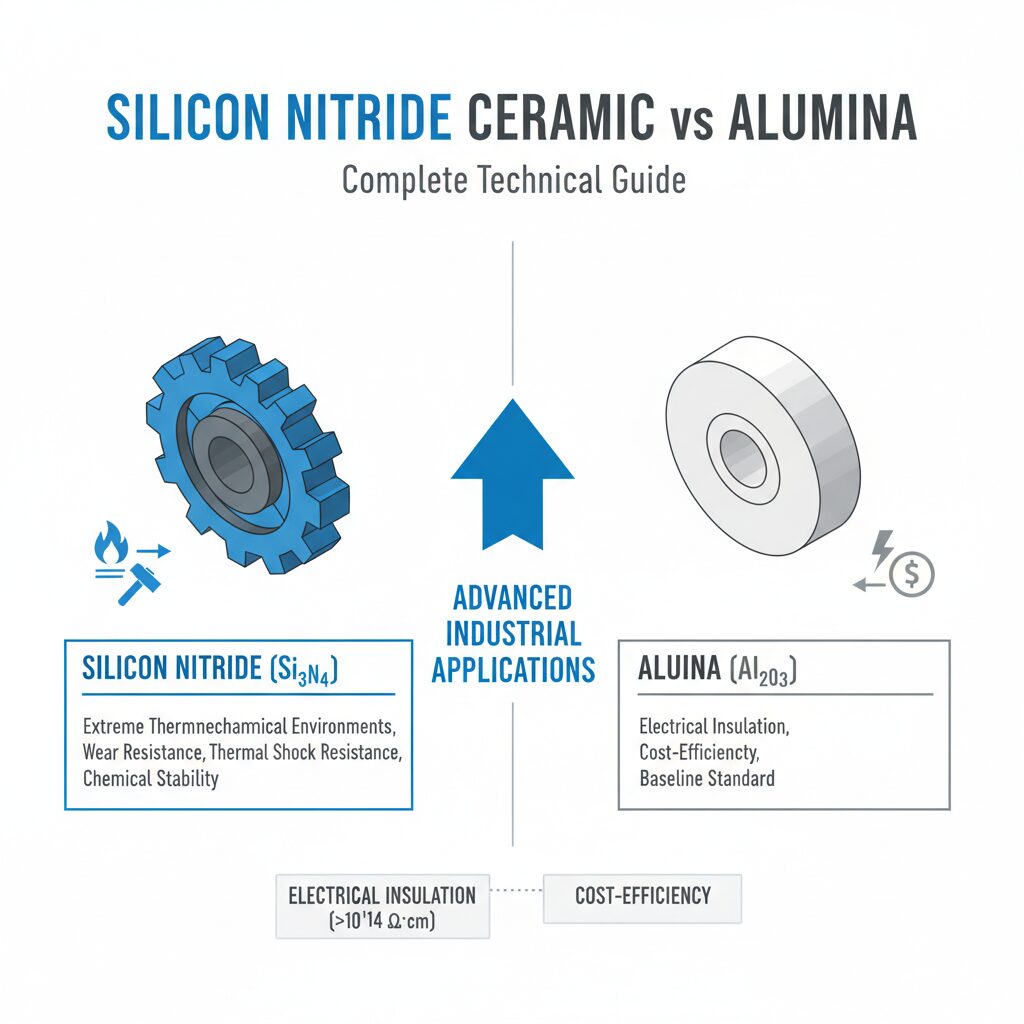
Material selection for advanced energy systems requires a rigorous comparative analysis of thermomechanical profiles. A zirconia ceramic substrate for energy must frequently be evaluated against alternative advanced technical ceramics to determine the optimal balance of thermal management, dielectric strength. And mechanical longevity. For instance, Tonerde/”>Tonerde provides a cost-effective baseline with excellent dielectric properties, but it severely lacks the fracture toughness required for dynamic, vibration-heavy energy platforms. Conversely, Siliziumkarbid offers immense thermal conductivity (upwards of 120 W/m·K) and hardness, making it ideal for severe heat dissipation, but its high electrical conductivity at elevated temperatures renders it unsuitable for specific electrochemical separator applications. A core differentiator for zirconia is its remarkably low thermal conductivity paired with a coefficient of thermal expansion (CTE) of approximately 10.5 × 10⁻⁶ /K. This closely matches that of high-temperature alloys and cast irons. This CTE matching is a critical engineering requirement in the design of Solid Oxide Fuel Cell stacks, where metallic interconnects and ceramic substrates must expand and contract in unison to prevent interfacial delamination during thermal cycling.
| Eigentum | Zirconia Ceramic Substrate for Energy | Tonerde | Zirkoniumdioxid | Siliziumnitrid |
|---|---|---|---|---|
| Wärmeleitfähigkeit | 2.2 | 30.0 | 2.5 | 30.0 – 90.0 |
| Härte | 1250 | 1500 | 1200 | 1500 |
| Bruchzähigkeit | 9.5 | 4.0 | 8.5 | 6.5 – 7.5 |
| Kosten | Hoch | Niedrig | Mittel | Sehr hoch |
Anwendungen
- Solid Oxide Fuel Cells (SOFCs): In SOFC architectures, the zirconia ceramic substrate for energy acts as the primary solid electrolyte layer. Operating at extreme temperatures between 700°C and 1000°C, engineers select 8YSZ (8 mol% yttria-stabilized zirconia) specifically for its exceptionally high oxygen ion conductivity (approximately 0.1 S/cm at 1000°C) and absolute electronic insulation. The substrate must be fabricated to ultra-thin dimensions (often 100 to 150 micrometers) to reduce ohmic resistance across the cell. Great Ceramic’s ability to maintain strict flatness and parallel parameters across these thin substrates prevents gas crossover between the anode and cathode, thereby maximizing the thermodynamic efficiency of the fuel cell stack.
- Solid-State Battery Electrolytes: Next-generation energy storage platforms are replacing highly flammable liquid electrolytes with solid ceramic separators to drastically improve energy density and system safety. Zirconia-based substrates, particularly lithium lanthanum zirconate oxide (LLZO), are deployed in these architectures. The material is selected because its extraordinarily high mechanical shear modulus (upwards of 60 GPa) is mathematically sufficient to physically suppress the nucleation and propagation of lithium dendrites. This typically short-circuit conventional batteries. Furthermore, its chemical stability against lithium metal allows for the engineering of high-voltage battery systems.
- High-Temperature Oxygen Sensors (Lambda Probes): In power generation plants and combustion energy systems, precision emissions control relies on lambda sensors. The zirconia ceramic substrate for energy is utilized here due to its unique electrochemical properties governed by the Nernst equation. When exposed to a differential in oxygen partial pressures between the reference gas and exhaust gas at temperatures above 300°C, oxygen ions migrate through the zirconia crystal lattice, generating a quantifiable, deterministic voltage. The thermal shock resistance and chemical inertness of the zirconia substrate allow these sensors to operate continuously in corrosive, high-velocity exhaust streams without signal degradation.
- Piezoelectric Energy Harvesting Platforms: Energy harvesting systems capture ambient kinetic energy—such as industrial machine vibration or automotive suspension movement—and convert it into usable electrical power. Zirconia serves as the foundational substrate for thin-film piezoelectric materials like lead zirconate titanate (PZT). Engineers select zirconia for this application because of its high flexural strength (1000 MPa). This allows the substrate to act as an optimal bending cantilever without suffering from early-onset fatigue failure. Furthermore, its chemical inertness ensures that it does not react with the PZT film during the high-temperature (600°C+) crystallization annealing phases of manufacturing.
- Concentrated Solar Power (CSP) Thermal Receivers: In CSP facilities, mirrors focus immense arrays of solar radiation onto central receiver components, generating localized temperatures that can melt standard industrial metals. Zirconia ceramic substrates are integrated as advanced thermal barrier coatings and structural isolators. The material is specified for this extreme environment primarily due to its exceedingly low thermal conductivity (2.2 W/m·K) and remarkably high melting point (2700°C). By utilizing zirconia components, mechanical engineers can effectively insulate internal heat-transfer fluid conduits from catastrophic thermal degradation, significantly extending the operational lifespan of the solar thermal generation plant.
Herstellungsprozess
The fabrication of a defect-free zirconia ceramic substrate for energy components is an exact science, demanding meticulous control over powder rheology, green-state forming kinematics. And ultra-high-temperature thermodynamics. The journey begins with the synthesis of sub-micron, highly reactive powder formulations. Precursor materials are typically derived via chemical coprecipitation or hydrothermal synthesis to guarantee a highly uniform distribution of the yttria stabilizing dopant throughout the primary zirconium lattice. The specific surface area of these powders (often measured via BET at > 10 m²/g) is tightly controlled to ensure a high driving force for densification. Following synthesis, the powder undergoes rigorous wet milling processes using zirconia grinding media to break down agglomerates and achieve a highly uniform particle size distribution (d50 < 0.5 µm). This is the critical prerequisite for achieving theoretical maximum density and a flawless micro-structure in the final substrate.
Formgebungsmethoden
- Tape Casting (Doctor Blade Process): The paramount forming method for thin, planar energy substrates. The zirconia powder is homogeneously dispersed into an intricate slurry consisting of specifically engineered solvents, polyvinyl butyral (PVB) binders. And advanced plasticizers. This non-Newtonian slip is continuously cast onto a moving polymer carrier tape beneath a precision-calibrated micrometric doctor blade. This shears the slurry to highly specific wet thicknesses ranging from 50 to 500 micrometers.
- Kaltisostatisches Pressen (CIP): For complex or thicker energy substrate geometries that require uniform isotropic density, dry pressing followed by CIP is utilized. Granulated zirconia powder is subjected to multi-axial hydraulic pressure (upwards of 300 MPa) within an elastomeric mold. This technique eliminates critical density gradients within the green body. This strictly prevents differential shrinkage, warping. And catastrophic internal shear stresses during the subsequent firing cycle.
Sintern
The sintering cycle is the most critical thermodynamic event in the manufacturing sequence. The green zirconia substrates are subjected to highly controlled thermal profiles in advanced atmospheric kilns, typically peaking at temperatures between 1400°C and 1500°C. The initial phase involves precision debinding at 300°C to 500°C to volatize organic binders without inducing internal vapor pressure cracking. As temperatures escalate, solid-state diffusion drives rapid densification, resulting in a volumetric shrinkage of 20% to 25%. Ramp rates (often restricted to 1°C to 2°C per minute) and extended dwell times are mathematically calculated to eliminate residual porosity while strictly suppressing excessive grain growth. An optimal, fine-grained micro-structure is imperative, as oversized grains destabilize the metastable tetragonal phase, drastically reducing the required fracture toughness of the energy substrate.
Endbearbeitung
Post-sintering, the substrate achieves its maximum hardness (1250 HV) and requires severe material removal processes to meet the stringent dimensional requirements of advanced energy architectures. Standard machining techniques are obsolete against fully dense yttria-stabilized zirconia. Precision ceramic machining protocols dictate the use of rigid, multi-axis CNC platforms equipped with resin-bonded and metal-bonded diamond abrasives. Lapping and chemical-mechanical polishing (CMP) are subsequently employed to reduce surface roughness down to Ra 0.05 µm, while double-sided planetary grinding ensures absolute parallelism and flatness, parameters that are critical for achieving perfect hermetic seals in high-temperature fuel cell stacks.
Vorteile und Beschränkungen
Vorteile
- Unparalleled Ionic Conductivity: High-temperature oxygen ion mobility is the foundational mechanism that allows zirconia to function as a solid electrolyte in energy generation and sensor systems, outperforming almost all standard technical ceramics.
- Phase Transformation Toughening: The volumetric expansion during the stress-induced martensitic phase change from tetragonal to monoclinic actively arrests micro-crack propagation, yielding exceptional fracture toughness (up to 10 MPa·m½) and extreme resistance to mechanical fatigue.
- Thermal Expansion Compatibility: A uniquely high CTE (~10.5 × 10⁻⁶ /K) among technical ceramics allows the substrate to be directly brazed or mechanically joined to cast irons and specialized high-temperature ferritic steel alloys without catastrophic interfacial shear stress during aggressive thermal cycling.
- Extreme Chemical Inertness: Zirconia substrates exhibit exceptional resistance to highly corrosive environments, molten metals. And harsh reducing/oxidizing (redox) atmospheres inherent to combustion and electrochemical energy generation processes.
Beschränkungen
- Low-Temperature Degradation (LTD): When exposed to high-humidity environments or water vapor at intermediate temperatures (200°C to 300°C), specific grades of yttria-stabilized zirconia can undergo spontaneous, uncontrolled phase transformation at the surface, leading to micro-cracking and a severe degradation of mechanical properties.
- Thermal Shock Vulnerability: Despite its high fracture toughness, the relatively low thermal conductivity and high thermal expansion coefficient of zirconia make it structurally inferior to materials like Siliziumnitrid when subjected to instantaneous, extreme thermal gradients, requiring careful engineering of system startup and shutdown ramp rates.
Überlegungen zur Bearbeitung
Achieving the ultra-tight dimensional specifications required by R&D engineers for a high-performance zirconia ceramic substrate for energy systems involves overcoming monumental machining barriers. The exact mechanism that gives zirconia its immense strength—transformation toughening—actively fights against material removal. As diamond grinding wheels attempt to shear the surface, the induced mechanical stress triggers localized phase transformations that blunt cutting tools and cause exponential spikes in frictional heat. If this heat is not properly managed, localized flash temperatures at the cutting zone can easily exceed 1000°C, causing catastrophic surface micro-fractures, sub-surface damage layers. And geometric warping of thin-film substrates. Great Ceramic solves these intense physical challenges through the deployment of highly deterministic micro-grinding techniques. By utilizing ultra-rigid CNC spindles (>20,000 RPM) to minimize harmonic vibration, highly calibrated feed rates in the ductile-grinding regime. And extreme-pressure synthetic flood coolants directed specifically at the tool-workpiece interface, Great Ceramic routinely achieves tolerances of ±0.005mm on highly complex energy components.
| Bearbeitungsparameter | Recommended Range | Engineering Purpose |
|---|---|---|
| Spindle Speed | 20,000 – 30,000 RPM | Reduces chip load per diamond grit. prevents brittle fracture. |
| Feed Rate | 10 – 50 mm/min | Maintains cutting forces within the ductile regime. |
| Coolant Pressure | > 50 Bar | Prevents localized phase transformation from extreme flash temperatures. |
| Körnung von Diamant-Schleifmittel | D46 (Rough) / D15 (Finish) | Ensures optimal material removal rates followed by Ra <0.05 µm finishes. |
FAQ
What is a zirconia ceramic substrate for energy?
A zirconia ceramic substrate for energy is a highly specialized, engineered structural component primarily composed of yttria- or scandia-stabilized zirconium oxide. It is mathematically formulated to provide an exceptional matrix of high mechanical fracture toughness, matched thermal expansion relative to industrial structural metals. And, critically, high oxygen-ion conductivity at elevated temperatures. These specialized substrates are utilized as foundational electrical isolators, functional solid electrolytes. And severe-environment thermal barriers in advanced power generation, energy conversion. And next-generation electrical storage architectures.
What are the main applications of a zirconia ceramic substrate for energy?
The primary applications are tightly concentrated within high-efficiency thermodynamics and electrochemical systems. The majority of these substrates are engineered for use as the central oxygen-ion conducting solid electrolyte in Solid Oxide Fuel Cells (SOFCs). They are also deeply integrated into high-temperature lambda oxygen sensors for precise combustion emissions control, deployed as ultra-hard solid-state separator layers in next-generation lithium-ion batteries to physically block catastrophic dendrite penetration. And utilized as mechanically robust base carriers for thin-film piezoelectric energy harvesting platforms.
How does a zirconia ceramic substrate for energy compare to other ceramics?
Compared to standard industry ceramics, zirconia operates in a distinct thermomechanical class. While traditional alumina offers excellent baseline electrical insulation and cost-efficiency, it lacks the fracture toughness to survive the high-vibration environments of energy turbines. Zirconia boasts a fracture toughness nearly 2.5 times higher than alumina. In contrast to high-thermal-conductivity materials, zirconia uniquely features extremely low thermal conductivity (around 2.2 W/m·K) and a high coefficient of thermal expansion, making it the only structural ceramic capable of seamlessly mating with steel and alloy interconnects in high-temperature systems without suffering from delamination during aggressive operational heating cycles.
What are the advantages of a zirconia ceramic substrate for energy?
The primary engineering advantages revolve around its dual nature: behaving as a structural super-material while offering functional electrochemical properties. Its unique transformation toughening mechanism grants it the highest mechanical strength and impact resistance among all oxide ceramics, practically eliminating the risk of sudden, brittle, catastrophic failure. Furthermore, its inherent high oxygen-ion conductivity at temperatures between 700°C and 1000°C makes it absolutely irreplaceable in fuel cell electrochemistry. Finally, its exceptional chemical inertness ensures decades of stable operation without oxidation or metallurgical degradation, even in highly volatile, corrosive, or reducing energy production environments.
How is a zirconia ceramic substrate for energy machined?
Machining fully sintered yttria-stabilized zirconia requires strict adherence to advanced, deterministic diamond-tooling kinematics. Due to its extreme hardness (1250 HV) and tendency for transformation toughening to resist traditional cutting, material must be removed using heavily bonded diamond abrasives mounted on ultra-rigid, multi-axis CNC grinding centers. Machinists must maintain specific spindle speeds to operate within the material’s ductile removal regime, preventing micro-fracture propagation. Great Ceramic specializes in this exact highly-controlled machining envelope, utilizing optimized high-pressure coolant strategies and precise feed rates to deliver defect-free energy substrates with exact surface finishes and rigorous tight tolerances held reliably to ±0.005mm.
Need custom zirconia ceramic substrate for energy parts? Kontakt zu Great Ceramic für Präzisionsbearbeitungsleistungen mit engen Toleranzen oder per E-Mail [email protected].
zirconia ceramic substrate for energy is widely used in advanced ceramic applications.
Erfahren Sie mehr über Zirconia Ceramic Substrate For Energy und unsere Dienstleistungen im Bereich der keramischen Präzisionsbearbeitung.