








Dichtungsring aus Siliziumkarbid-Keramik für die Halbleiterindustrie: Umfassender technischer Leitfaden
Der Übergang zu Halbleiterfertigungsknoten unter 7 nm und unter 5 nm hat zu beispiellosen mechanischen und chemischen Belastungen in den Wafer-Bearbeitungsumgebungen geführt. In modernen, hochmodernen Foundries besteht ein Bedarf an einer zuverlässigen Siliziumkarbid Keramikdichtungsring für Halbleiter Die Nachfrage nach entsprechenden Anwendungen ist sprunghaft angestiegen. Ingenieure sehen sich mit entscheidenden Herausforderungen der Branche konfrontiert: aggressive Erosion durch Halogenplasma, Verformungen durch hohe Temperaturen während der schnellen thermischen Bearbeitung (RTP) sowie katastrophale Waferkontamination durch Metall- oder Partikelablagerungen. Ein Dichtungsring aus Siliziumkarbid (SiC) bietet die ultimative technische Lösung: Er verfügt über einen thermischen Ausdehnungskoeffizienten (CTE), der perfekt auf Siliziumwafer abgestimmt ist, und zeichnet sich zudem durch außergewöhnliche chemische Inertheit aus. Great Ceramic fertigt diese Komponenten nach exakten Spezifikationen und nutzt dabei unsere Kernkompetenz der Bearbeitung mit engen Toleranzen von ±0,005 mm, um Vakuumlecks und die Entstehung von Mikropartikeln zu vermeiden. Ganz gleich, ob Ihre Anlagen hochreines gesintertes Alpha-SiC oder durch chemische Gasphasenabscheidung (CVD) beschichtete Komponenten erfordern – unsere Präzisionsfertigung gewährleistet eine maximale mittlere Betriebsdauer zwischen Ausfällen (MTBF) für kritische Fertigungsanlagen. Eine technische Beratung anfordern Optimieren Sie noch heute die Konstruktion Ihres Dichtungsrings.
Materialeigenschaften
Für Ingenieure im Bereich der Halbleiterausrüstung ist es unerlässlich, die genauen physikalischen, mechanischen und thermischen Eigenschaften von Siliziumkarbid zu kennen. Die folgenden Daten beziehen sich auf hochreines gesintertes Siliziumkarbid (SSiC). Dabei handelt es sich um die Standardqualität, die zur Herstellung eines hochleistungsfähigen Dichtungsrings aus Siliziumkarbid-Keramik für Halbleiterprozesskammern verwendet wird. Die außergewöhnlichen Werte hinsichtlich Härte und Wärmeleitfähigkeit bestimmen sowohl die Leistungsfähigkeit des Materials in der Fertigungsanlage als auch die für seine Herstellung erforderlichen Verfahren.
| Eigentum | Wert | Einheit |
|---|---|---|
| Dichte | 3.15 | g/cm³ |
| Härte | 2800 | HV |
| Biegefestigkeit | 450 | MPa |
| Bruchzähigkeit | 4.5 | MPa-m½ |
| Wärmeleitfähigkeit | 150 | W/m-K |
| Elektrischer spezifischer Widerstand | 10³ – 10⁶ | Ω-cm |
| Maximale Betriebstemperatur | 1600 | °C |
Die Dichte von 3,15 g/cm³ deutet auf eine Mikrostruktur mit praktisch null Porosität hin. Dies ist entscheidend für die Aufrechterhaltung von Hochvakuumumgebungen (bis zu 10⁻⁹ Torr) ohne Ausgasung. Mit einer Vickers-Härte von 2800 HV gehört SiC zu den härtesten verfügbaren technischen Keramiken und wird nur von Diamant und Borcarbid übertroffen. Diese extreme Härte führt direkt zu einer überragenden Verschleißfestigkeit gegenüber beweglichen Teilen und Gasströmen mit hoher Geschwindigkeit. Die Biegefestigkeit von 450 MPa gewährleistet, dass Dichtungsringe mit dünnem Querschnitt den Klemmkräften standhalten können, ohne dass es zu einem katastrophalen Sprödbruch kommt. Darüber hinaus ermöglicht die Wärmeleitfähigkeit von 150 W/m·K eine schnelle und gleichmäßige Wärmeableitung und verhindert so lokale Temperaturgradienten, die zu mechanischen Verformungen führen. Der einstellbare elektrische spezifische Widerstand (10³ bis 10⁶ Ω·cm) ist besonders wichtig für elektrostatische Spannvorrichtungen (ESC) und Komponenten von Plasmakammern, bei denen eine präzise Impedanzanpassung erforderlich ist.
Vergleich mit anderen Keramiken
Bei der Entwicklung einer Dichtungslösung für Halbleiter-Produktionsanlagen ist die Materialauswahl von entscheidender Bedeutung. Während Siliziumkarbid ist die erste Wahl für plasmaexponierte Bauteile; Ingenieure vergleichen es daher häufig mit Tonerde/”>Aluminiumoxid, Zirkoniumdioxid. Und Siliziumnitrid. Die folgende Tabelle gibt einen Überblick über die wesentlichen technischen Unterschiede.
| Eigentum | Dichtungsring aus Siliziumkarbid-Keramik | Tonerde (99,5%) | Zirkonoxid (YTZP) | Siliziumnitrid (GPS) |
|---|---|---|---|---|
| Wärmeleitfähigkeit (W/m-K) | 150 | 30 | 2.5 | 30 – 80 |
| Härte (HV) | 2800 | 1500 | 1250 | 1600 |
| Bruchzähigkeit (MPa-m½) | 4.5 | 4.0 | 10.0 | 6,5 – 8,0 |
| Wärmeausdehnungskoeffizient (10-⁶/K) | 4.0 | 8.0 | 10.3 | 3.2 |
| Kosten | Hoch | Niedrig | Mittel | Hoch |
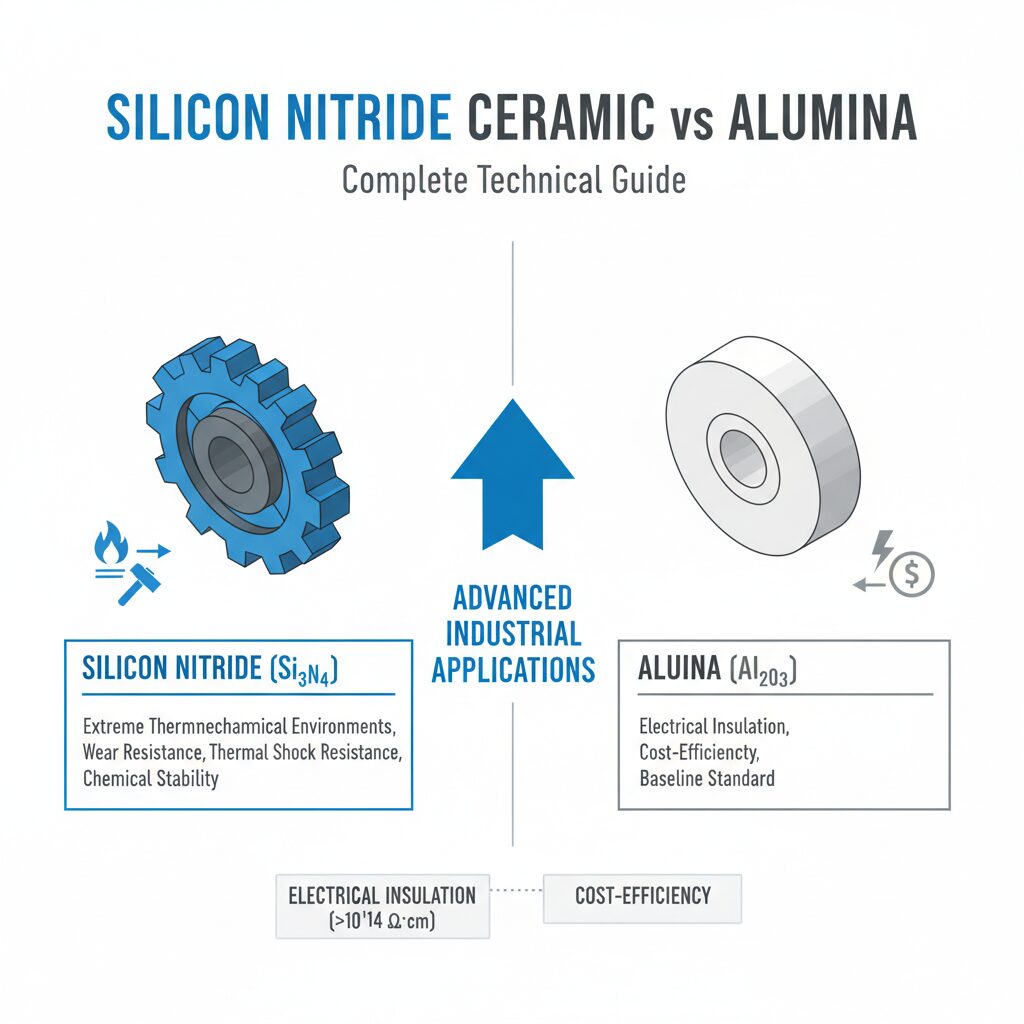
Die Vergleichsdaten verdeutlichen, warum ein Dichtungsring aus Siliziumkarbid-Keramik für Halbleiteranwendungen in Umgebungen mit hoher Beanspruchung besser abschneidet als Alternativen. Aluminiumoxid ist zwar kostengünstig und wird häufig für allgemeine elektrische Isolierungen verwendet, weist jedoch eine relativ geringe Wärmeleitfähigkeit (30 W/m·K) und eine geringere Härte (1500 HV) auf. In einer stark erosiven Fluor- oder Chlorplasmaumgebung zersetzt sich Aluminiumoxid bis zu zehnmal schneller als SiC und erzeugt dabei Aluminiumfluorid (AlF₃)-Partikel, die fatale Waferdefekte verursachen. Zirkonoxid bietet eine unübertroffene Bruchzähigkeit (10,0 MPa·m½), wodurch es äußerst widerstandsfähig gegen mechanische Stöße ist, doch seine äußerst schlechte Wärmeleitfähigkeit (2,5 W/m·K) und sein hoher Wärmeausdehnungskoeffizient (10,3 × 10⁻⁶/K) führen bei Temperaturen über 400 °C zu schweren Thermoschockversagen. Siliziumnitrid bietet eine ausgezeichnete Thermoschockbeständigkeit und mäßige Zähigkeit, doch SiC weist eine überlegene Hochtemperaturstabilität und eine unübertroffene Härte (2800 HV) auf. Zudem ist der Wärmeausdehnungskoeffizient von SiC (4,0 × 10⁻⁶/K) nahezu identisch mit dem eines Einkristall-Siliziumwafers (2,6 – 4,2 × 10⁻⁶/K, je nach Temperatur), was sicherstellt, dass sich der Dichtungsring und der Wafer während der Temperaturwechselbeanspruchung mit derselben Geschwindigkeit ausdehnen und zusammenziehen, wodurch mechanische Spannungen und Partikelreibung verhindert werden. Für Anwendungen, die ein spezifisches Wärmemanagement ohne Plasmaeinwirkung erfordern, Aluminiumnitrid wird zwar manchmal in Betracht gezogen, weist jedoch nicht die chemische Inertheit von SiC auf. Ebenso gilt, Bornitrid eignet sich hervorragend zur Schmierung und bei extremer Hitze, ist jedoch für dynamische Dichtungsanwendungen viel zu weich.
Anwendungen
Der Einsatz eines Dichtungsrings aus Siliziumkarbid-Keramik in der Halbleiterfertigung ist in mehreren Phasen der Waferherstellung von entscheidender Bedeutung. Die anspruchsvollen Spezifikationen für Knoten unter 7 nm erfordern eine Partikelbildung von Null und absolute chemische Reinheit.
- Plasmaätzanlagen (ICP und RIE): Dichtungsringe dienen dazu, die Vakuumkammer von der Außenumgebung abzuschirmen, während sie gleichzeitig aggressiven Halogengasen (wie CF₄, CHF₃, SF₆ und Cl₂) in Systemen für induktiv gekoppeltes Plasma (ICP) und reaktives Ionenätzen (RIE) direkt ausgesetzt sind. SiC wird gewählt, da seine Sputterausbeute unter Ionenbeschuss um Größenordnungen geringer ist als die von Aluminiumoxid oder Quarz, was zu einer verlängerten Lebensdauer der Bauteile und einer metallfreien Kontamination führt.
- Kammern für die schnelle thermische Behandlung (RTP): Diese Bauteile, die als Wärmeisolationsringe und Dichtungen zum Einsatz kommen, müssen Temperatursprünge von Umgebungstemperatur auf 1200 °C in weniger als 10 Sekunden aushalten. SiC wird aufgrund seiner hervorragenden Wärmeleitfähigkeit (150 W/m·K) und seines geringen Wärmeausdehnungskoeffizienten (CTE) ausgewählt. Dadurch wird vollständig verhindert, dass sich der Dichtungsring während dieser heftigen thermischen Transienten verzieht oder Risse bildet.
- Systeme zur chemischen Gasphasenabscheidung (CVD) und zur physikalischen Gasphasenabscheidung (PVD): In Hochtemperatur-Abscheidungsumgebungen gewährleisten Dichtungsringe die Gasdichtheit um Gasdüsen und Wafer-Sockel herum. SiC wird bevorzugt eingesetzt, da seine Hochtemperaturstabilität (bis zu 1600 °C) eine Ausgasung verhindert. Darüber hinaus können CVD-SiC-Beschichtungen auf den Dichtungsring aufgebracht werden, um eine hochreine, porenfreie Oberfläche zu schaffen, die Ablagerungen widersteht und eine aggressive In-situ-Kammerreinigung mit NF₃-Plasma ermöglicht.
- Elektrostatische Spannvorrichtungen (ESC) und Wafer-Handhabung: Dichtungsringe werden am Umfang von ESCs eingesetzt, um die empfindlichen inneren Elektroden vor Prozessgasen zu schützen. Der einstellbare elektrische spezifische Widerstand von SiC ermöglicht es Ingenieuren, die Johnsen-Rahbek-Kräfte (JR-Kräfte) effektiv zu steuern. SiC wird gewählt, weil sein Wärmeausdehnungskoeffizient (CTE) dem des Siliziumwafers entspricht. Das bedeutet, dass der Dichtungsring bei Erwärmung des Spannfutters keinen mechanischen Abrieb an der Rückseite des Wafers verursacht und somit die Entstehung von Partikeln auf der Rückseite verhindert.
- Nasschemische Bearbeitung und CMP: In Anlagen für das Nassätzen und die chemisch-mechanische Planarisierung (CMP) schützen rotierende Dichtungsringe Antriebswellen und Lager vor stark korrosiven Schlämmen und Säuren (wie HF und RCA-Reinigungsmitteln). SiC wird gewählt, da es gegenüber allen bekannten Säuren und Laugen vollkommen unempfindlich ist. Zudem widersteht seine extreme Härte (2800 HV) den abrasiven Siliziumdioxid- oder Ceroxid-Nanopartikeln, die in CMP-Schlämmen enthalten sind.
Herstellungsprozess
Die Herstellung eines hochreinen Dichtungsrings aus Siliziumkarbid-Keramik für Halbleiteranwendungen ist ein komplexer, mehrstufiger metallurgischer und verfahrenstechnischer Prozess. Um die erforderlichen mechanischen Eigenschaften und einen Gehalt an metallischen Verunreinigungen von unter 1 Teil pro Million (ppm) zu erreichen, muss jeder Schritt – von der Synthese des Rohpulvers bis zur abschließenden Messtechnik – streng kontrolliert werden.
Formgebungsmethoden
- Kaltisostatisches Pressen (CIP): Hochreines Alpha-SiC-Pulver im Submikronbereich wird mit nichtmetallischen organischen Bindemitteln vermischt und in eine flexible Elastomerform gegeben. Die Form wird in eine Flüssigkeit getaucht und einem in alle Richtungen wirkenden Hydraulikdruck im Bereich von 200 bis 300 MPa ausgesetzt. Dieses Verfahren gewährleistet eine vollkommen gleichmäßige Rohkörperdichte. Dies ist entscheidend, um die anisotrope Schrumpfung während des Sinterns zu minimieren und innere Hohlräume zu vermeiden.
- Schleuderguss: Bei Dichtungsringen mit komplexen inneren Geometrien oder außergewöhnlich großen Durchmessern (bis zu 450 mm für 300-mm-Wafer-Anlagen) wird eine wässrige Suspension aus SiC-Pulver mit hohem Feststoffanteil in eine poröse Gipsform gegossen. Durch Kapillarwirkung wird die Flüssigkeit abgesaugt, sodass ein dicht gepackter Pulverkompakt zurückbleibt. Dieser Prozess ist hochgradig optimiert, um eingeschlossene Luftblasen zu vermeiden, die später Makrodefekte bilden würden.
Sintern
Die Rohlinge werden in einer streng kontrollierten, inerten Argon- oder Tiefvakuumatmosphäre drucklos gesintert. Da die kovalenten Bindungen in SiC außergewöhnlich stark sind, sind für eine vollständige Verdichtung Sintertemperaturen zwischen 2100 °C und 2200 °C erforderlich. Während dieser Phase fördern Kohlenstoff- und Bor- (oder Aluminium-)Dotierungsmittel die Festkörperdiffusion, wodurch Porosität beseitigt und eine endgültige theoretische Dichte von >98,5% erreicht wird. Für Halbleiteranwendungen mit ultrahoher Reinheit wird gesintertes Siliziumkarbid (SSiC) gegenüber reaktionsgebundenem Siliziumkarbid (RBSiC) bevorzugt, da RBSiC 8–15% freies Silizium enthält, das von fluorhaltigen Plasmen aggressiv angegriffen werden kann, was zu einem raschen Verschleiß der Dichtungsringe führt.
Endbearbeitung
Nach dem Sintern schrumpft der SiC-Dichtungsring um etwa 15–20% und erreicht seine endgültige Härte von 2800 HV. Um die strengen Maßanforderungen der Halbleiterindustrie zu erfüllen, muss der gesinterte Rohling umfangreichen Präzisionskeramikbearbeitung. Bei diesem Verfahren kommen spezielle 5-Achsen-CNC-Schleifzentren zum Einsatz, die mit kunstharz- und metallgebundenen Diamantschleifscheiben ausgestattet sind. Der Prozess beginnt mit dem Grobschliff unter Verwendung von Diamantscheiben der Körnung 80–120, um die primäre Geometrie festzulegen, gefolgt von einer Präzisionsfeinbearbeitung mit Scheiben der Körnung 400–800. Die kritischen Dichtflächen werden anschließend einem beidseitigen Planetenläppen und einem chemomechanischen Polieren (CMP) unter Verwendung von Diamantsuspensionen im Submikrometerbereich unterzogen, um eine Ebenheit auf optischem Niveau (häufig <1 Helium-Lichtband) und eine Oberflächenrauheit (Ra) von <0,1 μm zu erreichen.
Vorteile und Beschränkungen
Vorteile
- Außergewöhnliche Plasma-Beständigkeit: SiC weist bei Einwirkung von Fluor- und Chlor-Radikalplasmen eine vernachlässigbare Ätzrate auf und hält 5- bis 10-mal länger als Standardkomponenten aus 99,5%-Aluminiumoxid. Dadurch lässt sich die Häufigkeit vorbeugender Wartungszyklen (PM) in Fertigungsanlagen drastisch reduzieren.
- Keine Partikelbildung: Aufgrund seiner extremen Härte und strukturellen Integrität gibt ein hochglanzpolierter SiC-Dichtungsring bei dynamischer mechanischer Reibung keine Partikel ab, wodurch die Reinraumstandards der ISO-Klasse 1 im Inneren der Prozesskammer gewahrt bleiben.
- Optimale Anpassung der Wärmeausdehnung: Mit einem CTE von 4,0 × 10⁻⁶/K weist SiC ein ähnliches thermisches Verhalten wie Siliziumwafer auf. Dies verhindert mechanische Spannungen, Mikrokratzer sowie das Verrutschen der Wafer bei schnellen Aufheiz- und Abkühlzyklen bis zu 1200 °C.
- Hohe Temperaturwechselbeständigkeit: Die Kombination aus hoher Wärmeleitfähigkeit (150 W/m·K) und geringem Wärmeausdehnungskoeffizienten (CTE) verleiht SiC einen außergewöhnlich hohen Thermoschockparameter, wodurch katastrophale Rissbildungen verhindert werden, wenn das Material in RTP- oder CVD-Systemen plötzlichen Temperaturgradienten ausgesetzt ist.
Beschränkungen
- Inhärente Sprödigkeit: Wie alle hochentwickelten technischen Keramiken weist SiC im Vergleich zu Metallen eine relativ geringe Bruchzähigkeit (4,5 MPa·m½) auf. Es kann keine plastische Verformung aufnehmen. Daher führen punktuelle Belastungen, ein zu hohes Drehmoment bei Befestigungselementen oder versehentliche Stöße während der Montage zu einem sofortigen katastrophalen Bruch.
- Hohe Herstellungskosten und lange Lieferzeiten: Die Notwendigkeit des Hochtemperatur-Vakuumsinterns (2200 °C) und die Abhängigkeit von langwierigem Präzisionsschleifen mit Diamantwerkzeugen machen die Herstellung eines Dichtungsrings aus Siliziumkarbid-Keramik für Halbleiteranwendungen im Vergleich zu technischen Kunststoffen oder Metallen von Natur aus kostspielig und zeitaufwendig.
Überlegungen zur Bearbeitung
Genau jene Eigenschaften, die einen Dichtungsring aus Siliziumkarbid-Keramik für die Halbleiterfertigung so effektiv machen – seine extreme Härte und chemische Beständigkeit –, machen seine Bearbeitung zugleich bekanntermaßen schwierig. Herkömmliche Schneidwerkzeuge aus Schnellarbeitsstahl oder Wolframkarbid werden beim Kontakt mit gesintertem SiC sofort stumpf. Die größte Herausforderung bei der Bearbeitung besteht darin, einen präzisen Materialabtrag zu erzielen, ohne dass es zu Mikrorissen unter der Oberfläche kommt. Diese können sich unter thermischer Belastung im Betrieb ausbreiten und Vakuumlecks verursachen.
Um diese Herausforderungen zu meistern, setzen die Ingenieure bei Great Ceramic fortschrittliche kinematische Schleifstrategien ein. Wir setzen das kontinuierliche Abrichtschleifen mit Kriechvorschub und hochkonzentrierten Diamantwerkzeugen ein und optimieren dabei den Kühlmitteldruck sowie die Strömungsrichtung, um Wärmeenergie aus der Schnittzone abzuführen. Die folgende Tabelle gibt einen Überblick über die außergewöhnlichen Toleranzen, die Great Ceramic bei der Fertigung maßgeschneiderter SiC-Dichtungsringe für führende Halbleiterausrüstungshersteller (OEMs) erzielt.
| Bearbeitungsparameter | Standardtoleranz | Great Ceramic-Präzisionsfähigkeit |
|---|---|---|
| Außendurchmesser/Innendurchmesser (OD/ID) | ±0,05 mm | ±0,005 mm |
| Dicke / Parallelität | 0,02 mm | 0,002 mm |
| Rundlaufgenauigkeit | 0,05 mm | 0,005 mm |
| Oberflächenrauheit (Ra) | 0,4 – 0,8 μm | <0,05 μm (poliert) |
| Oberflächenebenheit | 5 Lichtbänder | <1 Lichtband (Helium) |
Um eine Oberflächenebenheit von weniger als 1 Helium-Lichtband (ca. 0,29 μm) und eine Parallelität von 0,002 mm über einen Dichtungsring mit 300 mm Durchmesser zu erreichen, ist eine strenge Messtechnik erforderlich, einschließlich Laserinterferometrie und Koordinatenmessgeräten (CMM), die direkt in die Fertigung integriert sind. Durch die strenge Kontrolle der Vorschubgeschwindigkeiten und den Einsatz einer schrittweisen Reduzierung der Diamantkörnung beseitigen wir Restspannungen in der Oberfläche. Erfahren Sie mehr über unsere Präzisionsbearbeitung von Keramik unsere Kompetenzen und wie wir Sie bei der Entwicklung Ihrer Geräte der nächsten Generation unterstützen können.
FAQ
Was ist ein Dichtungsring aus Siliziumkarbid-Keramik für Halbleiter?
Ein Dichtungsring aus Siliziumkarbid-Keramik für die Halbleiterindustrie ist ein hochpräzises, hochreines mechanisches Bauteil, das zur Herstellung gasdichter und vakuumsicherer Dichtungen in Anlagen zur Waferfertigung verwendet wird. Diese Ringe werden entweder aus gesintertem Siliziumkarbid (SSiC) oder aus CVD-Siliziumkarbid hergestellt und sind so ausgelegt, dass sie extremen Umgebungsbedingungen standhalten, darunter der direkten Einwirkung aggressiver Halogenplasmen, Temperaturen von über 1200 °C sowie korrosiven Nasschemikalien. Sie sind entscheidend, um das Eindringen von Außenluft zu verhindern, interne Prozessgase zu kontrollieren und sicherzustellen, dass während der Bearbeitung keinerlei Partikel- oder Metallverunreinigungen auf den Siliziumwafer gelangen.
Was sind die wichtigsten Anwendungsbereiche eines Dichtungsrings aus Siliziumkarbid-Keramik für die Halbleiterindustrie?
Die Hauptanwendungsbereiche liegen in den anspruchsvollsten Prozesskammern einer Halbleiterfertigungsanlage. Sie kommen vorwiegend in Plasmaätzanlagen (RIE und ICP) zum Einsatz, wo sie als Fokusringe oder Isolationsdichtungen dienen, die dem Fluor-/Chlor-Plasma standhalten. Außerdem sind sie in Kammern für die chemische Gasphasenabscheidung (CVD) und die physikalische Gasphasenabscheidung (PVD) unverzichtbar, um Gasdüsen und Suszeptoren bei hohen Temperaturen abzudichten. Zudem werden sie als Randdichtungen um elektrostatische Spannvorrichtungen (ESCs) herum eingesetzt, um die inneren Elektroden zu schützen. Und in Kammern für die schnelle thermische Bearbeitung (RTP) aufgrund ihrer außergewöhnlichen Temperaturwechselbeständigkeit.
Inwiefern unterscheidet sich ein Dichtungsring aus Siliziumkarbid-Keramik für Halbleiter von anderen Keramiken?
Im Vergleich zu anderen technischen Keramiken bietet SiC eine überlegene Kombination aus Plasmabeständigkeit, Wärmeleitfähigkeit und Härte. Aluminiumoxid (Al₂O₃) ist zwar kostengünstiger, zersetzt sich jedoch in Halogenplasmen rasch und erzeugt gefährliche Aluminiumfluorid-Partikel. Zirkonoxid (ZrO₂) ist zwar zäher, versagt jedoch unter hoher thermischer Belastung aufgrund seiner extrem geringen Wärmeleitfähigkeit (2,5 W/m·K) und seines hohen Wärmeausdehnungskoeffizienten. Siliziumnitrid (Si₃N₄) verfügt über hervorragende Thermoschockbeständigkeit, kann jedoch nicht mit der Härte und der Plasmaerosionsbeständigkeit von SiC mithalten. Vor allem weist SiC einen thermischen Ausdehnungskoeffizienten (4,0 × 10⁻⁶/K) auf, der fast perfekt mit dem von Einkristall-Silizium übereinstimmt, wodurch mechanische Reibung am Wafer verhindert wird.
Welche Vorteile bietet ein Dichtungsring aus Siliziumkarbid-Keramik für die Halbleiterindustrie?
Zu den wichtigsten Vorteilen zählen die nahezu null Partikelbildung und die höchste chemische Inertheit. Diese Eigenschaften sind für Halbleiterknoten unter 7 nm unerlässlich. Die Vickers-Härte von 2800 HV gewährleistet eine beispiellose Verschleißfestigkeit gegenüber beweglichen Teilen und Hochgeschwindigkeitsgasströmen. Die hohe Wärmeleitfähigkeit (150 W/m·K) verhindert lokale Hotspots und thermisches Verziehen. Darüber hinaus verlängert die extrem geringe Sputterausbeute bei Ionenbeschuss die Lebensdauer des Bauteils im Vergleich zu Quarz oder Aluminiumoxid erheblich, wodurch Ausfallzeiten der Kammer reduziert und die Gesamtbetriebskosten (TCO) für Fabrikbetreiber gesenkt werden.
Wie wird ein Dichtungsring aus Siliziumkarbid-Keramik für die Halbleiterindustrie gefertigt?
Aufgrund seiner extremen Härte lässt sich SiC nicht mit herkömmlichen Zerspanungswerkzeugen bearbeiten. Hierfür ist eine spezielle Diamantschleiftechnologie erforderlich. Der Prozess umfasst das CNC-Präzisionsschleifen unter Verwendung von harz- und metallgebundenen Diamantscheiben unter kontinuierlicher Flutkühlung, um thermische Schäden zu vermeiden. Die endgültigen Dichtflächen werden durch Planetenläppen und chemisch-mechanisches Polieren (CMP) unter Verwendung von Diamantschleifpasten im Submikrometerbereich erzielt. Great Ceramic nutzt modernste 5-Achsen-CNC-Schleifzentren, um diese komplexen Bearbeitungsvorgänge durchzuführen. Durch unsere spezialisierte Präzisionskeramikbearbeitung Bei der Fertigung erreicht Great Ceramic routinemäßig enge Toleranzen von ±0,005 mm, eine Rundlaufgenauigkeit von 0,005 mm sowie die für Halbleiterumgebungen im Ultrahochvakuum erforderliche Oberflächenebenheit in optischer Qualität.
Benötigen Sie einen maßgefertigten Dichtungsring aus Siliziumkarbid-Keramik für Halbleiterbauteile? Kontakt zu Great Ceramic für Präzisionsbearbeitungsleistungen mit engen Toleranzen oder per E-Mail [email protected].
Dichtungsringe aus Siliziumkarbid-Keramik für die Halbleiterindustrie finden breite Anwendung in hochmodernen Keramikanwendungen.
Erfahren Sie mehr über Dichtungsring aus Siliziumkarbid-Keramik für die Halbleiterindustrie und unsere Dienstleistungen im Bereich der keramischen Präzisionsbearbeitung.