








Silicon Carbide Ceramic Insulator for Automotive: Complete Technical Guide
The transition to 800V and 1000V electrical architectures in the automotive sector has fundamentally altered the thermal and electrical demands placed on isolating components. Traditional polymeric insulators fail under the extreme heat fluxes and high-voltage stress inherent to modern electric vehicle (EV) powertrains. A Siliziumkarbid ceramic insulator for automotive applications provides the definitive engineering solution to these pain points, simultaneously delivering dielectric strengths exceeding 15 kV/mm and thermal conductivity rates up to 170 W/m·K. This dual capability eliminates thermal bottlenecks in high-power inverters, onboard chargers. And battery management systems. At Great Ceramic, we address the critical challenge of manufacturing these ultra-hard components by applying proprietary diamond grinding techniques that achieve stringent ±0.005mm dimensional tolerances. This technical guide delivers comprehensive engineering data, material comparisons. And manufacturing protocols necessary for integrating Siliziumkarbid components into next-generation automotive platforms. Ready to optimize your thermal management systems? Contact Great Ceramic to discuss your engineering requirements.
Materialeigenschaften
The engineering value of a silicon carbide ceramic insulator for automotive systems lies in its specific thermodynamic and mechanical profile. The material exhibits a highly covalent bonding structure (approximately 88% covalent and 12% ionic). This requires extreme energy to disrupt. This atomic lattice configuration directly yields its exceptional hardness of up to 2800 HV and structural integrity under prolonged thermal cycling. In automotive powertrains, where ambient under-hood temperatures can swing from -40°C to 150°C in minutes, the dimensional stability of the insulator is non-negotiable. Furthermore, its coefficient of thermal expansion (CTE) of 4.0 × 10^-6/K closely matches that of semiconductor dies (like silicon and silicon carbide MOSFETs), mitigating thermomechanical shear stresses at the substrate-die interface during peak power loads of up to 300 kW.
| Eigentum | Wert | Einheit |
|---|---|---|
| Dichte | 3.15 | g/cm³ |
| Härte | 2800 | HV |
| Biegefestigkeit | 420 | MPa |
| Bruchzähigkeit | 4.5 | MPa-m½ |
| Wärmeleitfähigkeit | 170 | W/m-K |
| Elektrischer spezifischer Widerstand | >10^13 | Ω-cm |
| Maximale Betriebstemperatur | 1600 | °C |
When analyzing the thermal conductivity (170 W/m·K), it is critical to note that this value outperforms virtually all metallic alloys used in standard automotive heat sinks, including many aluminum grades (which typically hover around 150-160 W/m·K depending on the alloy). However, unlike aluminum, silicon carbide provides absolute electrical isolation with a volume resistivity exceeding 10^13 Ω·cm at room temperature. This combination prevents parasitic capacitance and current leakage in EV traction inverters switching at frequencies of 20 kHz to 100 kHz. The high flexural strength of 420 MPa ensures that the ceramic insulators can withstand the high clamping forces required during the assembly of power modules without micro-cracking, while the maximum working temperature of 1600°C provides an unprecedented safety margin against thermal runaway events in battery packs.
Vergleich mit anderen Keramiken
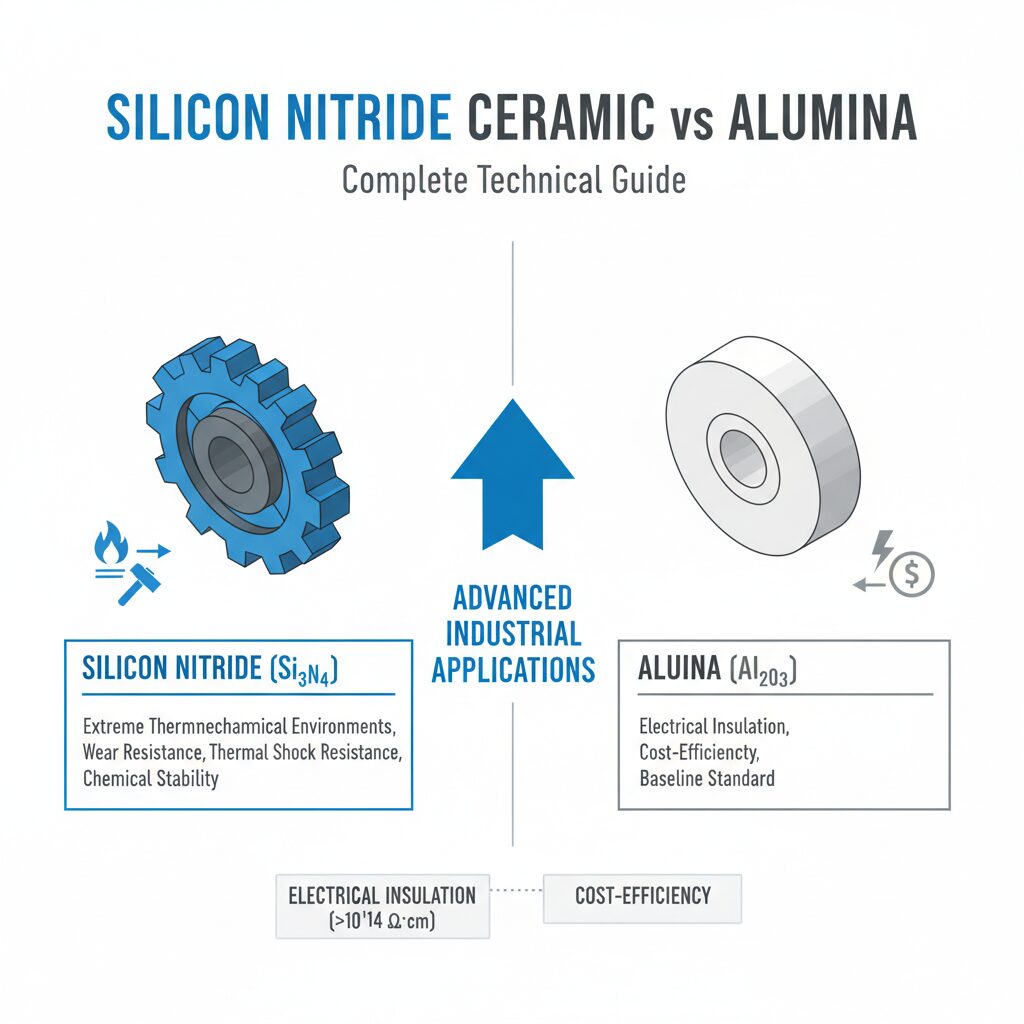
Selecting the optimal advanced ceramic requires analyzing the operational loads against the material’s inherent characteristics. Automotive engineers frequently evaluate silicon carbide against Tonerde/”>Tonerde, Zirkoniumdioxid. Und Siliziumnitrid. While each material serves a specific industrial function, the silicon carbide ceramic insulator for automotive use offers a distinct profile engineered for extreme thermal dissipation coupled with high-voltage isolation.
| Eigentum | Siliziumkarbid | Tonerde | Zirkoniumdioxid | Siliziumnitrid |
|---|---|---|---|---|
| Wärmeleitfähigkeit | 170 W/m·K | 25-35 W/m·K | 2-3 W/m·K | 80-90 W/m·K |
| Härte | 2800 HV | 1500 HV | 1200 HV | 1600 HV |
| Bruchzähigkeit | 4.5 MPa·m½ | 3.5-4.0 MPa·m½ | 8,0-10,0 MPa-m½ | 6.0-7.0 MPa·m½ |
| Kosten | Hoch | Niedrig | Mittel | Sehr hoch |
Thermal Conductivity Comparison: Silicon carbide radically outperforms both alumina and zirconia in heat dissipation. Alumina, the historical standard for electronic substrates, maxes out at approximately 35 W/m·K. Zirconia acts almost as a thermal insulator at 2-3 W/m·K. While silicon nitride offers a respectable 90 W/m·K, silicon carbide nearly doubles this figure, making it the superior choice for high-power-density 800V EV traction inverters where every degree of temperature reduction directly increases switching efficiency and range.
Mechanical Robustness: Zirconia possesses the highest fracture toughness (up to 10.0 MPa·m½) due to transformation toughening, making it highly resistant to impact. However, its poor thermal conductivity disqualifies it for power electronic cooling. Silicon carbide provides a balanced mechanical profile with 4.5 MPa·m½ fracture toughness and an exceptionally high hardness of 2800 HV. This extreme hardness translates to superior wear resistance in environments subjected to high-frequency vibrations typical of automotive powertrains, though it simultaneously complicates the machining process.
Cost-to-Performance Ratio: Alumina remains the most cost-effective solution for standard 12V and 48V automotive systems. However, as architectures push toward 800V and beyond, the thermal bottlenecks of alumina require liquid cooling systems that add excessive weight and complexity. Despite the higher initial component cost of silicon carbide, its superior thermal management capabilities allow engineers to downsize the liquid cooling loop, ultimately reducing overall system weight and lowering the vehicle’s total bill of materials.
Anwendungen
The integration of a silicon carbide ceramic insulator for automotive applications spans multiple subsystems within modern electric and hybrid-electric vehicles. The following applications highlight specific scenarios where thermal dynamics and high-voltage requirements mandate its use.
- EV Traction Inverter Power Modules: Inverters utilizing SiC MOSFETs switch at high frequencies (up to 100 kHz) and operate on 800V buses. These modules generate localized heat fluxes exceeding 200 W/cm². Silicon carbide insulators are utilized as direct-bonded copper (DBC) or active metal brazed (AMB) substrates. The material is chosen because its 170 W/m·K thermal conductivity rapidly pulls heat away from the semiconductor die into the liquid cooling plate, while its 15 kV/mm dielectric strength prevents high-voltage arcing to the chassis. Furthermore, its CTE matches the semiconductor chips, eliminating solder fatigue over tens of thousands of thermal cycles (-40°C to +150°C).
- On-Board Charger (OBC) Isolation: OBCs convert AC power from the grid into DC power to charge the high-voltage battery pack. Capable of handling up to 22 kW of power, these units require compact, thermally efficient isolation between the primary and secondary high-voltage circuits. Silicon carbide insulators are selected to replace bulky polymeric thermal pads, reducing the spatial footprint of the OBC by up to 30% while improving thermal transfer efficiency by over 400%, allowing for faster charging rates without triggering thermal throttling.
- Battery Management System (BMS) High-Voltage Relays: The BMS coordinates the safety of battery packs containing up to 400 individual cells. High-voltage contactors and relays must safely interrupt direct currents of up to 500 Amps during fault conditions. Silicon carbide arc chutes and isolator pins are utilized because the material can withstand the extreme localized plasma temperatures generated during an arc flash (exceeding 3000°C for milliseconds) without melting, carbonizing, or losing its dielectric isolating properties, whereas standard plastics would instantly vaporize and cause catastrophic failure.
- PTC Heater Substrates for Cabin Warming: Electric vehicles lack the waste heat generated by internal combustion engines, requiring Positive Temperature Coefficient (PTC) electrical heaters for cabin warming and battery pre-conditioning. Operating at 400V or 800V, these heaters output up to 7 kW of thermal energy. Silicon carbide ceramic insulators act as the structural mount and thermal bridge between the heating element and the airflow matrix. The material is chosen because it rapidly conducts the generated heat to the fins while safely isolating the 800V circuit from the vehicle’s metallic HVAC housing, ensuring passenger safety.
- LiDAR and ADAS Sensor Thermal Packaging: High-performance Autonomous Driving Assistance Systems (ADAS) utilize solid-state LiDAR units equipped with power-dense laser diodes and processing units. These components are extremely sensitive to temperature variations. This can cause beam deflection and measurement inaccuracies. Silicon carbide insulators are employed within the sensor housing to provide a rigidly flat (within 0.002mm) mounting surface that pulls heat away from the laser diodes at 170 W/m·K, ensuring the sensor maintains thermal equilibrium and measurement precision regardless of external weather conditions.
Herstellungsprozess
Producing a high-purity silicon carbide ceramic insulator for automotive applications requires a strictly controlled, multi-stage manufacturing protocol. Unlike standard metals that can be melted and cast, silicon carbide covalently decomposes at temperatures around 2700°C rather than melting. Consequently, it must be fabricated using advanced powder metallurgy techniques. The process begins with the synthesis of sub-micron alpha-SiC powder, mixed with precise organic binders and sintering aids such as boron or carbon (typically kept below 2% by weight to preserve dielectric integrity).
The manufacturing process demands absolute environmental control to prevent metallic ion contamination. This could drastically reduce the required >10^13 Ω·cm electrical resistivity. Every stage, from powder handling to high-temperature consolidation, is meticulously engineered to ensure a fully dense, pore-free microstructure capable of surviving standard automotive validation testing (e.g., AEC-Q200 equivalent stress tests for passive components).
Formgebungsmethoden
- Kaltisostatisches Pressen (CIP): For complex or large-volume automotive insulators, the prepared SiC powder is sealed in an elastomeric mold and subjected to uniform fluid pressure ranging from 200 to 300 MPa. This produces a highly uniform “green” (unsintered) compact with a green density of roughly 60%. CIP is critical for eliminating density gradients, ensuring uniform shrinkage during sintering and preventing internal stresses that could lead to dielectric breakdown under high voltage.
- Ceramic Injection Molding (CIM): For high-volume automotive production of intricate insulator shapes (such as ribbed stand-offs or complex connector housings), CIM is utilized. The SiC powder is compounded with a thermoplastic polymer binder (up to 20% by volume) to create a feedstock. This feedstock is injected into steel molds at pressures of 50-100 MPa and temperatures of 150-200°C. Following molding, the parts undergo a rigorous catalytic or thermal debinding process at 400-600°C to remove the polymers without disrupting the delicate particle matrix.
Sintern
The sintering phase is the most critical step in determining the final thermal and electrical properties of the silicon carbide ceramic insulator for automotive use. Solid-State Sintered Silicon Carbide (SSiC) is the preferred grade for high-voltage isolation. The green parts are placed in vacuum or argon-atmosphere graphite furnaces and heated to extreme temperatures between 2100°C and 2200°C. During this phase, atomic diffusion causes the sub-micron particles to bond, eliminating porosity. The material undergoes a volumetric shrinkage of 15% to 20%. Great Ceramic meticulously profiles the heating and cooling ramps (often lasting over 48 hours) to control grain growth, targeting a fine-grained microstructure (typically 2-5 µm grain size) that maximizes mechanical strength (420 MPa) and fracture toughness (4.5 MPa·m½).
Endbearbeitung
Because the sintered silicon carbide reaches a hardness of 2800 HV, traditional high-speed steel or carbide tooling is completely ineffective. Final machining can only be accomplished using diamond abrasive technology. This stage dictates the ultimate precision of the insulator. Great Ceramic employs multi-axis CNC grinding centers equipped with resin-bonded and metal-bonded diamond wheels. The grinding process involves step-down reductions, starting with coarse grits (D126) for bulk material removal and progressing to ultra-fine grits (D15) for finishing. Coolant flow, wheel speed (typically 30-45 m/s). And feed rates must be optimized to prevent micro-cracking and subsurface damage, allowing us to achieve strict surface finishes (Ra < 0.2 µm) and dimensional tolerances of ±0.005mm.
Vorteile und Beschränkungen
Deploying a silicon carbide ceramic insulator for automotive systems fundamentally shifts the performance ceiling of EV power electronics, but it requires engineers to understand both its formidable strengths and its specific constraints.
Vorteile
- Unmatched Thermal Conduction: At 170 W/m·K, silicon carbide moves heat away from sensitive semiconductor junctions 5 to 6 times faster than standard alumina (30 W/m·K). This allows automotive engineers to increase the power density of inverters without increasing the physical size of the cooling plates.
- Außergewöhnliche dielektrische Festigkeit: Capable of withstanding up to 15 kV/mm without breaking down, SiC insulators provide an enormous margin of safety for 800V and future 1000V DC bus architectures, preventing fatal arc flashes within compact onboard chargers and traction inverters.
- Thermomechanical Stability: With a CTE of 4.0 × 10^-6/K, SiC expands and contracts at virtually the same rate as the silicon or SiC chips mounted to it. This eliminates the thermomechanical shear stress that typically causes solder delamination and premature failure in power modules over a 15-year automotive lifespan.
- Chemical and Environmental Inertness: Silicon carbide is highly resistant to automotive fluids, including dielectric cooling oils, ethylene glycol mixtures. And battery electrolyte leakage. It exhibits zero moisture absorption, ensuring its electrical resistivity (>10^13 Ω·cm) remains constant regardless of ambient humidity.
Beschränkungen
- Inhärente Sprödigkeit: Despite a fracture toughness of 4.5 MPa·m½ (superior to many ceramics), SiC is still an advanced ceramic and lacks the ductility of metals or polymers. It cannot absorb high-impact shock through plastic deformation, requiring careful handling during automotive assembly and specialized mounting torque protocols to avoid point-loading stress fractures.
- High Machining Costs: The extreme hardness (2800 HV) that gives SiC its durability also makes post-sintering modifications intensely difficult. Any tight tolerances or complex geometries must be machined using consumable diamond tooling at slow feed rates. This exponentially increases the manufacturing lead time and cost per unit compared to injection-molded plastics.
Überlegungen zur Bearbeitung
The true bottleneck in utilizing a silicon carbide ceramic insulator for automotive components is not the material’s performance, but the profound difficulty of its hard machining. Achieving the geometric specifications required for automotive power electronics—such as flatness tolerances of 0.002 mm over a 100 mm span to ensure perfect thermal contact with heat sinks—requires highly specialized Präzisionskeramikbearbeitung protocols.
At Great Ceramic, we overcome the machining challenges of silicon carbide through rigorous parameter control and advanced equipment. The primary challenge is tool wear. grinding SiC rapidly strips the abrasive particles from diamond wheels. If wheel conditioning is not maintained, the tool will rub rather than cut, inducing extreme localized heat and causing micro-cracks that compromise the insulator’s 420 MPa flexural strength. To mitigate this, we utilize continuous dressing technologies and high-pressure flood cooling (exceeding 50 bar) directly at the cutting zone to flush away abrasive swarf and maintain thermal equilibrium.
For holes, slots. And complex features required in automotive connectors, ultrasonic-assisted machining is highly advantageous. By superimposing high-frequency, low-amplitude longitudinal vibrations (e.g., 20 kHz) onto the rotating diamond core drill, the cutting forces are reduced by up to 40%. This drastic reduction in force prevents chipping at the exit point of through-holes and enables the machining of thin-walled isolation barriers (down to 0.5 mm thickness). Our deep expertise ensures that every silicon carbide ceramic insulator for automotive applications leaves our facility meeting an exacting ±0.005mm dimensional tolerance, free of subsurface damage. And ready for immediate deployment in critical high-voltage EV subsystems.
FAQ
What is a silicon carbide ceramic insulator for automotive?
A silicon carbide ceramic insulator for automotive is a highly engineered, non-conductive component used primarily in electric and hybrid vehicles. Manufactured from sub-micron alpha-SiC powders sintered at over 2100°C, it is designed to simultaneously provide electrical isolation in high-voltage environments (up to 15 kV/mm dielectric strength) and ultra-efficient thermal dissipation (up to 170 W/m·K). These dual properties are critical for managing the intense heat and electrical stress generated by 800V traction inverters, onboard chargers. And battery management systems, outperforming traditional plastic and alumina alternatives.
What are the main applications of a silicon carbide ceramic insulator for automotive?
The primary applications revolve around power electronics and thermal management in EVs. They serve as direct-bonded copper (DBC) or active metal brazed (AMB) substrates for mounting high-power SiC MOSFETs in traction inverters. Additionally, they are used as isolation pads in high-capacity (up to 22 kW) onboard chargers, arc-resistant structural components within battery management system (BMS) contactors, thermally conductive bridges in high-voltage Positive Temperature Coefficient (PTC) cabin heaters. And precision-machined thermal mounts for ADAS LiDAR sensors.
How does a silicon carbide ceramic insulator for automotive compare to other ceramics?
Silicon carbide vastly outperforms standard ceramics like alumina in thermal management, offering a thermal conductivity of 170 W/m·K compared to alumina’s 25-35 W/m·K. While it is more expensive than alumina, this thermal efficiency allows engineers to design smaller, more power-dense EV inverters. Compared to Aluminiumnitrid. This also has high thermal conductivity (170-200 W/m·K), silicon carbide offers vastly superior mechanical hardness (2800 HV vs. 1100 HV) and structural rigidity. Compared to Bornitrid, silicon carbide is significantly harder and more suitable for structural load-bearing applications, whereas boron nitride is highly machinable but mechanically weaker.
What are the advantages of a silicon carbide ceramic insulator for automotive?
The central advantages are its combined thermal and electrical capabilities. It rapidly dissipates heat (170 W/m·K) away from sensitive electronics while maintaining absolute electrical isolation (>10^13 Ω·cm). Furthermore, its coefficient of thermal expansion (4.0 × 10^-6/K) closely matches semiconductor dies, preventing mechanical fatigue and delamination over thousands of thermal cycles. It is also completely chemically inert, resisting degradation from automotive cooling fluids and oils. And features exceptional structural rigidity with a flexural strength of 420 MPa.
How is a silicon carbide ceramic insulator for automotive machined?
Due to its extreme hardness (2800 HV), a silicon carbide ceramic insulator cannot be machined using conventional cutting tools. It must undergo precision ceramic machining using diamond-abrasive grinding wheels, core drills. And specialized techniques like ultrasonic-assisted machining. This process requires precise control of wheel speeds, feed rates. And high-pressure coolant to prevent micro-cracking and structural damage. At Great Ceramic, we utilize multi-axis CNC diamond grinding centers to efficiently process hard-sintered silicon carbide, reliably achieving stringent automotive tolerances of ±0.005mm and pristine surface finishes (Ra < 0.2 µm).
Need custom silicon carbide ceramic insulator for automotive parts? Kontakt zu Great Ceramic für Präzisionsbearbeitungsleistungen mit engen Toleranzen oder per E-Mail [email protected].
silicon carbide ceramic insulator for automotive is widely used in advanced ceramic applications.
Erfahren Sie mehr über Silicon Carbide Ceramic Insulator For Automotive und unsere Dienstleistungen im Bereich der keramischen Präzisionsbearbeitung.