








Silicon Carbide Ceramic Density: The Definitive Technical Guide for Engineering and Machining
In the realm of advanced technical ceramics, Silicon Carbide (SiC) stands as a titan of industrial performance. For engineers, material scientists. And procurement specialists, understanding Siliziumkarbid Keramikdichte is not merely an academic exercise—it is a critical parameter that dictates the material’s mechanical strength, thermal conductivity. And suitability for extreme environments. At Great Ceramic, we specialize in transforming this incredibly hard material into precision components, where the relationship between density and performance is at the forefront of every project.
This comprehensive guide explores the nuances of SiC density, comparing different grades, manufacturing processes. And how these factors influence the CNC machining process. Whether you are designing semiconductor wafer carriers or high-pressure pump seals, the density of your silicon carbide component will be a primary driver of its lifecycle and reliability.
What is Silicon Carbide Ceramic Density?
Density, defined as mass per unit volume (expressed in g/cm³), is a fundamental physical property that reflects the atomic arrangement and porosity of a material. For Silicon Carbide, the theoretical density of a pure SiC crystal is approximately 3.21 g/cm³. However, in industrial applications, “bulk density” is the measurement used to describe the actual density of a sintered or bonded ceramic part.
The closer a ceramic component is to its theoretical density, the fewer internal voids (porosity) it contains. High-density silicon carbide typically exhibits superior hardness, higher Young’s modulus. And better resistance to chemical erosion. Conversely, lower density or controlled porosity SiC may be used in specific applications like filtration or thermal insulation, though these are less common in precision-machined technical components.
Technical Property Tables: Comparing SiC Variants
Silicon carbide is not a monolithic material. It exists in several forms, each produced through different chemical and thermal processes. These processes significantly impact the final density and performance characteristics.
Table 1: Density and Physical Properties of SiC Types
| Eigentum | Gesintertes SiC (SSiC) | Reaction Bonded SiC (RBSiC) | Nitride Bonded SiC (NSiC) | Recrystallized SiC (RSiC) |
|---|---|---|---|---|
| Dichte (g/cm³) | 3.10 - 3.15 | 3.02 – 3.10 | 2.60 – 2.85 | 2.70 – 2.80 |
| Porosität (%) | < 1% | < 0.1% (Filled with Si) | 10% – 15% | 15% – 20% |
| Hardness (HV0.5) | 2500 - 2800 | 2000 – 2500 | 1000 – 1500 | 1200 – 1600 |
| Wärmeleitfähigkeit (W/m-K) | 110 – 130 | 100 – 120 | 30 – 40 | 35 – 45 |
| Biegefestigkeit (MPa) | 400 - 600 | 250 – 400 | 150 – 200 | 100 – 150 |
Table 2: Comparison with Other Technical Ceramics
| Material | Dichte (g/cm³) | Härte (Mohs) | Max Op Temp (°C) |
|---|---|---|---|
| Siliziumkarbid (SSiC) | 3.15 | 9.5 | 1600 |
| Tonerde (99.5% Al2O3) | 3.90 | 9.0 | 1700 |
| Zirkoniumdioxid (Y-TZP) | 6.05 | 8.5 | 1200 |
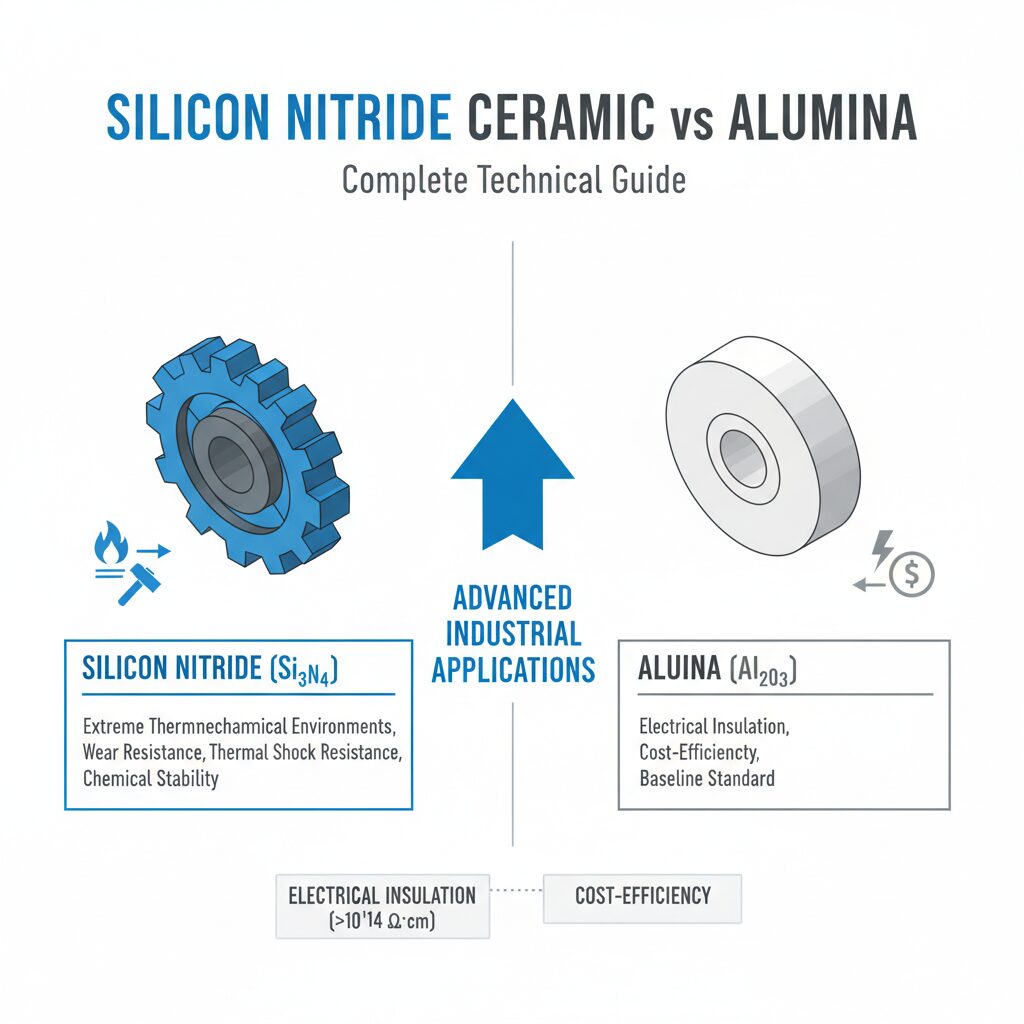
| Siliziumnitrid (Si3N4) | 3.20 | 9.0 | 1200 |
The Impact of Density on SiC Performance
1. Mechanical Strength and Hardness
The density of silicon carbide is a direct indicator of its structural integrity. In Sintered Silicon Carbide (SSiC), the absence of a secondary bonding phase and near-zero porosity results in extreme hardness—second only to diamond and boron carbide. High density ensures that the covalent bonds between silicon and carbon atoms are maximized, providing high resistance to wear and abrasion.
2. Thermal Management
Silicon carbide is prized for its high thermal conductivity. Density plays a vital role here: internal pores act as thermal insulators. Therefore, high-density SSiC or RBSiC is significantly more effective at dissipating heat than more porous variants like NSiC. This makes high-density SiC the preferred choice for heat exchangers and semiconductor processing equipment.
3. Chemical Resistance
In highly corrosive environments, density serves as a barrier. A fully dense ceramic body prevents the infiltration of acids or alkalis into the material’s core. Porous ceramics suffer from “intergranular attack,” where corrosive agents penetrate the pores and weaken the structure from within. High-density SiC is virtually inert to most known chemicals, including hot hydrofluoric acid.
Industry Applications of High-Density Silicon Carbide
Because of its unique density-to-strength ratio, SiC is utilized across various demanding industries:
Luft- und Raumfahrt und Verteidigung
In aerospace, weight is a critical constraint. Silicon carbide’s relatively low density (compared to metals like superalloys or tungsten) combined with its extreme stiffness makes it ideal for telescope mirrors, turbine vanes. And ballistic armor plates. High-density SiC provides the necessary protection without the weight penalty of traditional steel or titanium armor.
Herstellung von Halbleitern
The semiconductor industry requires materials that can withstand high temperatures and plasma environments while maintaining ultra-high purity. High-density SSiC is used for wafer carriers, susceptors. And focus rings. Its high density ensures that no particles are released during the etching process, preventing wafer contamination.
Mechanical Seals and Bearings
In the oil and gas or chemical processing sectors, pump seals are subjected to abrasive slurries and high pressures. The high density and hardness of silicon carbide ensure that the seal faces do not wear down prematurely. SiC-on-SiC bearing combinations are often used in submersible pumps where lubrication is provided by the process fluid itself.
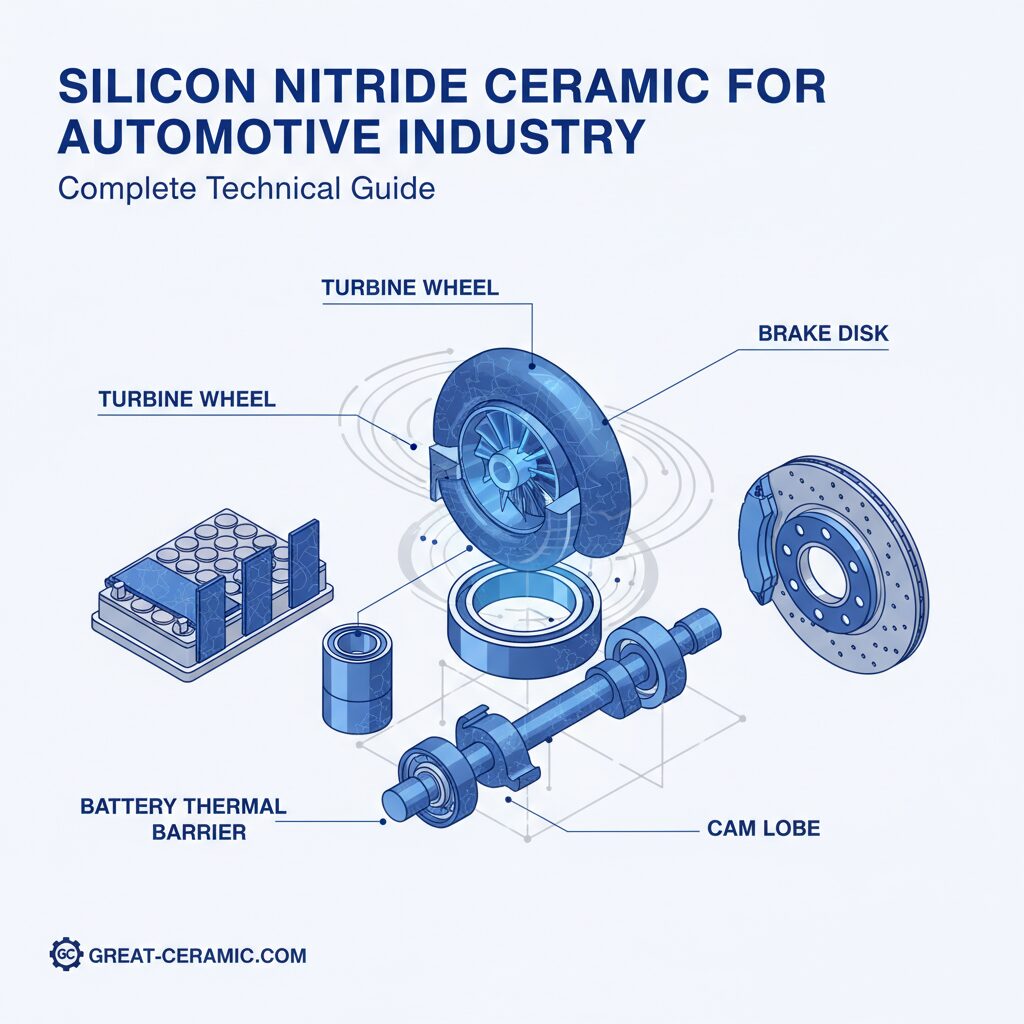
Automotive and High-Performance Braking
Carbon-fiber-reinforced silicon carbide (C/SiC) composites utilize the density of the SiC matrix to provide friction stability and thermal shock resistance in high-end braking systems. While the composite density differs from monolithic SiC, the SiC phase remains the primary wear-resistant component.
CNC Machining Specifics for Silicon Carbide
Machining silicon carbide is one of the most significant challenges in the ceramic industry. Its high density and extreme hardness (9.5 on the Mohs scale) mean that it cannot be cut using traditional metalworking tools. At Great Ceramic, we employ specialized techniques to achieve precision tolerances.
Diamant-Schleifen
Because SiC is harder than tungsten carbide and Alumina, only diamond-tipped or diamond-impregnated tools can effectively remove material. This is a grinding process rather than a traditional “cutting” process. The high density of the material means that tool wear is significant, requiring constant monitoring of tool geometry and sophisticated cooling systems to prevent thermal cracking.
Ultraschall-Bearbeitung (USM)
For complex geometries, internal threads, or small holes in high-density SiC, ultrasonic machining is often used. This process involves a tool vibrating at high frequencies in an abrasive slurry. The “hammering” action of the abrasive particles against the dense ceramic allows for material removal with minimal residual stress.
Elektrische Funkenerosion (EDM)
While most ceramics are electrical insulators, certain grades of Silicon Carbide—specifically Reaction Bonded SiC (RBSiC)—have enough free silicon or dopants to be semi-conductive. This allows for Wire EDM or Sinker EDM. This can produce incredibly complex shapes that are impossible to reach with traditional grinding wheels. However, the density and conductivity must be uniform to ensure a stable spark.
Hard Machining vs. Green Machining
To reduce costs, Great Ceramic often utilizes “Green Machining.” This involves machining the SiC “green body” (the pressed powder before it is sintered to full density). In the green state, the material is chalk-like and much easier to shape. However, one must account for the shrinkage that occurs during the sintering process as the material reaches its final density. Precision “Hard Machining” is then performed after sintering to reach the final microns of the specification.
Quality Control: Measuring SiC Density
To ensure our customers receive the highest quality components, Great Ceramic employs rigorous density testing protocols:
- Archimedes Method: The most common method for measuring bulk density and apparent porosity. It involves weighing the part in air and then in a liquid (usually water) to calculate volume based on displacement.
- Helium Pycnometry: Used for ultra-precise measurements of true density by using helium gas displacement to measure the volume of solid objects, including those with complex geometries.
- Ultrasonic Testing: High-density ceramics transmit sound waves at specific velocities. Any variation in density or internal porosity can be detected by measuring changes in sound wave travel time.
Häufig gestellte Fragen (FAQ)
What is the theoretical density of silicon carbide?
The theoretical density of a pure silicon carbide crystal is 3.21 g/cm³. Industrial-grade sintered SiC usually reaches 96% to 99% of this value.
Does density affect the thermal shock resistance of SiC?
Yes. Higher density generally improves thermal conductivity. This helps distribute heat and reduce localized stresses. However, the high elastic modulus of dense SiC also means it is less forgiving of rapid temperature changes than more porous ceramics.
Why is Sintered SiC denser than Reaction Bonded SiC?
Sintered SiC (SSiC) is made by heating ultra-fine powder with sintering aids at extremely high temperatures, causing the particles to fuse into a nearly solid mass. Reaction Bonded SiC (RBSiC) involves infiltrating a porous carbon/SiC preform with liquid silicon. While the resulting part has zero porosity, it contains about 10-15% free silicon. This has a lower density than SiC, resulting in a lower overall bulk density.
Can you machine high-density SiC to tight tolerances?
Absolutely. Through precision diamond grinding and ultrasonic machining, Great Ceramic can achieve tolerances as tight as +/- 0.001mm, even on materials with a density of 3.15 g/cm³.
How does density impact the cost of SiC parts?
Generally, higher density requires more advanced processing (like Hot Isostatic Pressing or high-temperature sintering). This increases the raw material cost. Additionally, denser materials are harder and take longer to machine. This increases the manufacturing cost.
Schlussfolgerung
Die silicon carbide ceramic density is the heartbeat of the material’s performance. It dictates how the ceramic will respond to heat, how long it will last under abrasive friction. And how it must be handled during the manufacturing process. By selecting the right grade and density, engineers can unlock the full potential of SiC, ensuring their systems operate at peak efficiency in the most hostile environments.
At Great Ceramic, we combine material expertise with state-of-the-art CNC machining capabilities to deliver silicon carbide solutions that meet the most exacting standards of the aerospace, semiconductor. And medical industries. We understand that in the world of technical ceramics, precision is everything.
Kontakt Great Ceramic für kundenspezifische Keramikbearbeitung Lösungen, die auf Ihre Anwendung zugeschnitten sind. Our team of experts is ready to assist you in selecting the ideal silicon carbide grade and density for your specific project needs.
“`
silicon carbide ceramic density is widely used in advanced ceramic applications.
Erfahren Sie mehr über Silicon Carbide Ceramic Density und unsere Dienstleistungen im Bereich der keramischen Präzisionsbearbeitung.