








Bornitrid ceramic ring for automotive: Complete Technical Guide
As automotive engineering transitions toward high-voltage 800V electric vehicle (EV) architectures and advanced high-efficiency internal combustion systems, thermal management and electrical isolation have become critical bottlenecks. A specialized component solving these complex electromechanical issues is the boron nitride ceramic ring for automotive applications. Engineers frequently encounter design challenges where traditional polymers degrade at temperatures exceeding 250°C. And standard technical ceramics lack the necessary thermal shock resistance or machinability for intricate, thin-walled geometries. Hexagonal Bornitrid (h-BN), often referred to as “white graphite,” bridges this gap by offering unparalleled thermal conductivity (up to 60 W/m·K), exceptional dielectric breakdown strength (>30 kV/mm). And a high degree of machinability. This comprehensive guide explores the thermomechanical properties, manufacturing workflows. And advanced machining techniques required to produce these high-precision rings. For procurement managers and R&D teams seeking tight-tolerance automotive components, achieving concentricity and dimensional accuracy within ±0.005mm is vital. If your engineering team requires immediate prototyping or production scaling, contact Great Ceramic today for custom manufacturing solutions.
Materialeigenschaften
| Eigentum | Wert | Einheit |
|---|---|---|
| Dichte | 2.1 – 2.2 | g/cm³ |
| Härte | 20 – 30 | HV |
| Biegefestigkeit | 30 – 35 | MPa |
| Bruchzähigkeit | 1.0 – 1.5 | MPa-m½ |
| Wärmeleitfähigkeit | 50 – 60 | W/m-K |
| Elektrischer spezifischer Widerstand | > 10^14 | Ω-cm |
| Maximale Betriebstemperatur | 900 (Air) / 1900 (Vacuum) | °C |
Vergleich mit anderen Keramiken
| Eigentum | boron nitride ceramic ring for automotive | Tonerde | Zirkoniumdioxid | Siliziumnitrid |
|---|---|---|---|---|
| Wärmeleitfähigkeit | 60 W/m·K | 24 – 35 W/m·K | 2 – 3 W/m·K | 25 - 30 W/m-K |
| Härte | 25 HV | 1500 HV | 1200 HV | 1500 HV |
| Bruchzähigkeit | 1.2 MPa·m½ | 4.0 MPa·m½ | 8,0 MPa·m½ | 6.5 MPa·m½ |
| Kosten | Mittel-Hoch | Niedrig | Mittel | Hoch |
Anwendungen
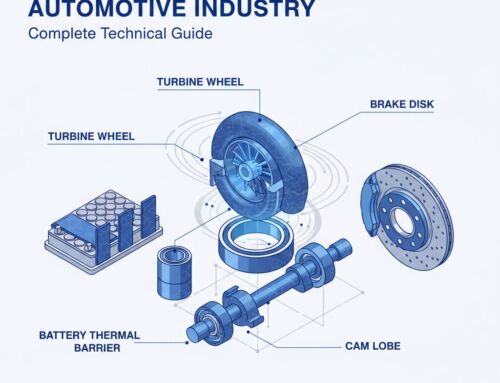
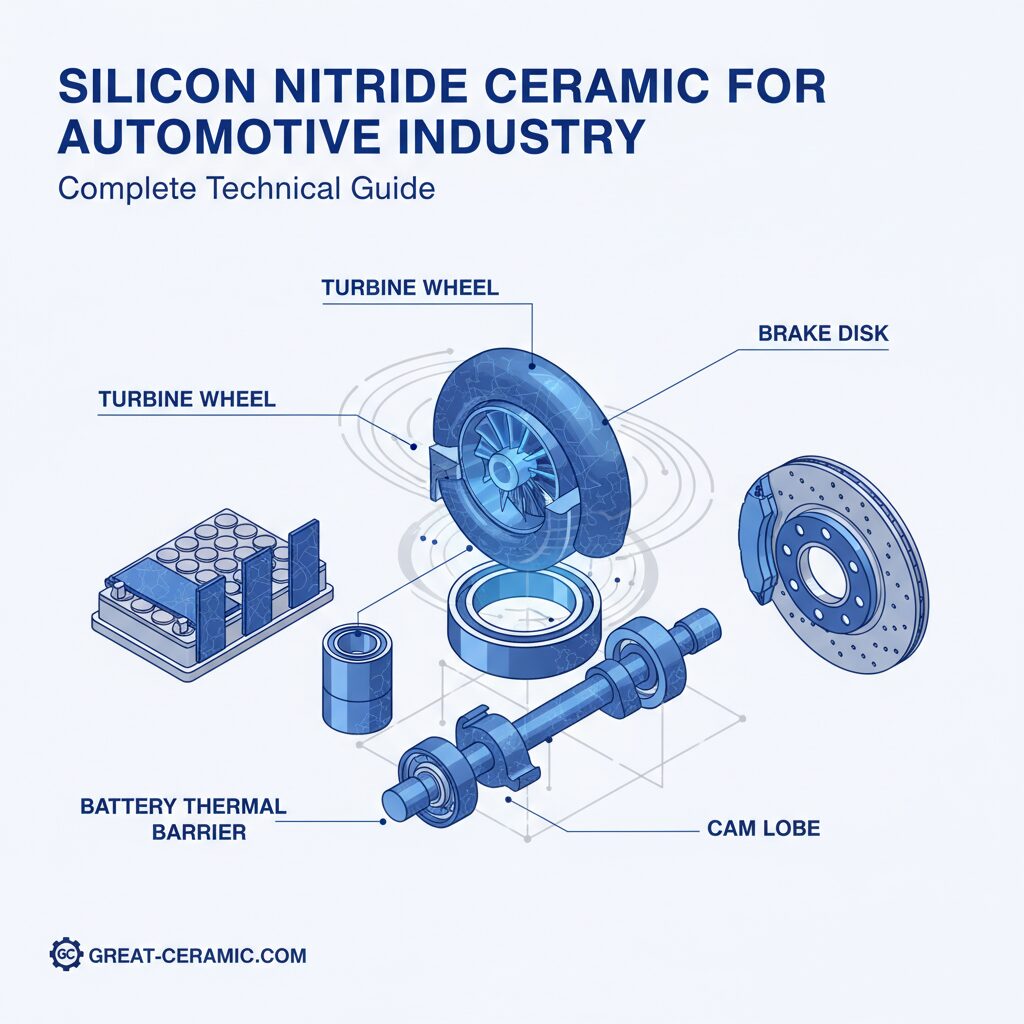
- EV Power Inverter Cooling Systems: In modern 800V electric vehicle architectures, insulated-gate bipolar transistors (IGBTs) and silicon carbide (SiC) MOSFETs generate extreme localized heat during power conversion. A boron nitride ceramic ring for automotive inverters serves as a critical thermal bridge. Unlike standard polymeric thermal interface materials that degrade under sustained thermal cycling, the h-BN ring offers a thermal conductivity of 60 W/m·K while maintaining absolute electrical isolation (>10^14 Ω·cm). This ensures that high-voltage electrical currents do not arc to the liquid cooling jacket, while simultaneously transferring heat away from the semiconductor junctions at highly efficient rates, thereby increasing the overall lifespan of the EV powertrain.
- High-Temperature Exhaust Gas Oxygen (HEGO) Sensor Insulators: Internal combustion engines and hybrid powertrains rely heavily on precise exhaust gas monitoring to optimize fuel-to-air ratios and comply with strict Euro 7 and EPA emissions standards. A boron nitride ceramic ring is frequently utilized as the primary insulating collar within HEGO sensors. Exhaust environments regularly subject components to severe thermal shock, with temperatures fluctuating from ambient up to 900°C in mere seconds. The near-zero thermal expansion coefficient of boron nitride ensures that the ceramic ring does not crack, spall, or lose its dimensional integrity under these rapid ΔT conditions, vastly outperforming standard Tonerde/”>Tonerde insulators which are prone to thermal fracturing.
- Bearing and Seal Components in High-Speed Electric Motors: Electric vehicle traction motors spin at extraordinary speeds, frequently exceeding 20,000 RPM. At these velocities, parasitic friction and eddy currents become significant engineering challenges. Because hexagonal boron nitride possesses a layered, platelet-like crystalline structure similar to graphite, a boron nitride ceramic ring for automotive motors acts as an inherent dry solid lubricant. With a coefficient of friction as low as 0.15, these rings are engineered into specialized sealing assemblies and magnetic bearing isolators where liquid lubrication is either impossible or poses a contamination risk to the motor’s electrical windings.
- Battery Thermal Runaway Mitigation Spacers: Lithium-ion and solid-state battery packs require rigorous fail-safes to prevent cascading thermal runaway in the event of a single cell failure. Automotive engineers utilize boron nitride rings as structural spacers and venting collars around high-capacity cylindrical cells (such as 4680 formats). Because the material remains structurally stable up to 1900°C in an inert environment and absorbs immense heat loads, the ring safely redirects outgassing pressures and insulates adjacent cells from the extreme 1000°C+ heat generated by the failing cell, maintaining the structural integrity of the battery module matrix.
- Advanced Ignition System Insulators for Lean-Burn Engines: High-performance and heavy-duty automotive engines utilizing lean-burn technologies require massive ignition voltages (frequently exceeding 40 kV) to effectively ignite air-heavy fuel mixtures. A precise boron nitride ceramic ring is integrated into the ignition coil and spark plug assembly to provide superior dielectric isolation. Traditional insulators suffer from dielectric breakdown and carbon tracking under high-voltage, high-heat conditions. However, the superior dielectric strength of boron nitride (exceeding 30 kV/mm) prevents high-voltage leaks, ensuring that the full electrical energy is delivered directly to the spark gap for optimal combustion efficiency.
Herstellungsprozess
The production of a high-performance boron nitride ceramic ring for automotive applications requires a meticulously controlled metallurgical and ceramic engineering workflow. Unlike conventional ceramics that can be cast or easily extruded, machinable hexagonal boron nitride relies on a combination of high-purity powder synthesis and intense thermomechanical consolidation. The process begins with the synthesis of sub-micron boron nitride powder, typically achieved by reacting boric oxide (B2O3) with ammonia (NH3) at temperatures exceeding 900°C. The resulting powder is highly anisotropic, meaning its physical properties vary depending on the direction of the crystalline planes. To align these planes and maximize thermal conductivity and structural integrity, specialized pressing and sintering techniques must be deployed, followed by ultra-high precision CNC machining to meet the rigorous ±0.005mm tolerances demanded by Tier 1 automotive suppliers.
Formgebungsmethoden
- Uniaxial Hot Pressing (HP): This is the dominant forming method for producing the dense boron nitride billets from which automotive rings are machined. The high-purity h-BN powder is loaded into a rigid graphite die and subjected to simultaneous mechanical pressure (ranging from 15 to 25 MPa) and extreme heat. The uniaxial pressure forces the plate-like hexagonal crystals to align perpendicular to the pressing direction, resulting in a dense, highly anisotropic ceramic block. This alignment is crucial for automotive applications, as engineers can orient the finished ring to direct heat away from sensitive components efficiently.
- Hot Isostatic Pressing (HIP): For automotive applications requiring isotropic properties (uniform strength and thermal conductivity in all directions) and near-zero porosity, Hot Isostatic Pressing is utilized. In this method, the boron nitride powder is sealed within a deformable high-temperature container and subjected to pressurized argon gas at pressures exceeding 100 MPa. This multi-directional consolidation eliminates internal micro-voids, producing an ultra-dense blank that is highly resistant to mechanical wear and electrical breakdown, making it ideal for the most demanding high-voltage EV environments.
Sintern
Because hexagonal boron nitride does not naturally melt or fuse easily, the sintering phase is typically combined directly with the forming phase (as in hot pressing). However, secondary thermal treatments are often required to finalize the crystalline structure and remove any residual binders or oxides (such as B2O3). The consolidated boron nitride blanks are placed into high-vacuum or high-purity nitrogen atmosphere furnaces and heated to temperatures between 1800°C and 2000°C. The dwell time at these peak temperatures can last from 10 to 14 hours. This intense thermal processing ensures complete densification and promotes grain growth. This directly enhances the material’s dielectric strength and thermal shock resistance. Carefully controlled cooling cycles are mandatory to prevent the introduction of internal thermal stresses that could cause the billet to fracture during subsequent machining operations.
Endbearbeitung
The consolidated blanks are subsequently subjected to advanced Präzisionskeramikbearbeitung to produce the final boron nitride ceramic ring for automotive deployment. Unlike ultra-hard ceramics such as Siliziumkarbid oder Zirkoniumdioxid, hexagonal boron nitride is relatively soft (20-30 HV) and highly machinable, akin to brass or Teflon. However, its softness presents unique challenges. the material is highly susceptible to edge chipping, delamination. And surface gouging if incorrect tooling or feed rates are applied. Using state-of-the-art 5-axis CNC turning and milling centers, engineers carefully carve out the ring’s complex geometries, including internal chamfers, O-ring grooves. And step-flanges. High-speed steel (HSS) or Polycrystalline Diamond (PCD) tooling is utilized depending on the required surface finish. Specialized vacuum chucks and custom collets are used to hold the delicate rings during machining to prevent clamping distortion, allowing Great Ceramic to reliably achieve exceptional ±0.005mm dimensional tolerances and surface finishes as fine as 0.4 Ra.
Vorteile und Beschränkungen
Vorteile
- Außergewöhnliches Wärmemanagement: With a thermal conductivity rating of 50-60 W/m·K, a boron nitride ceramic ring for automotive use significantly outperforms competing insulators. This allows high-voltage EV electronics and high-temperature engine components to rapidly dissipate damaging heat loads, preventing thermal degradation of surrounding polymeric seals and sensitive microelectronics.
- Unmatched Thermal Shock Resistance: The material boasts a remarkably low coefficient of thermal expansion (roughly 1.0 to 3.0 x 10^-6/°C) combined with high thermal conductivity. This allows the ceramic ring to withstand instantaneous temperature fluctuations of over 500°C without cracking, spalling, or undergoing catastrophic mechanical failure, a critical requirement for internal combustion exhaust systems.
- Superior Machinability: Unlike Siliziumnitrid or alumina which require expensive and time-consuming diamond grinding processes post-sintering, hexagonal boron nitride can be machined using standard cutting tools. This drastically reduces lead times for automotive prototyping and allows for the creation of incredibly intricate micro-features, thin-walled cross-sections. And complex internal threads that would be impossible in harder ceramics.
- High Dielectric Strength: Operating safely up to and beyond 30 kV/mm, boron nitride rings provide absolute electrical isolation. This is an indispensable advantage in 800V and 1000V electric vehicle platforms, where preventing electrical arcing and short-circuiting in the powertrain inverter and battery management systems is a critical safety and compliance requirement.
Beschränkungen
- Low Mechanical Strength: With a flexural strength of merely 30-35 MPa and a fracture toughness of 1.0-1.5 MPa·m½, boron nitride is comparatively fragile under high-impact or heavy structural load conditions. It cannot be used as a primary load-bearing component in the automotive chassis or powertrain, requiring engineers to design housings that protect the ceramic ring from direct mechanical shock and heavy vibration.
- High-Temperature Oxidation in Air: While extremely stable in inert atmospheres or vacuums up to 1900°C, hexagonal boron nitride begins to oxidize when exposed to oxygen-rich environments (such as standard engine bay air) at temperatures exceeding 850°C to 900°C. Prolonged exposure above this threshold leads to the formation of boron oxide (B2O3) on the surface. This degrades the ring’s structural integrity and dielectric properties over time.
Überlegungen zur Bearbeitung
Machining a boron nitride ceramic ring for automotive applications is a highly specialized engineering discipline that requires a deep understanding of the material’s anisotropic and brittle nature. While h-BN is soft and machinable, its layered micro-structure makes it incredibly prone to edge breakout, tear-out. And delamination during cutting operations, especially when machining thin-walled rings (e.g., wall thicknesses below 1.0mm). Standard workholding devices like 3-jaw chucks cannot be used, as the localized clamping force will instantly crush or deform the ring out of its ±0.005mm concentricity tolerance. Instead, machinists must utilize custom-machined soft jaws, expansion mandrels, or specialized vacuum fixturing to distribute the holding pressure evenly across the ring’s surface area.
Tool selection and cutting parameters are equally critical. Because boron nitride is abrasive at a micro-level despite its macro-softness, standard carbide tools can wear quickly, leading to increased cutting pressures and subsequent part fracture. Polycrystalline Diamond (PCD) tools or highly polished, uncoated micro-grain solid carbide tools with high positive rake angles are recommended to shear the material cleanly rather than plowing through it. Furthermore, h-BN absorbs moisture. therefore, machining is almost exclusively performed entirely dry. To manage the immense volume of fine ceramic dust generated, high-velocity localized vacuum extraction systems must be integrated directly at the spindle.
| Bearbeitungsverfahren | Spindeldrehzahl (U/min) | Feed Rate (mm/rev) | Recommended Tooling | Schnitttiefe (mm) |
|---|---|---|---|---|
| Rough Turning | 1,500 – 3,000 | 0.10 – 0.25 | Uncoated Solid Carbide | 1.0 – 2.5 |
| Finish Turning | 3,000 – 5,000 | 0.02 – 0.08 | PCD (Polycrystalline Diamond) | 0.1 – 0.5 |
| Micro-Milling | 10.000 – 15.000 | 0.01 – 0.05 | 2-Flute Polished Carbide | 0.05 – 0.2 |
| Hole Drilling | 2,000 – 4,000 | 0.03 – 0.06 | Carbide Drill (118° Point Angle) | Peck Drilling req. |
Achieving the extreme tolerances demanded by the automotive industry requires state-of-the-art equipment and decades of ceramic expertise. Great Ceramic specializes in the advanced fabrication of technical ceramics, ensuring that every boron nitride ceramic ring for automotive integration meets exact OEM blueprints. From managing anisotropic thermal expansion rates during the machining phase to performing final Coordinate Measuring Machine (CMM) inspections, our engineering team guarantees a flawless product. Ready to optimize your automotive thermal management system? Request an engineering consultation and RFQ from Great Ceramic today.
FAQ
What is a boron nitride ceramic ring for automotive?
A boron nitride ceramic ring for automotive is a specialized, high-precision. And highly machinable technical ceramic component utilized primarily for its unique combination of thermal and electrical properties. Manufactured from hexagonal boron nitride (h-BN), these rings act as critical insulators, thermal bridges. And low-friction seals within modern vehicles. They are extensively integrated into the power electronics of electric vehicles (EVs), high-temperature internal combustion engine exhaust sensors. And advanced battery management systems. The material’s structure allows it to transfer heat efficiently away from sensitive components while simultaneously preventing high-voltage electrical arcing, a mandatory requirement in next-generation 800V+ automotive architectures.
What are the main applications of a boron nitride ceramic ring for automotive?
The main applications revolve around extreme thermal management and high-voltage isolation. In electric vehicles, these rings are used as cooling standoffs for high-power inverters (IGBT and SiC modules), where they sink heat from the electronics to the liquid cooling system without transferring electrical current. They are also deployed as thermal runaway mitigation spacers in advanced lithium-ion battery packs, preventing cascading heat transfer between battery cells. In internal combustion and hybrid systems, boron nitride rings are utilized as ultra-high-temperature insulators for Exhaust Gas Oxygen (HEGO) sensors and high-performance ignition coil systems, where they easily withstand temperatures up to 900°C and severe thermal shock without fracturing.
How does a boron nitride ceramic ring for automotive compare to other ceramics?
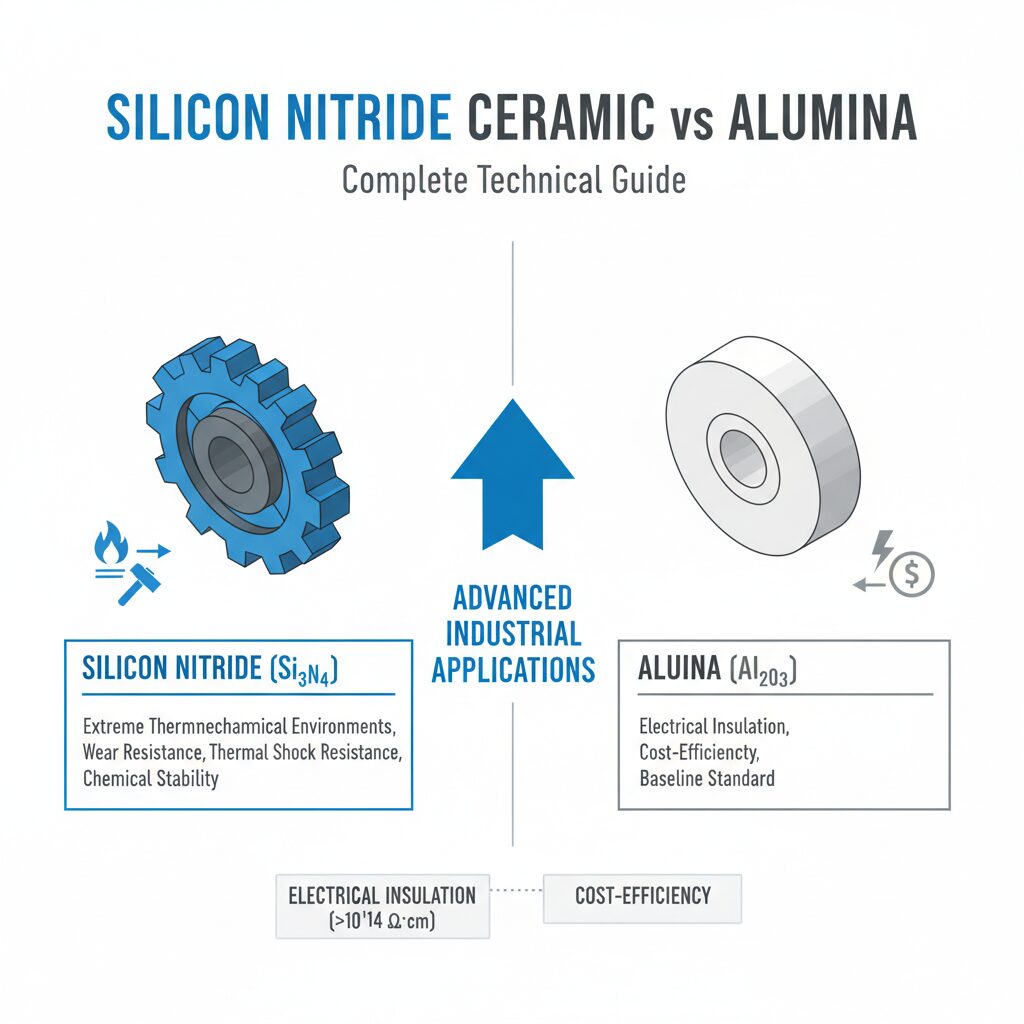
When compared to traditional technical ceramics like Tonerde oder Zirkoniumdioxid, boron nitride offers distinct advantages and trade-offs. Alumina and zirconia are incredibly hard (1200-1500 HV) and offer high mechanical strength, but they lack advanced machinability and have lower thermal shock resistance. Conversely, a boron nitride ceramic ring is relatively soft (20-30 HV), allowing it to be CNC machined to extreme tolerances (±0.005mm) without the need for expensive diamond grinding. Furthermore, boron nitride offers double the thermal conductivity of standard alumina (up to 60 W/m·K) and possesses a much lower coefficient of thermal expansion, making it vastly superior in environments experiencing rapid, extreme temperature fluctuations. However, it cannot be used for high-stress load-bearing structural applications like Siliziumnitrid can.
What are the advantages of a boron nitride ceramic ring for automotive?
The primary advantages include unparalleled thermal shock resistance, excellent high-temperature stability, superior machinability. And world-class dielectric strength. Because boron nitride has a low coefficient of thermal expansion combined with high thermal conductivity, it will not crack when subjected to instantaneous automotive temperature spikes. Its machinability drastically cuts down prototyping and production lead times, allowing engineers to design rings with intricate micro-features and ultra-thin walls. Additionally, its inherent lubricity (a friction coefficient of ~0.15) makes it an excellent choice for frictionless seals and bearings in high-RPM electric motors where traditional liquid lubricants cannot be utilized. Finally, its >30 kV/mm dielectric strength ensures complete safety in high-voltage EV powertrains.
How is a boron nitride ceramic ring for automotive machined?
Because hexagonal boron nitride is soft, it is machined using traditional high-speed CNC milling and turning equipment, rather than requiring the abrasive diamond grinding processes used for harder ceramics like Aluminiumnitrid. However, the machining process is highly complex due to the material’s brittleness and anisotropic structure. It requires precise feeds, high spindle speeds. And specialized Polycrystalline Diamond (PCD) or uncoated carbide tooling with high positive rake angles to prevent edge chipping and delamination. Specialized vacuum fixturing must be used instead of standard chucks to prevent the delicate rings from crushing or distorting out of roundness. Great Ceramic leverages advanced 5-axis Präzisionskeramikbearbeitung capabilities, sophisticated toolpath programming. And strict quality control to machine these rings dry (to avoid moisture absorption), achieving dimensional tolerances as tight as ±0.005mm to meet strict automotive engineering standards.
Need custom boron nitride ceramic ring for automotive parts? Kontakt zu Great Ceramic für Präzisionsbearbeitungsleistungen mit engen Toleranzen oder per E-Mail [email protected].
boron nitride ceramic ring for automotive is widely used in advanced ceramic applications.
Erfahren Sie mehr über Boron Nitride Ceramic Ring For Automotive und unsere Dienstleistungen im Bereich der keramischen Präzisionsbearbeitung.