








Silicon Nitride Ceramic for Medical Industry: Complete Technical Guide
The integration of advanced bioceramics in healthcare has established Siliziumnitrid ceramic for medical industry applications as a highly disruptive material, specifically engineering solutions for orthopedic implants, surgical instrumentation. And diagnostic imaging equipment. Historically, biomedical engineers and medical device procurement teams have faced severe limitations with traditional titanium alloys (Ti-6Al-4V) and cobalt-chromium (Co-Cr), primarily concerning stress shielding due to high Young’s modulus (up to 110 GPa for Ti), radiopacity that obstructs postoperative MRI/CT imaging. And wear-induced metallosis. Silicon nitride (Si3N4) effectively resolves these critical industry pain points by providing an unprecedented combination of high fracture toughness (up to 7.0 MPa·m½), profound biocompatibility. And inherent antibacterial surface chemistry that limits biofilm formation. Unlike traditional oxide ceramics, its interlocked acicular microstructure prevents catastrophic brittle failure. At Great Ceramic, our advanced engineering facilities specialize in tight-tolerance Präzisionskeramikbearbeitung, reliably achieving dimensional accuracies of ±0.005mm for complex medical components. This comprehensive technical guide analyzes the mechanical properties, comparative performance data. And stringent manufacturing protocols required for medical-grade silicon nitride. For specialized project requirements, engineer-to-engineer consultations are available to streamline your transition from prototyping to full-scale production.
Materialeigenschaften
The deployment of silicon nitride in physiological environments relies on its unique stoichiometry and crystallographic structure. Medical-grade Si3N4 is typically formulated with specific sintering additives (such as yttrium oxide and aluminum oxide) to optimize densification while strictly adhering to ISO 10993 biological evaluation standards. The resulting alpha-to-beta phase transformation yields an interlocking needle-like grain structure. This microstructure is responsible for the material’s exceptional mechanical reliability and crack-deflection capabilities. This are vital for load-bearing spinal and joint arthroplasty applications. Below is the quantitative engineering data detailing the physical, mechanical. And thermal properties of medical-grade silicon nitride.
| Eigentum | Wert | Einheit |
|---|---|---|
| Dichte | 3.20 – 3.30 | g/cm³ |
| Härte | 1500 - 1600 | HV |
| Flexural Strength (4-point) | 850 – 1000 | MPa |
| Bruchzähigkeit (K1c) | 6.0 - 7.0 | MPa-m½ |
| Wärmeleitfähigkeit | 20 – 30 | W/m-K |
| Elektrischer spezifischer Widerstand | > 10^14 | Ω-cm |
| Maximale Betriebstemperatur | 1200 | °C |
| Elastizitätsmodul | 300 - 320 | GPa |
| Wärmeausdehnungskoeffizient (CTE) | 3.2 – 3.4 | 10^-6/K |
| Druckfestigkeit | > 3000 | MPa |
| Weibull Modulus | 15 – 20 | – |
From an orthopedic design perspective, the density of silicon nitride (3.20 g/cm³) is significantly closer to human cortical bone (approx. 1.80 to 2.00 g/cm³) than cobalt-chromium alloys (8.50 g/cm³) or stainless steel 316L (8.00 g/cm³). This weight reduction minimizes patient fatigue in massive endoprosthetic reconstructions. Furthermore, the material exhibits a flexural strength routinely exceeding 850 MPa, allowing for the design of thinner, less invasive implant geometries without compromising structural integrity under dynamic biomechanical loading. The high electrical resistivity (>10^14 Ω·cm) and thermal stability up to 1200°C ensure that surgical instruments fabricated from this material provide absolute isolation during high-voltage electrosurgical interventions.
Vergleich mit anderen Keramiken
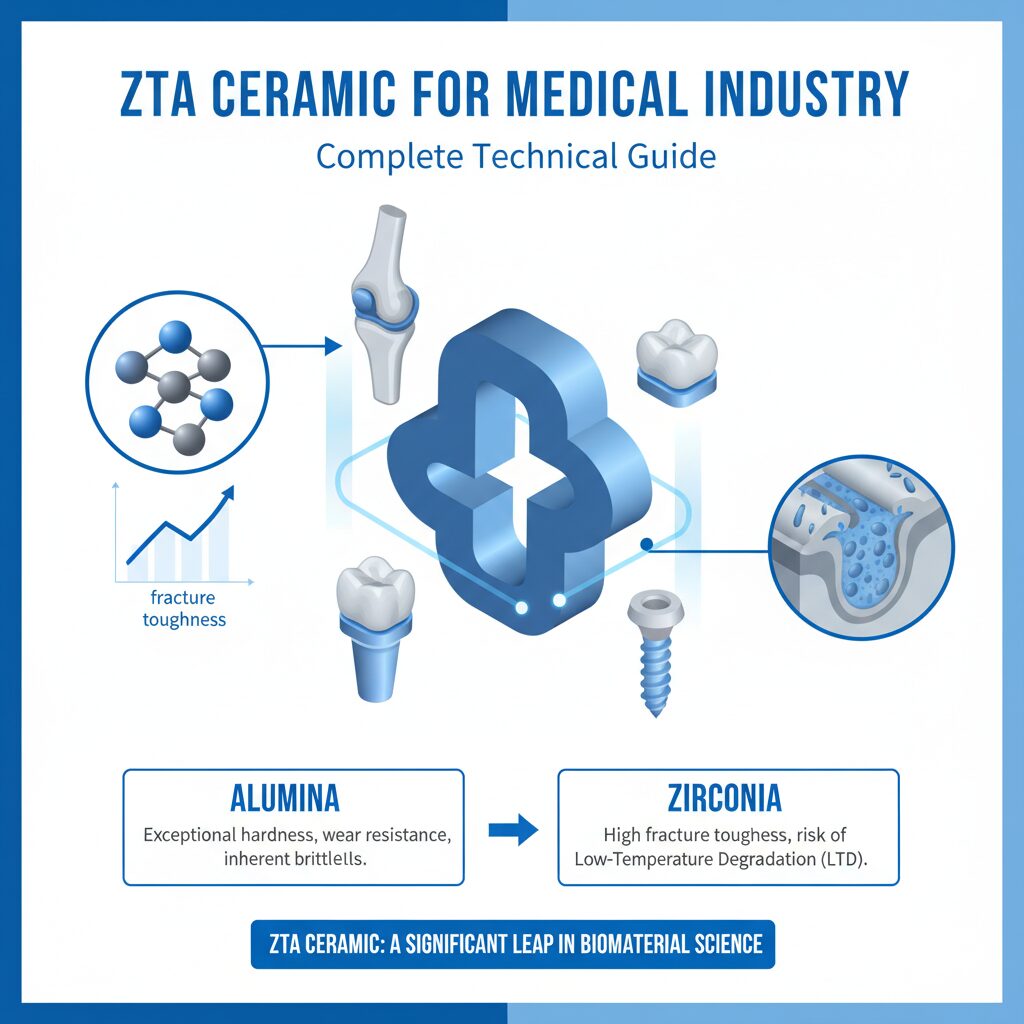
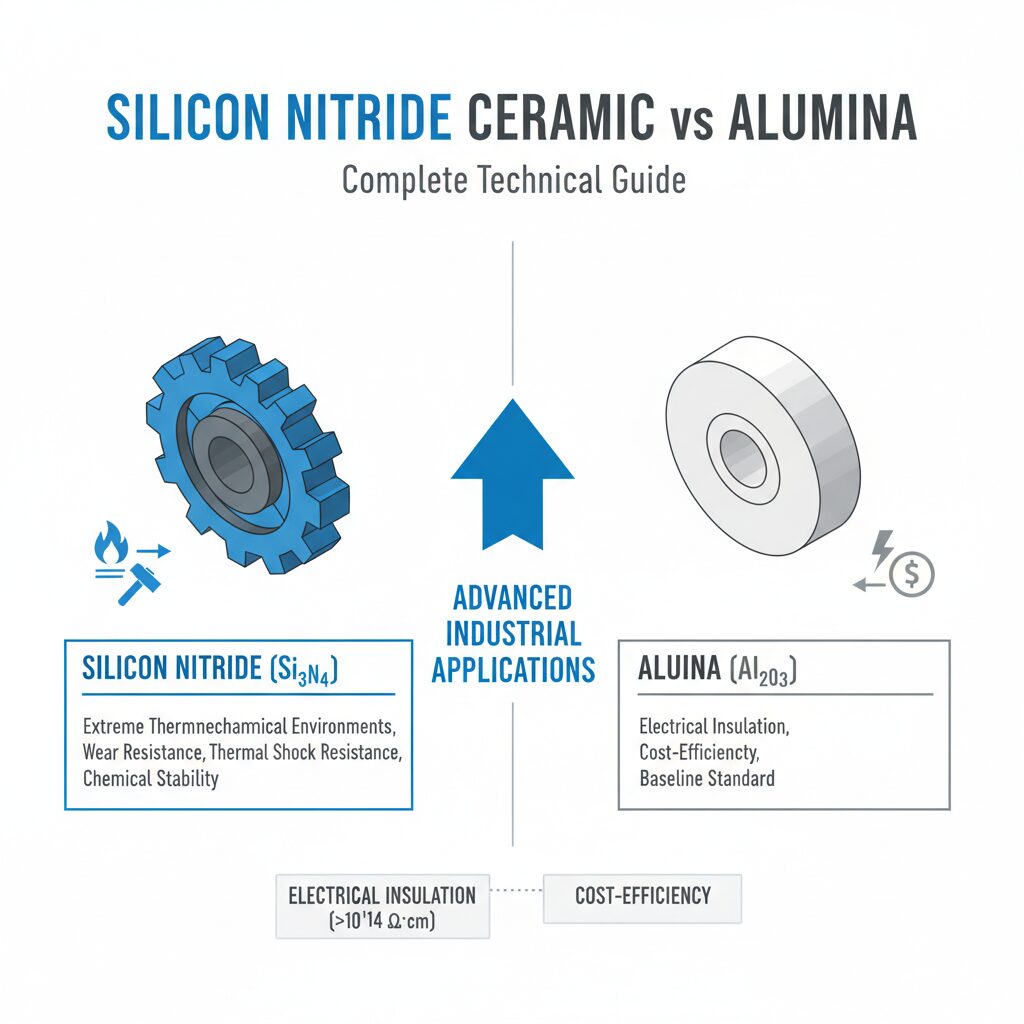
Selecting the correct bioceramic requires a rigorous comparative analysis of mechanical constraints and biological responses. While Tonerde/”>Tonerde und Zirkoniumdioxid have been utilized in total hip arthroplasty (THA) for decades, they present distinct limitations. Alumina suffers from inherently low fracture toughness (typically 3.5 to 4.5 MPa·m½), rendering it susceptible to catastrophic brittle fracture. Zirconia (specifically Y-TZP) offers high initial toughness (up to 9.0 MPa·m½) but is highly vulnerable to Low-Temperature Degradation (LTD) or hydrothermal aging, where moisture in the human body triggers a spontaneous tetragonal-to-monoclinic phase transformation, severely degrading the implant’s strength over 10 to 15 years. Silicon nitride ceramic for medical industry use bypasses LTD entirely due to its non-oxide covalent bonding, while providing higher structural reliability than alumina. We also compare it to Siliziumkarbid and standard industrial Siliziumnitrid to highlight the tailored nature of medical-grade formulations.
| Eigentum | silicon nitride ceramic for medical industry | Tonerde | Zirkoniumdioxid | Silicon Nitride (Industrial) |
|---|---|---|---|---|
| Wärmeleitfähigkeit (W/m-K) | 25 | 30 | 2.5 | 30 – 40 |
| Härte (HV) | 1550 | 1800 | 1250 | 1600 |
| Bruchzähigkeit (MPa-m½) | 6.5 – 7.0 | 4.0 | 8.0 – 9.0 | 6.0 |
| Kosten | Hoch | Niedrig | Mittel | Mittel-Hoch |
| Hydrothermal Stability (LTD) | Excellent (No LTD) | Ausgezeichnet | Poor to Moderate | Ausgezeichnet |
| Antibacterial Properties | Exceptional | Minimal | Minimal | Mäßig |
| Imaging Radiopacity | Radiolucent | Radiopaque | Radiopaque | Radiolucent |
The comparative data illustrates why medical-grade silicon nitride is rapidly capturing market share in load-bearing implants. While zirconia boasts a slightly higher initial fracture toughness, its susceptibility to aqueous environments drastically reduces its in-vivo lifespan. Silicon nitride maintains its 6.5 – 7.0 MPa·m½ toughness indefinitely in bodily fluids. Furthermore, its completely radiolucent nature means it generates zero scattering artifacts under CT scans and MRI, allowing surgeons to accurately assess postoperative osteointegration and bone fusion—a feat impossible with radiopaque alumina, zirconia, or titanium. Though the cost factor is higher than standard technical ceramics due to rigorous biological certification processes, the reduction in revision surgeries and post-operative infections yields a substantially lower total lifecycle cost for healthcare providers.
Anwendungen
- Spinal Fusion Implants (Cervical and Lumbar Spacers): Silicon nitride is revolutionizing spinal arthrodesis. The material features a highly hydrophilic surface combined with a negative surface charge. When implanted, it rapidly adsorbs fibronectin and vitronectin, promoting immediate osteoblast adhesion. In clinical settings, Si3N4 spinal cages demonstrate superior osteointegration rates compared to PEEK (Polyetheretherketone). This is naturally hydrophobic and biologically inert. Additionally, silicon nitride exhibits a bacteriostatic surface chemistry. it naturally forms trace amounts of reactive nitrogen species and peroxynitrite radicals in vivo. This have been proven to lyse the cell walls of Staphylococcus aureus and Pseudomonas aeruginosa, reducing biofilm formation by up to 99%.
- Total Joint Arthroplasty (Hip and Knee Replacements): The extreme hardness (1550 HV) and ultra-smooth surface finish achievable through precision machining (Ra < 0.05 μm) make this ceramic ideal for articulating joint surfaces. In simulated hip simulator tests running to 50 million cycles, silicon nitride articulating against cross-linked polyethylene generates significantly lower volumetric wear debris (< 0.1 mm³/million cycles) compared to traditional Cobalt-Chromium-Molybdenum alloys. This near-zero wear rate prevents metallosis and osteolysis, extending the implant survivorship well beyond the current 15-to-20-year benchmark.
- Dental Implants and Prosthetics: In dental applications, the aesthetic appeal and biological performance of silicon nitride are paramount. Titanium implants frequently suffer from peri-implantitis due to bacterial accumulation at the gingival margin, leading to crestal bone loss. Si3N4 dental roots leverage the material’s innate antibacterial properties to drastically lower the incidence of peri-implantitis. Furthermore, unlike titanium which can leave a gray shadow through thin gingival tissue, the off-white or customized coloring of silicon nitride provides superior optical aesthetics closely mimicking natural dentin.
- Endoscopic and Minimally Invasive Surgical Instrumentation: Modern electrosurgery relies heavily on instruments that require precise electrical insulation combined with mechanical rigidity. Silicon nitride forceps, scalpel handles. And laparoscopic cutting tools offer an electrical resistivity exceeding 10^14 Ω·cm, completely eliminating the risk of stray current arcing to adjacent healthy tissue during high-frequency electrocautery. Furthermore, these tools withstand rigorous hospital sterilization protocols, enduring thousands of cycles in high-vacuum steam autoclaves at 134°C without suffering the micro-cracking or oxidative degradation seen in polymer-coated metallic instruments.
- Diagnostic Imaging Equipment Components: Beyond direct patient contact, silicon nitride is highly sought after for the mechanical infrastructure of advanced diagnostic machines. High-speed CT scanner gantries rotate at speeds exceeding 300 RPM, subjecting bearings to immense centrifugal forces. Silicon nitride ball bearings operate seamlessly at these speeds with minimal lubrication, owing to a low coefficient of friction (μ = 0.1 to 0.2). Furthermore, due to its non-magnetic properties, it is utilized extensively in MRI machines where ferrous metals would be lethally drawn to the 1.5T to 3.0T superconducting electromagnets.
Herstellungsprozess
The transition from raw powder to a high-tolerance medical device is a complex thermodynamic and mechanical journey. Medical-grade silicon nitride cannot be synthesized through conventional melt-casting due to its dissociation into silicon and nitrogen gas at 1850°C. Instead, it relies on advanced powder metallurgy and consolidation techniques. Controlling trace impurities (such as iron or carbon) to levels below 50 parts per million (ppm) is strictly enforced to pass ISO 10993 cytotoxicity testing. The process leverages liquid-phase sintering mechanisms where carefully controlled oxide additives melt to form a secondary grain boundary phase, drawing the alpha-Si3N4 particles together before transforming them into the mechanically robust beta-Si3N4 phase.
Formgebungsmethoden
- Kaltisostatisches Pressen (CIP): For complex orthopedic implants, spray-dried sub-micron silicon nitride powder is encapsulated in a flexible elastomer mold and subjected to uniform hydraulic pressure ranging from 200 to 300 MPa. This multidirectional compaction ensures an ultra-homogenous green body density, virtually eliminating density gradients that cause warping during the high-temperature shrinkage phase.
- Injection Molding (CIM): For high-volume, intricate surgical instrument components, Ceramic Injection Molding is deployed. The ceramic powder is compounded with a thermoplastic binder system (typically 15-20% by weight). It is then injected into heated tool steel molds at pressures up to 100 MPa. This method allows for near-net-shape forming of highly complex internal geometries, significantly reducing the volume of expensive post-sintering diamond machining required.
Sintern
Achieving a theoretical density of >99% in silicon nitride demands specialized high-temperature environments. Standard pressureless sintering is often insufficient. Instead, Gas Pressure Sintering (GPS) is the industry standard for medical applications. Green bodies are placed in high-temperature graphite or tungsten furnaces at temperatures between 1750°C and 1850°C. To suppress the thermal decomposition of the ceramic at these extreme temperatures, the furnace is pressurized with ultra-pure Nitrogen gas at levels ranging from 10 to 100 MPa. During this stage, the material undergoes roughly 15% to 20% linear shrinkage. The precise control of the time-temperature-pressure profile dictates the aspect ratio of the resulting hexagonal beta-phase grains—the fundamental mechanism behind the material’s fracture toughness.
Endbearbeitung
Sintered silicon nitride achieves a hardness of up to 1600 HV, rendering traditional high-speed steel or carbide tooling completely ineffective. Final machining—necessary to achieve the precise articulating contours of a joint replacement or the sharp cutting edge of a surgical tool—must be executed using diamond-impregnated abrasives. This involves multi-axis Computer Numerical Control (CNC) grinding, honing. And lapping. At Great Ceramic, state-of-the-art ultrasonic-assisted grinding technology is often employed. By introducing high-frequency (20 kHz), low-amplitude micro-vibrations to the diamond tool, we significantly reduce cutting forces, minimizing subsurface micro-fracture damage and enabling the consistent realization of tight tolerances down to ±0.005mm.
Vorteile und Beschränkungen
Vorteile
- Profound Biocompatibility & Osteoconductivity: Fully compliant with FDA and ISO 10993 requirements, the material does not trigger foreign body giant cell responses. Its surface energy promotes rapid protein adsorption and subsequent osteoblast proliferation, accelerating patient recovery times in fusion surgeries.
- Inherent Antibacterial Surface Mechanics: By naturally buffering the local aqueous environment to create an alkaline micro-layer and generating trace reactive oxygen/nitrogen species, the ceramic actively repels and neutralizes common nosocomial pathogens like MRSA and E. coli.
- Unobstructed Diagnostic Imaging: The complete lack of radiopacity and magnetic interference allows for artifact-free imaging across X-ray, Fluoroscopy, CT. And MRI modalities. Surgeons can accurately evaluate the bone-to-implant interface post-operatively without signal blooming or scattering.
- Exceptional Wear Resistance: Boasting a surface hardness superior to most biomaterials, Si3N4 maintains a highly polished articulating surface over decades of in vivo mechanical friction, effectively eliminating the generation of inflammatory particulate debris that plagues metal-on-metal or metal-on-polyethylene joints.
Beschränkungen
- High Raw Material & Processing Costs: The synthesis of highly pure sub-micron starting powders, combined with the energy-intensive Gas Pressure Sintering process, makes silicon nitride significantly more expensive than standard alumina or medical-grade stainless steel.
- Complex Machining Constraints: The extreme hardness and toughness drastically lower material removal rates (MRR) during final shaping. Custom diamond tooling is mandatory. And tool wear rates are high. This can extend lead times for complex, highly contoured parts if not managed by an experienced precision machining facility.
Überlegungen zur Bearbeitung
The very properties that make silicon nitride ceramic for medical industry applications so reliable—its immense hardness (1550 HV) and high fracture toughness (7.0 MPa·m½)—create substantial engineering challenges during final part fabrication. Attempting to force material removal using aggressive feed rates will inevitably induce subsurface micro-cracking (Hertzian cone fractures). This acts as stress concentrators and critically degrades the implant’s flexural strength, leading to disastrous in-vivo catastrophic failure.
To overcome these challenges, Great Ceramic utilizes an optimized approach specifically tailored for Präzisionskeramikbearbeitung. We utilize resin-bonded diamond grinding wheels, typically ranging from D46 to D15 grit sizes, depending on the required surface finish (Ra). Spindle speeds must be strictly maintained to ensure a surface cutting speed of 25 to 35 meters per second (m/s). The depth of cut (DOC) during the finishing passes is meticulously controlled to a maximum of 0.002mm to 0.005mm per pass. Furthermore, copious amounts of specialized, high-pressure, water-based synthetic coolant must be directed exactly at the tool-workpiece interface to mitigate the localized thermal spikes that could induce thermal shock micro-fissures.
Machining Parameters for Medical Silicon Nitride
| Bearbeitungsstufe | Körnung von Diamant-Schleifmittel | Surface Speed (m/s) | Schnitttiefe (mm) | Coolant Pressure (Bar) |
|---|---|---|---|---|
| Grobschleifen | D91 – D126 | 25 – 30 | 0.010 – 0.020 | > 15 |
| Halbfeinschleifen | D46 – D64 | 28 – 32 | 0,005 – 0,010 | > 20 |
| Finish Grinding | D15 – D25 | 30 – 35 | 0.001 – 0.003 | > 25 |
| Lapping / Polishing | 1μm – 3μm Paste | < 5 | < 0.0005 | N/A (Slurry) |
Achieving a dimensional tolerance of ±0.005mm on multi-curved orthopedic components is not merely a matter of equipment. it requires deep metallurgical and ceramic engineering expertise. The structural integrity of a spinal cage or knee condyle is heavily reliant on removing the damaged surface layer generated during rough grinding. By strictly adhering to these empirically derived machining parameters, Great Ceramic guarantees that every medical component leaving our facility possesses maximum mechanical reliability and flawless surface topography. If your R&D team is struggling with the manufacturability of a new bioceramic device, integrating our engineering feedback early in the design phase will dramatically reduce your time-to-market.
FAQ
What is silicon nitride ceramic for medical industry?
Silicon nitride ceramic for medical industry is an advanced, non-oxide bioceramic material primarily utilized in orthopedic implants, spinal fusion devices. And surgical instrumentation. Unlike structural metals or traditional oxide ceramics, it offers a unique combination of high fracture toughness (up to 7.0 MPa·m½), bone-like density (3.2 g/cm³). And inherent antibacterial surface properties. It is highly valued in the medical sector because it provides load-bearing strength while remaining entirely radiolucent, allowing for clear, artifact-free postoperative CT and MRI imaging.
What are the main applications of silicon nitride ceramic for medical industry?
The primary applications include spinal arthrodesis devices (such as cervical and lumbar fusion cages), where its osteoconductive and hydrophilic properties accelerate bone growth. It is also utilized in total joint replacements (hip, knee. And shoulder arthroplasty) due to its extremely low friction and near-zero wear rate, preventing metallosis. Furthermore, its excellent electrical insulation and thermal stability make it a premier choice for high-frequency electrosurgical tools, endoscopic instrumentation. And high-speed bearings within diagnostic equipment like CT scanners.
How does silicon nitride ceramic for medical industry compare to other ceramics?
Compared to standard medical ceramics, silicon nitride provides superior overall reliability. Alumina is highly biocompatible but suffers from low fracture toughness, making it brittle and prone to shattering under high impact. Zirconia offers high initial strength but is susceptible to Low-Temperature Degradation (LTD)—a process where bodily moisture causes a phase change that weakens the implant over time. Silicon nitride does not experience LTD, maintains higher long-term fracture toughness than alumina. And is uniquely osteoconductive and bacteriostatic, setting it apart from all other oxide bioceramics.
What are the advantages of silicon nitride ceramic for medical industry?
The core advantages encompass its dual-action biological performance: it simultaneously promotes rapid osteointegration (bone healing) while actively resisting bacterial biofilm formation (reducing infection rates by up to 99%). Mechanically, it boasts high flexural strength (up to 1000 MPa) and extreme wear resistance. Clinically, its absolute radiolucency allows surgeons to monitor bone fusion without the blinding glare and scattering artifacts caused by titanium or cobalt-chromium implants. Additionally, its non-magnetic nature makes it completely safe for high-tesla MRI environments.
How is silicon nitride ceramic for medical industry machined?
Due to its extreme hardness (1500+ HV), silicon nitride cannot be machined using standard metal-cutting tools like carbide or high-speed steel. Sintered blanks must be shaped using multi-axis CNC grinding centers equipped with specialized resin-bonded or metal-bonded diamond wheels. The process requires precise spindle speeds (25-35 m/s), microscopic depths of cut (0.001mm – 0.005mm per pass). And high-pressure flood cooling to prevent subsurface micro-fracturing. At Great Ceramic, our advanced Präzisionskeramikbearbeitung capabilities enable us to routinely achieve ultra-tight tolerances of ±0.005mm and pristine surface finishes (Ra < 0.05 μm) required for critical medical device approvals.
Need custom silicon nitride ceramic for medical industry parts? Kontakt zu Great Ceramic für Präzisionsbearbeitungsleistungen mit engen Toleranzen oder per E-Mail [email protected].
silicon nitride ceramic for medical industry is widely used in advanced ceramic applications.
Erfahren Sie mehr über Silicon Nitride Ceramic For Medical Industry und unsere Dienstleistungen im Bereich der keramischen Präzisionsbearbeitung.