








Six sintering processes for 炭化ケイ素 セラミックス
炭化ケイ素(SiC)セラミック焼結について
炭化ケイ素セラミックスは、高硬度、高融点、高耐摩耗性、耐食性に加え、耐酸化性、高温強度、化学的安定性、耐熱衝撃性、熱伝導性、気密性に優れ、幅広い用途に使用されています。
現在、炭化ケイ素セラミックスの焼結方法には、主に熱間プレス焼結、非プレス焼結、反応焼結、再結晶焼結、マイクロ波焼結、放電プラズマ焼結などがある。
ホットプレス焼結
Hot pressing sintering is to place the silicon carbide powder in the mold and apply an axial pressure of 20~50MPa at the same time of heating. This is helpful to increase the contact, diffusion and flow between particles and accelerate the rearrangement and densification in the sintering process.
Hot pressing sintering process is simple, the product density is high, can reach more than 99% of the theoretical density. Because the temperature of hot pressing sintering is low, the growth of grain is inhibited. And the resulting sintered grain is fine and strong. However, the hot pressing sintering equipment is complex, the mold material requirements are high, the production process requirements are strict, only suitable for the preparation of simple shape parts. And the energy consumption is large, low production efficiency, high production cost.
無加圧焼結
炭化ケイ素の非加圧焼結プロセスは、固相焼結と液相焼結に分けられる。
The main disadvantages of solid phase sintering are as follows: high sintering temperature (> 2000℃) is required, high purity of raw materials is required. And the sintered body has low fracture toughness and strong crack strength sensitivity. This is manifested as coarse grain and poor uniformity in structure. And the fracture mode is typical transgranular fracture. In recent years, the research on silicon carbide ceramics at home and abroad focuses on liquid phase sintering.
液相焼結の実現は、Y2O3二元系、三元系添加剤のような一定数の多変量共晶酸化物焼結添加剤に基づいており、SiCとその複合材料は、材料を実現するために、より低い温度で緻密化、液相焼結を提示することができます、同時に、粒界に液相が導入され、独特の界面結合強度が弱まるため、セラミック材料の破壊モードが粒界破壊に移行し、セラミック材料の破壊靭性を大幅に向上させることができます。
反応焼結
反応焼結による炭化ケイ素の調製方法は、炭化ケイ素粉末に適量の炭素含有材料を予混合し、炭化ケイ素粉末中の炭素と残留ケイ素との高温反応を利用して新しい炭化ケイ素を合成し、コンパクトな構造の炭化ケイ素セラミックスを形成する。
Reactive sintering process has the advantages of low sintering temperature, short sintering time and near net size forming, etc. It is the most effective method to prepare large size and complex shape silicon carbide ceramics. However, reaction sintering is prone to some problems, such as uneven density of sintered products, easy cracking of sintered products. And insufficient silicon penetration in the sintering process. Moreover, this sintering process has high requirements on raw materials, high energy consumption and high production cost.
再結晶焼結
Recrystallization SiC ceramic material is different size of SiC particles in a column of grading than after molding for billet, grain in the slab of fine particles can be evenly distributed between the coarse particle pore. And then in the high temperature of 2100 ℃ above and some flow under the protection of the atmosphere, SiC fine particles gradually after evaporation condensation of coarse particle contact point precipitation, until the fine particle completely disappear. As a result of this evaporation-condensation mechanism, new grain boundaries are formed at the neck of the particles, resulting in the migration of fine particles and the formation of bridge structures between large particles and sintered bodies with a certain porosity.
This ceramic material does not contract despite the obvious neck growth process. Results The density of the product does not change in the sintering process, so its strength is relatively low. However, its advantage is that the ceramic material does not need any sintering assistant during the sintering process. And the sintered body is a single SiC crystal phase, so the material has excellent anti-oxidation performance. Meanwhile, the sintering process can produce large products with high precision size and no deformation.
マイクロ波焼結
従来の焼結プロセスと比較して、マイクロ波焼結はマイクロ波電磁界における材料の誘電損失を利用して、材料全体を焼結温度まで加熱し、焼結と高密度化を実現します。従来の焼結法と比較すると、マイクロ波焼結は、焼結温度が低い、加熱速度が速い、材料密度が良いなど、多くの利点があります。同時に、マイクロ波焼結は材料の物質移動プロセスを加速し、微細粒材料を得ることができます。
放電プラズマ焼結
Discharge plasma sintering technology is a new powder metallurgy technology for the preparation of block materials. It USES high energy electric spark to complete the sample sintering process at low temperature and in a short time. It can be used for the preparation of metal materials, ceramic materials and composite materials. In the sintering process, instantaneous discharge between particles and high-temperature plasma can break or remove impurities (such as oxidation film) and adsorbed gas on the surface of powder particles, activate the surface of powder particles. And improve the sintering quality and efficiency.
By means of discharge plasma sintering technology, the SiC powder with Al2O3 and Y2O3 accelerators was sintered rapidly. And the dense SiC ceramics could be obtained.
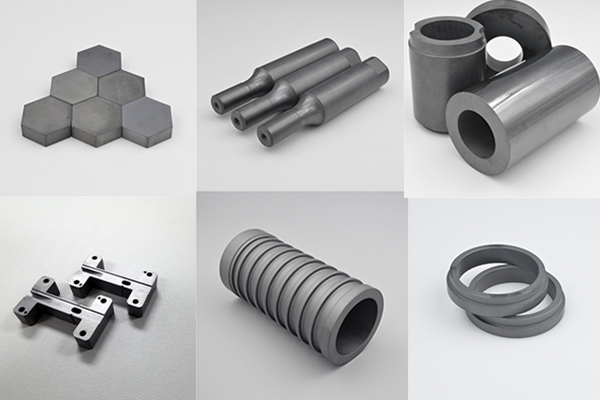
炭化ケイ素構造セラミックス部品
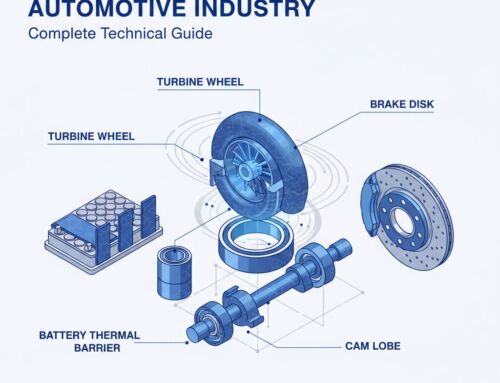
Due to its various excellent properties, high-temperature bearings, bulletproof plates, nozzles, high-temperature corrosion-resistant parts. And electronic equipment parts in the high-temperature and high-frequency range made of SiC ceramics are widely used in petroleum, chemical, microelectronics and other fields, automobiles, It is widely used in industrial fields such as aerospace, aviation, papermaking, laser, mining and atomic energy.
Silicon carbide sintering is widely used in advanced ceramic applications.
詳細はこちら Silicon Carbide Sintering and our 精密セラミック加工 サービスを提供する。.
よくある質問
What is Silicon carbide sintering?
Silicon Carbide Sintering is an advanced technical ceramic material known for its exceptional properties including high thermal conductivity, excellent electrical insulation, and superior mechanical strength. Great Ceramic specializes in precision manufacturing of Silicon carbide sintering components.
What are the main applications of Silicon carbide sintering?
Silicon Carbide Sintering is widely used in semiconductor manufacturing, aerospace components, electronic substrates, medical implants, and high-temperature industrial applications. Its unique properties make it ideal for demanding environments.
How is Silicon carbide sintering machined?
Silicon Carbide Sintering requires specialized machining techniques including diamond grinding, ultrasonic machining, and laser cutting to achieve precision tolerances. Great Ceramic provides custom Silicon carbide sintering machining services with tight tolerances.